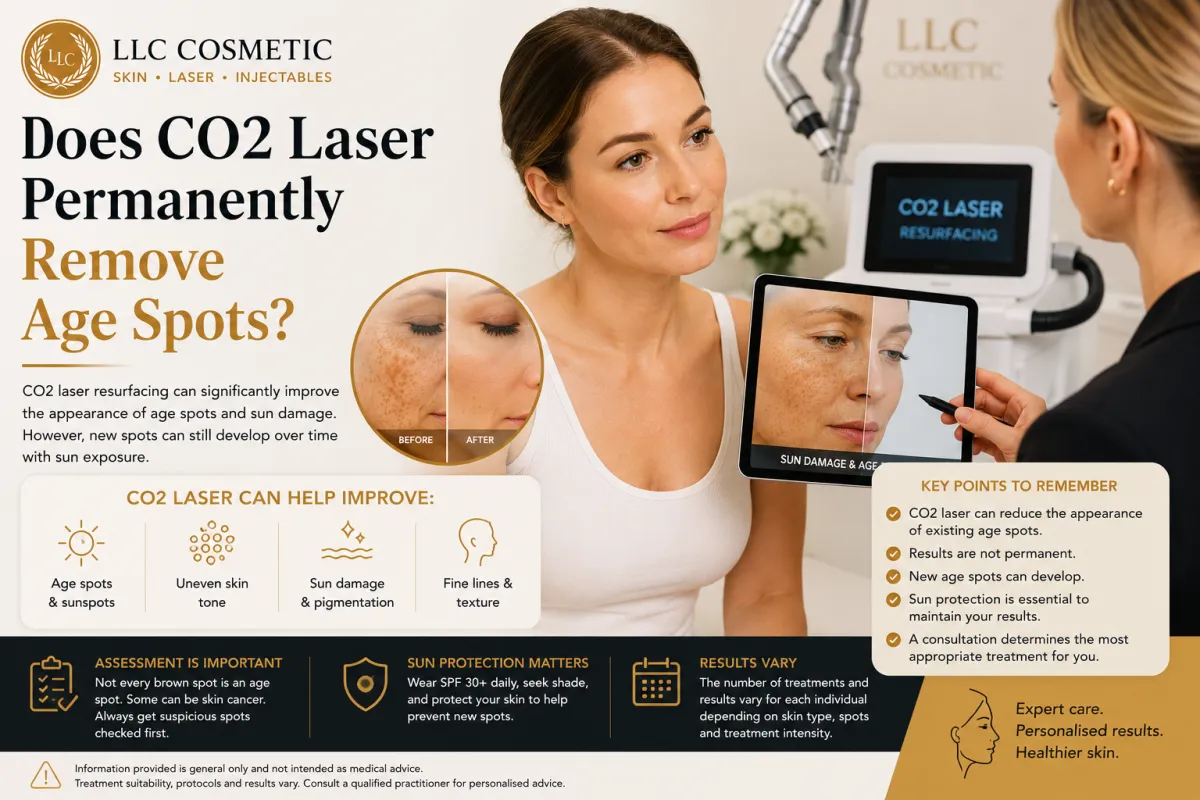
Does CO2 Laser Permanently Remove Age Spots?
If you're dealing with brown spots on your face, hands, chest or other areas exposed to the sun, you may have wondered:
“Does CO2 laser permanently remove age spots?”
The short answer is: CO2 laser resurfacing can significantly reduce the appearance of some age spots, but it would be inaccurate to promise that it permanently prevents age spots from returning.
Age spots—also called sunspots, liver spots or solar lentigines—are associated with cumulative UV exposure. Laser resurfacing is one treatment option for reducing signs of sun damage, including age spots.
However, treating an existing spot doesn't stop your skin from developing new pigmentation in the future.
That's why sun protection is such an important part of maintaining results.
And before treating any dark or changing spot, it's important to make sure it really is an age spot. Some pigmented lesions can resemble skin cancer and should be assessed before cosmetic treatment.
Quick Answer: Can CO2 Laser Permanently Remove Age Spots?
CO2 laser can improve or remove the visible appearance of certain age spots, but “permanent removal” should be used carefully.
Laser resurfacing can treat age spots and other signs of sun-damaged skin. Mayo Clinic lists age spots, uneven skin colour and sun-damaged skin among the concerns that laser resurfacing can address.
However, there are two separate questions:
Can the existing pigmentation be treated?
Yes, depending on the type of pigmentation and whether CO2 resurfacing is an appropriate treatment.
Can you guarantee that age spots will never come back?
No.
The American Academy of Dermatology explains that age spots can return after treatment and that sun protection is essential to help prevent recurrence.
So a more accurate way to describe the goal is:
CO2 laser may significantly improve existing sun-related pigmentation, but it does not permanently stop future sun damage or guarantee that new age spots won't develop.
What Are Age Spots?
Age spots are flat areas of increased pigmentation that commonly appear on skin exposed to the sun.
They may be:
Light brown
Tan
Dark brown
Sometimes almost black
Flat rather than raised
Round or oval
Common locations include:
Face
Hands
Shoulders
Arms
Upper back
Chest
Mayo Clinic describes age spots as solar lentigines and notes that they are associated with cumulative sun exposure.
Despite the name, you don't necessarily have to be older to develop them.
Someone who has experienced significant UV exposure can develop sunspots earlier in life.
Why Do Age Spots Develop?
UV radiation stimulates pigment production in the skin.
Over time, repeated sun exposure can cause pigment-producing cells to produce and accumulate more melanin in certain areas.
The result can be visible brown patches or spots.
The American Academy of Dermatology describes age spots as one of the visible signs of cumulative sun damage.
This is why treating the spots without changing your approach to sun protection may produce disappointing long-term results.
You can remove or lighten a spot while continuing to expose your skin to the same UV triggers that contributed to the pigmentation in the first place.
How Does CO2 Laser Help With Age Spots?
CO2 laser is an ablative laser.
Rather than simply targeting pigment, ablative CO2 resurfacing removes the outer layer of skin and heats underlying tissue.
As the treated skin heals, new skin develops.
Mayo Clinic identifies CO2 lasers as one type of ablative laser resurfacing and lists age spots and sun-damaged skin among the concerns that laser resurfacing may improve.
DermNet NZ also lists uneven pigmentation, brown spots, freckles and lentigines among conditions that can be treated with carbon dioxide laser.
However, CO2 laser isn't automatically the best treatment for every brown spot.
Depending on the pigmentation, other approaches may be more appropriate.
Is CO2 Laser the Best Laser for Age Spots?
Not necessarily.
This is an important distinction.
Age spots can be treated using several approaches, including:
Pigment-specific lasers
Intense pulsed light (IPL)
Chemical peels
Cryotherapy
Topical treatments
Laser resurfacing
The American Academy of Dermatology lists laser therapy, IPL, chemical peels, cryosurgery and other approaches as possible treatments for age spots.
DermNet NZ notes that pigment-specific lasers and IPL are commonly used for solar lentigines, while resurfacing lasers such as CO2 can also improve pigmented lesions.
That means the right question isn't:
“Can CO2 remove my age spots?”
It's:
“What treatment is most appropriate for the type of pigmentation I have?”
Why Your Age Spot Should Be Assessed Before Laser Treatment
This is one of the most important points in the entire article.
Not every brown spot is an age spot.
Some skin cancers and precancerous lesions can resemble benign pigmentation.
Mayo Clinic recommends having new or changing dark spots assessed, particularly if a spot is:
Black
Increasing in size
Irregular around the edges
Unusual in colour
Bleeding
DermNet NZ also lists melanoma and other pigmented conditions among the possible differential diagnoses for solar lentigines.
That's why cosmetic laser treatment should not simply be used to erase an unexplained dark lesion.
A suspicious spot needs appropriate medical assessment first.
Will One CO2 Laser Treatment Remove Age Spots?
There isn't a universal number of treatments.
The number of sessions depends on:
The type of pigmentation
How extensive the sun damage is
Treatment intensity
Treatment area
Skin type
Previous treatments
Individual response
The American Academy of Dermatology notes that one or two laser treatments may treat age spots, although the appropriate treatment varies.
Mayo Clinic also notes that laser and IPL treatments for age spots may commonly require multiple sessions depending on the approach used.
So it would be misleading to promise:
“One CO2 session will permanently remove every age spot.”
A consultation is needed to determine the appropriate treatment plan.
What Happens to Age Spots After CO2 Laser?
The treated area can look quite different during the healing process.
Depending on the intensity of treatment, you may experience:
Redness
Swelling
Sensitivity
Dryness
Peeling
Crusting
Temporary changes in pigmentation
The treated pigmentation may appear darker initially before it fades as the skin heals.
Laser resurfacing can also cause temporary or longer-lasting changes in skin colour, including hyperpigmentation or hypopigmentation.
So don't judge the final pigmentation result immediately after treatment.
Healing comes first.
Can Age Spots Come Back After CO2 Laser?
Yes.
This is one of the most important things to understand before treatment.
The laser may treat the pigmentation you currently see.
But it doesn't stop future UV exposure from affecting your skin.
The American Academy of Dermatology specifically states that age spots can return after treatment and recommends sun protection to help prevent them.
Mayo Clinic similarly warns that new sun damage can reverse some of the benefits of laser resurfacing.
Think about it this way:
Treatment addresses existing damage.
Sun protection helps reduce future damage.
You need both if you want to maintain the appearance of your skin over time.
Does Sun Protection Really Matter After CO2 Laser?
Absolutely.
If you're investing in laser resurfacing but don't protect your skin from UV exposure, you're making it harder to maintain your results.
Dermatologists recommend protecting treated skin from the sun.
The AAD recommends broad-spectrum sunscreen with SPF 30 or higher, along with shade and protective clothing.
After laser resurfacing, Mayo Clinic also recommends daily sun protection.
Your practitioner may provide more specific instructions based on your treatment and skin type.
Can Sun Exposure Make Age Spots Return?
Yes.
Age spots are strongly associated with cumulative UV exposure.
Mayo Clinic explains that repeated sun exposure contributes to the development of age spots.
This means that even if a particular spot has been successfully treated, continued sun exposure can contribute to:
New age spots
Darkening pigmentation
Uneven skin tone
Additional photoaging
DermNet NZ specifically notes that strict sun protection is required to help prevent recurrence after treatment of solar lentigines.
Can CO2 Laser Treat All Types of Pigmentation?
No.
This is another reason diagnosis matters.
“Brown spots” can refer to several different conditions, including:
Solar lentigines
Freckles
Melasma
Post-inflammatory hyperpigmentation
Pigmented actinic keratoses
Seborrhoeic keratoses
Other pigmented lesions
These conditions don't necessarily respond to the same treatment.
For example, melasma can behave differently from an isolated sunspot and may require a different management strategy.
A consultation should determine what type of pigmentation you're actually dealing with before treatment is selected.
What About Darker Skin Types?
Laser treatment requires careful consideration for people with darker skin tones because of the risk of unwanted pigment changes.
Laser resurfacing can cause post-inflammatory hyperpigmentation or hypopigmentation.
That doesn't automatically mean people with darker skin cannot receive laser treatment.
It means the treatment plan should be appropriately selected and individualised.
If you have a darker skin tone, ask your practitioner about:
Your pigmentation risk
Appropriate treatment settings
Alternative treatment options
Expected recovery
Previous experience treating similar skin types
Your practitioner should assess whether the proposed treatment is appropriate for you.
Can CO2 Laser Make Pigmentation Worse?
It can.
Although the goal may be to improve pigmentation, laser treatment can sometimes cause unwanted pigment changes.
Mayo Clinic lists both darker and lighter skin colour changes as potential complications of laser resurfacing.
DermNet NZ also notes that pigmentary changes can occur after treatment of brown spots and that post-inflammatory pigmentation is a possible issue.
This is why realistic expectations matter.
The goal isn't simply:
“Remove every brown spot at any cost.”
The goal is:
Improve the appearance of pigmentation while choosing a treatment approach appropriate for your skin and risk profile.
What Is the Difference Between Removing an Age Spot and Preventing New Ones?
This distinction is worth remembering.
Removing or reducing an existing spot
A treatment such as laser therapy can target existing pigmentation and make it less visible.
Preventing new spots
This requires ongoing management of UV exposure.
That can include:
Daily sunscreen
Protective clothing
Seeking shade
Avoiding tanning beds
Limiting unnecessary direct sun exposure
The AAD recommends daily sun protection to help prevent further sun damage and maintain treatment results.
How Long Do CO2 Laser Results Last?
There isn't one guaranteed timeframe.
Results can last for years, but ageing and continued environmental exposure continue.
Mayo Clinic notes that the effects of laser resurfacing can last for years, while also warning that new sun damage can reverse some of the benefits.
So it's better to think of CO2 resurfacing as part of an ongoing skin-management strategy rather than a one-time reset button.
Your skin continues to age.
Your skin continues to experience environmental exposure.
And new pigmentation can develop.
Does CO2 Laser Permanently Remove the Cause of Age Spots?
No.
CO2 laser can treat the appearance of existing sun damage, but it doesn't remove your underlying susceptibility to UV-related pigmentation.
This is why the word “permanent” can be misleading in cosmetic treatment marketing.
A treated spot may remain significantly improved for a long time.
But that doesn't mean:
No new spots will appear
Existing pigmentation can never return
Sun damage has been permanently reversed
You no longer need sunscreen
The American Academy of Dermatology makes this distinction clear: treatment can reduce signs of sun damage, but continued sun exposure can cause further damage.
What Should You Ask Before Booking CO2 Laser for Age Spots?
If pigmentation is your main concern, ask these questions during your consultation.
1. Are these definitely age spots?
Don't assume every brown mark is a solar lentigo.
2. Why are you recommending CO2 laser?
Ask why CO2 is appropriate compared with other options.
3. Would a pigment-specific laser or IPL be more suitable?
Different technologies target pigmentation differently.
4. How many treatments might I need?
Ask for an estimated range rather than a guaranteed number.
5. What happens if my pigmentation becomes darker?
Understand the potential risks before treatment.
6. How long will I need to recover?
Recovery depends on the treatment performed.
7. What should I do before treatment?
Ask about sun exposure, skincare products and other preparation requirements.
8. What should I do after treatment?
Get written aftercare instructions.
9. How can I reduce the chance of pigmentation returning?
Your practitioner should explain the importance of sun protection.
10. What results are realistic for my skin?
Your result may differ from online before-and-after photographs.
CO2 Laser for Age Spots: Pros and Considerations
Potential benefits
CO2 laser resurfacing may:
Improve the appearance of sun-damaged skin
Reduce visible pigmentation
Improve uneven skin tone
Improve skin texture
Address multiple signs of photoaging at the same time
Laser resurfacing is used to address age spots, uneven colour and other signs of sun damage.
Important considerations
CO2 laser can also involve:
Downtime
Redness
Swelling
Peeling
Pigment changes
Infection risk
Scarring risk
The possibility of pigmentation returning or new spots developing
The right treatment depends on your individual skin and goals.
How to Maintain Your Results After CO2 Laser
If you've had treatment for sun damage, protecting your skin should become part of your long-term routine.
Use sunscreen consistently
The AAD recommends broad-spectrum SPF 30 or higher.
Seek shade
Especially during periods of strong UV exposure.
Wear protective clothing
Hats, sunglasses and clothing can reduce direct UV exposure.
Avoid tanning beds
Artificial UV exposure can continue to contribute to skin damage.
Follow your clinic's aftercare
Don't introduce aggressive skincare products too early after resurfacing.
Monitor your skin
Keep an eye on existing pigmentation and any new or changing lesions.
When Should You Get a Brown Spot Checked?
Before cosmetic treatment, seek medical assessment if a spot is:
New and unusual
Changing in size
Changing in colour
Irregular
Very dark or black
Bleeding
Crusting unexpectedly
Different from your other spots
Mayo Clinic advises medical evaluation of spots with concerning changes because some can resemble skin cancer.
Cosmetic treatment should not replace medical assessment.
Final Takeaway: Does CO2 Laser Permanently Remove Age Spots?
CO2 laser resurfacing can significantly improve the appearance of some age spots and sun-damaged skin, but it should not be marketed as a guaranteed permanent solution.
The existing pigmentation may be substantially reduced or removed depending on the type of lesion and treatment approach.
But new age spots can develop because your skin continues to experience UV exposure and the ageing process.
The American Academy of Dermatology notes that age spots can return after treatment and that consistent sun protection is essential for maintaining results.
It's also important to remember that not every dark spot is an age spot. New, changing, irregular or suspicious pigmentation should be assessed before cosmetic laser treatment.
So instead of asking:
“Will CO2 laser permanently remove my age spots?”
a better question is:
“Is CO2 laser the right treatment for my specific pigmentation, and how can I maintain the result?”
That's the conversation to have during your consultation.
Frequently Asked Questions
Does CO2 laser permanently remove age spots?
It can significantly improve or remove the appearance of some age spots, but it cannot guarantee that pigmentation will never return or that new age spots won't develop.
How effective is CO2 laser for age spots?
Laser resurfacing can improve age spots and sun-damaged skin, although the most appropriate laser depends on the type of pigmentation and your individual skin characteristics.
Can age spots come back after laser?
Yes. Continued UV exposure can contribute to recurrence or new pigmentation. Sun protection is an important part of maintaining results.
Is CO2 laser the same as a pigment laser?
No. CO2 is an ablative resurfacing laser that removes the outer layer of skin, whereas some pigment-specific lasers target melanin more selectively.
Can CO2 laser make pigmentation worse?
Yes. Laser resurfacing can cause post-inflammatory hyperpigmentation or hypopigmentation, so treatment needs to be appropriately selected and planned.
How many CO2 laser treatments are needed for age spots?
There is no universal number. Treatment requirements depend on the pigmentation, treatment approach, skin type and individual response.
Can CO2 laser remove sun damage?
It can improve some visible signs of sun damage, including age spots, uneven pigmentation and skin texture.
Does sunscreen matter after CO2 laser?
Yes. Sun protection is important after laser treatment and can help reduce further UV-related pigmentation and damage.
Should every brown spot be treated with laser?
No. Some pigmented lesions can resemble skin cancer, so suspicious or changing spots should be assessed before cosmetic treatment.
Important Publishing Note
Important: CO2 laser treatment, pigmentation risks, treatment suitability, recovery and expected results vary according to the individual, treatment settings, skin type, treatment area and clinical assessment. This article is general educational information and should not be presented as individual medical advice or a guarantee of treatment results.
LLC Cosmetic should confirm its current treatment protocols, clinical claims, treatment indications and aftercare guidance before publishing or updating this article.
Do not describe CO2 laser as “permanently removing age spots” as an unconditional outcome. The article should distinguish between improving or treating existing pigmentation and preventing future sun-related pigmentation.
Any suspicious, changing or unusual pigmented lesion should be appropriately assessed before cosmetic treatment.