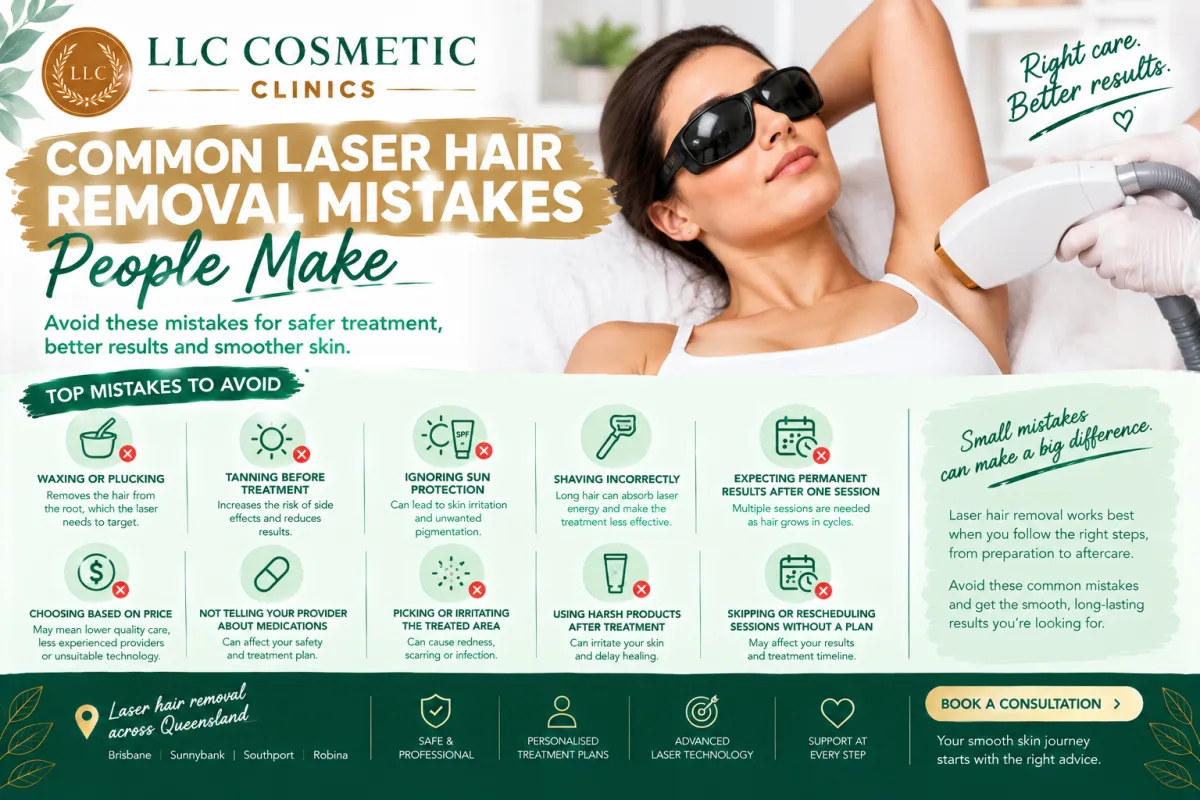
Common Laser Hair Removal Mistakes People Make
Laser hair removal can be an effective way to achieve long-term reduction in unwanted hair, but the results depend on more than simply booking a series of appointments.
What you do before, during and after each treatment can affect your experience and how safely your skin responds.
Unfortunately, some common mistakes can make laser hair removal less effective, increase the chance of irritation, or create unrealistic expectations about how quickly you'll see results.
If you're considering laser hair removal in Brisbane or on the Gold Coast—or you've already started a treatment course—here are the most common mistakes to avoid.
Quick Answer: What Are the Most Common Laser Hair Removal Mistakes?
Some of the most common mistakes include:
Waxing or plucking hair between laser sessions
Tanning before treatment
Ignoring sun exposure after treatment
Shaving incorrectly or arriving with long hair
Expecting permanent hair removal after one session
Treating every area with the same expectations
Choosing a provider based only on price
Not telling the clinic about medications or skin changes
Picking or irritating the treated skin
Using harsh skincare products immediately after treatment
Booking sessions without following an appropriate treatment schedule
Failing to disclose previous laser or IPL treatments
Assuming all lasers work equally well for every skin and hair type
The good news is that most of these mistakes are easy to avoid once you understand how laser hair removal actually works.
1. Waxing or Plucking Between Laser Sessions
This is one of the biggest mistakes people make.
Laser hair removal relies on the hair and its pigment to help deliver energy toward the follicle.
If you wax, tweeze or pluck the hair from the root between sessions, you remove the target the laser needs to work on.
Cleveland Clinic specifically recommends avoiding waxing, tweezing and plucking in treated areas once laser hair removal treatment begins.
What should you do instead?
Shaving is generally the preferred option between treatments.
Shaving cuts the hair at the skin's surface rather than removing the follicle from the root.
Always follow your clinic's specific instructions because preparation requirements can vary depending on the laser system and treatment area.
2. Tanning Before Laser Hair Removal
Another common mistake is treating recently tanned skin as though nothing has changed.
Sun exposure can increase the amount of pigment in your skin. That matters because laser energy interacts with pigment.
Cleveland Clinic recommends avoiding tanning beds and limiting sun exposure before treatment because recently tanned skin can make treatment less effective and increase the risk of side effects.
This is particularly important in Queensland, where UV exposure can be significant even when the weather doesn't feel extremely hot.
Before your appointment
Tell your clinic if you've recently:
Been in strong sunlight
Had a beach holiday
Used a tanning bed
Used self-tanning products
Developed a sunburn
Experienced significant skin darkening
Your provider can determine whether it is appropriate to proceed.
3. Ignoring Sun Protection After Treatment
Sun protection isn't just something to think about before your appointment.
Your treated skin can be more sensitive immediately after laser treatment, so protecting it from direct sunlight is important.
The American Academy of Dermatology recommends avoiding direct sunlight on treated skin and avoiding tanning beds and sun lamps after laser hair removal.
A simple habit can make a difference
After treatment:
Protect the treated area from direct sun.
Follow your clinic's sunscreen instructions.
Avoid tanning.
Don't deliberately expose the area to strong sunlight.
Follow the aftercare instructions provided by your practitioner.
If you're having laser hair removal on an exposed area such as the face, arms or legs, sun protection becomes especially important.
4. Arriving With Hair That Is Too Long
Some people assume that allowing their hair to grow as long as possible will make laser treatment more effective.
That's not necessarily the case.
Long hair sitting above the skin can absorb laser energy at the surface instead of allowing the treatment to target the follicle efficiently. It can also make treatment less comfortable.
Cleveland Clinic recommends shaving the treatment area before laser hair removal and notes that treatment is not effective on hair that is too long.
However, don't automatically shave immediately before every appointment unless your clinic instructs you to do so.
Your provider may give you specific shaving instructions depending on the treatment area and device being used.
5. Thinking One Session Should Remove All the Hair
This is probably the biggest expectation mistake.
Laser hair removal isn't normally a one-and-done treatment.
Hair grows through different stages, and laser treatment is more effective on hair follicles during particular stages of the growth cycle.
That's why multiple sessions are generally required.
The American Academy of Dermatology notes that many patients require multiple laser treatments and that results vary depending on factors including hair colour, hair thickness, treatment area, laser type and skin colour.
So if you still have hair after your first treatment, that doesn't automatically mean the treatment didn't work.
6. Expecting the Same Results on Every Body Area
Your underarms aren't the same as your face.
Your legs aren't the same as your bikini area.
And facial hair isn't necessarily going to respond in exactly the same way as body hair.
Hair thickness, density, colour, hormonal influences and the treatment area can all affect results.
This is why a personalised assessment is more useful than comparing your treatment results with a friend's.
Someone might see rapid reduction in one area while another area takes longer.
7. Choosing a Clinic Based Only on the Cheapest Price
Price matters—but it shouldn't be your only consideration.
A very cheap treatment isn't necessarily a bargain if the provider lacks appropriate training, uses unsuitable equipment or doesn't properly assess your skin and hair before treatment.
In Queensland, cosmetic laser use is regulated. Queensland Health states that people using cosmetic laser apparatus—including for hair reduction—must hold the appropriate Use Licence, and competency involves relevant theoretical and practical training.
When comparing clinics, look beyond the advertised price.
Ask:
Who performs the treatment?
What training do they have?
Are they appropriately licensed?
What laser technology is being used?
How is your skin type assessed?
How is the treatment plan personalised?
What happens if your skin reacts unexpectedly?
Is a consultation available before you purchase a package?
A professional consultation should be part of the decision—not an afterthought.
8. Not Telling Your Provider About Your Medications
Your clinic needs accurate information about your health and medications.
Don't assume that something prescribed by another healthcare professional is irrelevant to cosmetic laser treatment.
Tell your provider about:
Prescription medications
Topical medications
Recent antibiotics or other treatments
Products that may increase skin sensitivity
Recent cosmetic procedures
Previous reactions to laser or light-based treatments
Your provider can then determine whether any additional precautions or changes to the treatment plan are required.
9. Treating Recently Irritated or Sunburned Skin
Laser hair removal should not be treated as something you simply push through regardless of your skin's condition.
If the treatment area is:
Sunburned
Severely irritated
Broken
Inflamed
Recently exposed to significant UV
Experiencing an unexplained rash
tell your clinic before treatment.
Your practitioner may recommend postponing the appointment.
It's much better to reschedule than to ignore a skin problem because you don't want to lose your appointment.
10. Using Harsh Products Immediately After Treatment
Your skin may look slightly red or swollen after laser hair removal.
The American Academy of Dermatology notes that redness and swelling can occur after treatment and often resemble a mild sunburn.
This isn't the ideal time to experiment with aggressive skincare.
Avoid adding unnecessary irritation to the treated area.
Depending on your clinic's instructions, you may be advised to temporarily avoid things such as:
Strong exfoliants
Scrubs
Irritating active ingredients
Very hot showers
Fragranced products
Other treatments that could irritate the area
Your provider should give you personalised aftercare instructions.
11. Picking or Scratching the Treated Area
If the skin feels itchy or irritated after treatment, scratching can make things worse.
Try not to pick at the skin or aggressively rub the area.
Instead, follow your clinic's aftercare instructions.
A cool compress may help with temporary discomfort after treatment. The American Academy of Dermatology notes that cool compresses can help reduce discomfort associated with post-treatment redness and swelling.
12. Booking Sessions Without Following a Treatment Schedule
More frequent appointments don't necessarily mean faster results.
Because hair grows in cycles, treatments need to be spaced appropriately so that the laser can target suitable follicles during their active growth stage.
Your treatment schedule may depend on:
Treatment area
Hair growth cycle
Hair density
Previous treatment response
Skin type
Device being used
Instead of thinking:
“The sooner I treat it, the faster I'll get rid of it,”
think:
“The right timing gives each session a better opportunity to target the appropriate hair growth stage.”
Your provider should determine the appropriate interval for you.
13. Comparing Your Results With Someone Else's
This is another surprisingly common mistake.
You might see a friend who had four sessions and almost no visible hair.
Then you have four sessions and still have noticeable growth.
That doesn't necessarily mean your treatment has failed.
Laser hair removal results can vary because of differences in:
Hair colour
Hair thickness
Hair density
Skin colour
Treatment area
Hormonal influences
Laser technology
Treatment settings
Individual response
The American Academy of Dermatology specifically notes that hair colour, thickness, treatment area, laser type and skin colour can influence results.
Your progress should be evaluated against your own baseline, not someone else's body.
14. Ignoring Hormonal Hair Growth
If you're treating facial hair and noticing persistent or increasing growth, hormonal factors may be relevant.
The chin, jawline, upper lip and neck can be particularly influenced by hormones.
If you notice significant changes in hair growth, particularly when accompanied by other symptoms, speak with an appropriate healthcare professional.
Laser hair removal can reduce unwanted hair, but it doesn't necessarily address the underlying reason why new hair is developing.
That's an important distinction.
15. Assuming More Power Always Means Better Results
This is a dangerous misconception.
Some people think:
Higher setting = stronger treatment = better results.
Laser treatment doesn't work that simply.
Treatment parameters need to be selected according to the individual's:
Skin type
Hair characteristics
Treatment area
Device
Previous response
Safety considerations
The objective isn't to use the highest possible setting.
The objective is to use an appropriate and safe treatment protocol.
That's one reason professional assessment matters.
16. Buying a Package Before Asking the Important Questions
A discounted package can look attractive.
But before committing to multiple sessions, make sure you understand what you're actually purchasing.
Ask:
How many sessions are included?
What areas are covered?
How far apart will sessions be?
What happens if my skin cannot be treated on the scheduled day?
Are maintenance treatments included?
What happens if I don't respond as expected?
Can unused sessions be transferred?
Does the package have an expiry date?
Understanding the terms can prevent disappointment later.
17. Forgetting to Mention Previous Laser or IPL Treatments
If you've previously had laser hair removal or IPL, tell your new provider.
Previous treatment history can help your practitioner understand:
What technology you've already tried
How your skin responded
Whether you experienced complications
How much hair reduction you've achieved
Whether you have recently tanned
Whether your treatment approach needs to change
Never assume your previous treatment is irrelevant.
18. Assuming All Laser Hair Removal Machines Are the Same
“Laser hair removal” describes a treatment category, not one single machine.
Different laser systems can have different wavelengths and characteristics.
The appropriate technology depends on the patient—not simply what device has the best marketing.
This is why a clinic should assess your skin and hair rather than telling everyone they need exactly the same treatment.
A good consultation should explain why a particular approach is appropriate for you.
19. Ignoring Unexpected Skin Reactions
Some temporary redness and swelling can occur after laser hair removal.
But don't ignore significant or unusual reactions.
Contact your provider if you develop concerning symptoms such as:
Significant blistering
Severe pain
Increasing swelling
Signs of infection
Significant skin colour changes
Burns
Symptoms that are worsening rather than improving
Queensland Health specifically advises that clients with injuries such as burns or infection should seek medical advice promptly.
20. Focusing on Hair Removal Instead of Hair Reduction
Finally, be careful with the phrase “permanent hair removal.”
A more realistic way to think about laser treatment is long-term hair reduction.
The American Academy of Dermatology explains that results vary and that many patients need multiple treatments.
You may achieve substantial reduction, but some hair can remain and maintenance treatments may be necessary.
That's not necessarily treatment failure.
It's simply a more realistic understanding of what laser hair removal can achieve.
How to Get Better Results From Laser Hair Removal
The easiest way to avoid most mistakes is to follow a simple routine.
Before treatment
Avoid tanning and significant sun exposure.
Tell your provider about medications and relevant skin conditions.
Follow the clinic's shaving instructions.
Don't wax or pluck the hair from the root.
Tell the clinic about previous laser or IPL treatments.
Reschedule if the treatment area is sunburned or significantly irritated.
During treatment
Wear the required protective eyewear.
Tell your practitioner if the treatment feels unusually painful.
Follow the instructions provided by your clinician.
Don't hesitate to ask questions about the technology and treatment plan.
After treatment
Protect the treated area from direct sunlight.
Follow the clinic's aftercare instructions.
Avoid unnecessary irritation.
Don't pick or scratch the area.
Give your skin time to settle.
Attend future sessions according to your recommended schedule.
How to Choose a Laser Hair Removal Clinic in Queensland
If you're in Brisbane or the Gold Coast, don't make your decision based on price alone.
Look for a clinic that takes the time to assess you properly.
In Queensland, cosmetic laser use—including hair reduction—is subject to radiation licensing requirements. Queensland Health states that Class 4 laser operators need an appropriate Use Licence, with relevant safety, theoretical and practical training.
A reputable clinic should be comfortable explaining:
Who will perform your treatment
Their relevant training and licensing
Which technology is being used
Why the treatment is appropriate for your skin and hair
What preparation is required
What aftercare is recommended
What results are realistic
What risks and side effects you should understand
You should never feel pressured to purchase a package before you understand the treatment.
Laser Hair Removal at LLC Cosmetic Clinics
At LLC Cosmetic Clinics, laser hair removal is approached as a personalised treatment rather than a one-size-fits-all procedure.
The clinic has locations across Brisbane CBD, Sunnybank, Southport and Robina, giving clients across Brisbane and the Gold Coast access to laser treatment.
A consultation allows your skin and hair characteristics, treatment goals and suitability to be considered before creating a treatment plan.
For anyone searching for laser hair removal in Brisbane, laser hair removal on the Gold Coast or laser hair removal in Robina, the most important first step is finding out whether the treatment is appropriate for your individual situation.
Final Thoughts
The most common laser hair removal mistakes people make aren't necessarily complicated.
They're usually small decisions that can affect the safety, comfort or effectiveness of treatment:
Waxing instead of shaving.
Tanning before treatment.
Ignoring sun protection.
Expecting results after one session.
Choosing a clinic based only on price.
Not following aftercare instructions.
Comparing your results with someone else's.
And perhaps most importantly, assuming that more laser always means better results.
Laser hair removal works best when treatment is properly planned around your individual skin, hair and treatment area.
If you're unsure whether you're preparing correctly—or you're not getting the results you expected—ask your provider for a reassessment rather than guessing.
FAQs
Can I wax between laser hair removal sessions?
Waxing and plucking are generally discouraged during a laser hair removal course because they remove the hair from the root. Shaving is generally preferred between treatments.
Can I shave before laser hair removal?
Usually, yes, but follow your clinic's specific instructions about when to shave. Preparation requirements can vary depending on the treatment area and laser system.
Can I get laser hair removal if I've been in the sun?
You should tell your provider about recent sun exposure or tanning. Recently tanned skin can increase treatment risks and may make treatment less effective.
Why am I still growing hair after laser hair removal?
Hair grows in cycles, so not every follicle is affected during every session. Multiple treatments are usually required, and results vary between people.
Is laser hair removal permanent?
Laser hair removal is better understood as long-term hair reduction rather than a guarantee that every hair will permanently disappear. Maintenance treatments may be needed.
How do I know if a laser hair removal clinic is qualified in Queensland?
Ask who will perform the treatment and whether they hold the appropriate Queensland laser Use Licence. Queensland Health requires appropriate licensing for people operating cosmetic laser apparatus, including for hair reduction.