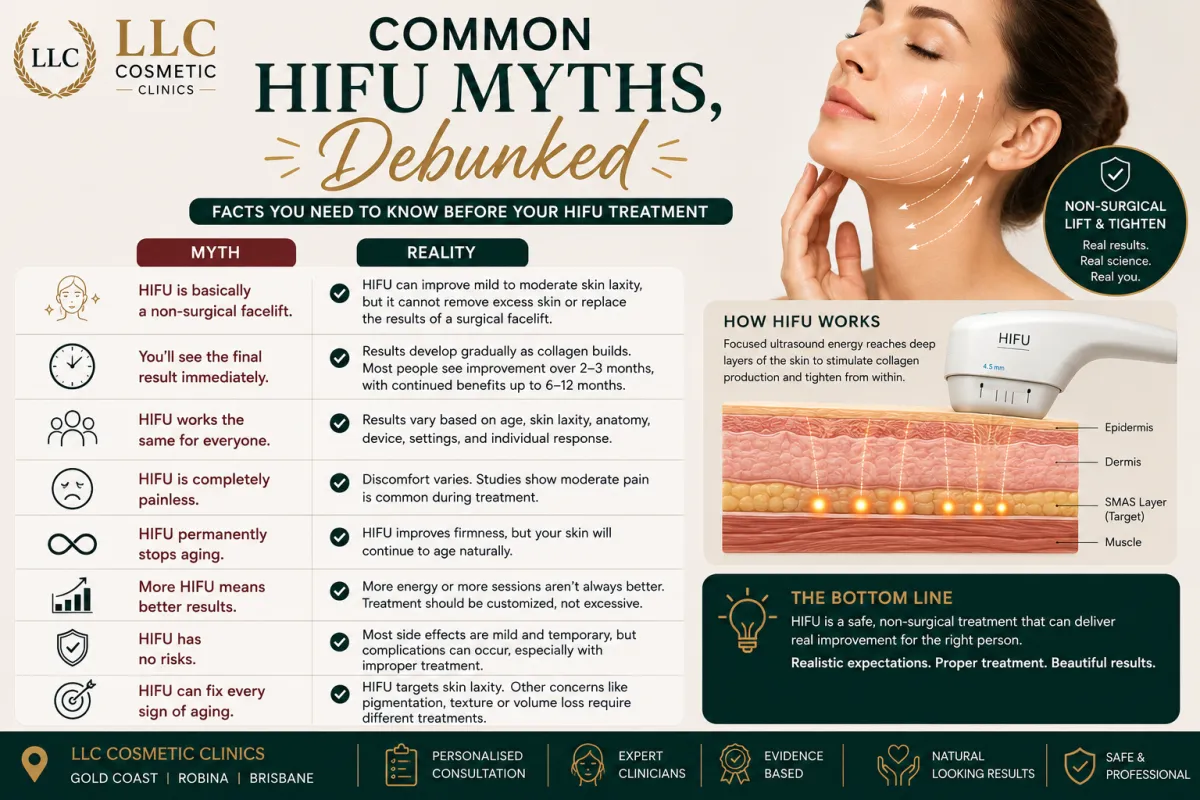
Common HIFU Myths, Debunked
HIFU has become a popular option for people looking for non-surgical skin tightening and facial rejuvenation.
But with its popularity comes plenty of misinformation.
You may have heard claims that HIFU can replace a facelift, that the results are instant, that it works for everyone, or that it is completely painless and risk-free.
The reality is more nuanced.
HIFU can provide meaningful improvement for appropriately selected patients with mild to moderate skin laxity, but it isn't a magic treatment—and realistic expectations matter. Systematic reviews have found evidence of improvement in facial tightening, while also reporting variability in results, moderate treatment discomfort and generally temporary side effects.
Let's separate some of the most common HIFU myths from what the evidence actually tells us.
HIFU Myths: The Quick Answer
Here are some of the most common claims:
Myth #1: HIFU gives you a facelift without surgery.
Reality: HIFU is non-surgical and may improve the appearance of mild to moderate laxity, but it cannot reproduce every effect of surgical lifting.
Myth #2: HIFU results are instant.
Reality: Results generally develop gradually rather than appearing immediately.
Myth #3: HIFU works equally well for everyone.
Reality: Results depend on factors such as skin laxity, anatomy, treatment settings and individual response.
Myth #4: HIFU is completely painless.
Reality: Discomfort varies, and studies have reported moderate pain during treatment.
Myth #5: HIFU permanently stops ageing.
Reality: Skin continues to age after treatment.
Myth #6: More HIFU means better results.
Reality: Treatment needs to be appropriately planned; more energy or more sessions aren't automatically better.
Myth #7: HIFU has no risks.
Reality: Most reported effects are temporary, but complications can occur, particularly when treatment is improperly performed.
Myth 1: HIFU Is Basically a Non-Surgical Facelift
The reality: HIFU is not the same as a surgical facelift.
This is probably one of the biggest misconceptions about HIFU.
HIFU uses focused ultrasound energy to create targeted thermal effects beneath the skin. The goal is to stimulate a tissue response associated with collagen remodelling and tightening.
It does not surgically remove excess skin.
A systematic review found that microfocused ultrasound can improve facial skin tightening, particularly in patients with mild to moderate laxity.
That distinction matters.
If someone has significant excess skin or advanced facial ageing, HIFU may not provide the degree of lifting they expect from surgery.
Think of it this way:
HIFU: non-surgical improvement in skin laxity
Facelift: surgical repositioning and removal of excess tissue
They're not interchangeable procedures.
Myth 2: You'll See the Final Result Immediately
The reality: HIFU results generally develop over time.
HIFU works through a biological response rather than simply pulling the skin tighter during the appointment.
Collagen remodelling takes time.
Research has found that improvement can continue over the months following treatment. One systematic review reported that investigator-assessed improvement was observed around 90 days and could continue through follow-up periods, although longer-term evidence remains limited.
A more recent 2026 prospective study also found that facial rejuvenation effects peaked around three months, with some benefits maintained through 9–12 months in the study population.
So don't judge the final outcome immediately after your appointment.
Myth 3: HIFU Works the Same for Everyone
The reality: Individual results can vary significantly.
Two people can have the same treatment and experience different outcomes.
Factors that may affect results include:
Degree of skin laxity
Age
Skin quality
Facial anatomy
Treatment area
Device used
Treatment settings
Treatment technique
Individual healing response
Research has specifically noted that treatment protocols, device settings and treatment energies vary across studies.
This is why before-and-after photographs should be viewed carefully.
A result achieved by one person isn't a guarantee of what another person will experience.
Myth 4: HIFU Is Completely Painless
The reality: HIFU can cause discomfort.
Some people describe the sensation as:
Heat
Tingling
Pressure
Sharp or prickling sensations
Brief pulses of discomfort
But pain levels aren't identical for everyone.
A 2025 systematic review and meta-analysis of microfocused ultrasound with visualization found a pooled mean pain score of 4.85 out of 10, indicating moderate discomfort overall.
Another meta-analysis found a lower average pain score, illustrating how results can vary between studies and treatment protocols.
So saying "HIFU doesn't hurt at all" is misleading.
A better expectation is:
The experience varies from person to person and depends on the treatment area and protocol.
Myth 5: HIFU Permanently Stops Skin Ageing
The reality: Your skin continues to age.
HIFU doesn't stop the biological ageing process.
Your skin will continue to experience changes in:
Collagen
Elasticity
Facial volume
Skin thickness
Sun-related damage
Overall tissue structure
HIFU may improve the appearance of laxity for an appropriate period, but it isn't a permanent barrier against future ageing.
A 2025 systematic review found generally favourable results and satisfaction following microfocused ultrasound treatment, but the evidence also highlights variation between studies and the need for further research.
The goal should be improvement—not stopping time.
Myth 6: More HIFU Always Means Better Results
The reality: Treatment should be customised.
It may seem logical that more energy, more treatment lines or more sessions would automatically produce better results.
But that's not how aesthetic treatment works.
The appropriate treatment depends on:
The area being treated
Skin thickness
Degree of laxity
Facial anatomy
Device
Treatment depth
Energy settings
Individual goals
Using excessive energy or treating inappropriately can increase the risk of unwanted effects.
The literature includes reports of rare but serious complications following microfocused ultrasound, including tissue injury and atrophy.
This is why more isn't necessarily better.
Correct treatment is better than excessive treatment.
Myth 7: HIFU Has Zero Risks
The reality: HIFU is non-surgical, but that doesn't mean risk-free.
HIFU and microfocused ultrasound are generally considered non-invasive treatments, and many reported side effects are temporary.
These can include:
Redness
Swelling
Tenderness
Bruising
Temporary sensitivity
The 2025 systematic review and meta-analysis found that common adverse events were generally mild to moderate.
However, rare complications have also been reported.
A published case series described serious adverse events including blistering, ulceration, tissue oedema, atrophy and skin necrosis following microfocused ultrasound treatment.
This doesn't mean these complications are typical.
It means HIFU should still be treated as a medical/aesthetic procedure that requires appropriate patient selection, equipment and technique.
Myth 8: HIFU Is Suitable for Everyone
The reality: Patient selection matters.
HIFU is generally more appropriate for people with certain degrees of skin laxity.
A systematic review concluded that microfocused ultrasound is effective for tightening mildly to moderately lax facial skin, while excessive laxity was associated with reduced positive results.
If there is significant excess skin, HIFU may not provide the result someone expects.
This is why a consultation should focus on your actual concern rather than simply asking:
"Can I have HIFU?"
The better question is:
"Is HIFU appropriate for the amount and type of laxity I have?"
Myth 9: HIFU Can Fix Every Sign of Ageing
The reality: HIFU has a specific purpose.
HIFU is primarily associated with tightening and lifting.
But ageing can involve many different concerns.
For example:
Sagging skin → HIFU may be considered.
Uneven texture → A resurfacing treatment may be more relevant.
Pigmentation → A pigmentation-focused treatment may be considered.
Acne scarring → A texture-focused treatment may be more appropriate.
Volume loss → HIFU may not address the underlying issue.
This is why choosing a treatment based on a specific skin concern is more useful than choosing one simply because it is popular.
Myth 10: HIFU Is Better Than Every Other Skin Treatment
The reality: Different treatments do different jobs.
HIFU isn't automatically "better" than laser, RF, microneedling or other cosmetic treatments.
They work differently and are designed to address different concerns.
For example:
HIFU
Primarily associated with deeper tightening and lifting.
CO₂ laser
Primarily used for resurfacing and concerns involving skin texture.
PICO laser
May be used for selected pigmentation and skin-quality concerns, depending on the device and protocol.
Microneedling
Creates controlled micro-injuries to stimulate a healing response and is commonly used for texture-related concerns.
RF
Uses radiofrequency energy to heat tissue and is used in various skin-tightening protocols.
The "best" treatment depends on what you're actually trying to improve.
Myth 11: HIFU Results Are Guaranteed
The reality: No cosmetic treatment can guarantee identical results for every person.
Clinical studies can tell us how groups of patients respond.
They cannot guarantee that every individual will achieve the same outcome.
A 2023 systematic review found evidence supporting facial tightening with microfocused ultrasound, but also noted differences between treatment protocols and a need for further research.
A more recent meta-analysis found generally positive outcomes, but again, results varied across studies.
Be cautious of marketing that promises:
Guaranteed lifting
Permanent results
A surgical-level transformation
Identical results for everyone
Realistic treatment planning is more trustworthy than exaggerated promises.
Myth 12: You Only Need One HIFU Treatment Forever
The reality: Results aren't permanent.
How long results last varies between individuals.
Ageing continues, and collagen and tissue structure continue to change.
Some people may consider maintenance treatments depending on their goals and the recommendations of their treating clinician.
However, the appropriate timing shouldn't be based on a generic schedule that applies to everyone.
Your response to the previous treatment matters.
What Does the Evidence Actually Say About HIFU?
The evidence is more balanced than many online claims suggest.
A 2023 systematic review concluded that microfocused ultrasound can improve facial skin tightening, particularly for mild to moderate laxity.
A 2025 systematic review and meta-analysis included 42 studies and found generally positive investigator and patient-reported outcomes, while also reporting moderate treatment pain and mostly mild-to-moderate adverse events.
A 2025 systematic review of HIFU across skin tightening and body contouring also identified a substantial clinical literature while highlighting the need for continued research.
So the evidence doesn't support either extreme:
"HIFU is a miracle treatment."
or
"HIFU doesn't work."
The more accurate conclusion is:
HIFU can be useful for appropriately selected patients, but results and suitability vary.
How to Avoid HIFU Marketing Hype
Before booking treatment, ask:
1. What exactly is being treated?
Is the concern skin laxity, texture, pigmentation, volume loss or something else?
2. What results are realistic?
Ask what level of improvement is realistic for your specific anatomy.
3. What device is being used?
Different HIFU and microfocused ultrasound systems are not necessarily identical.
4. Who is performing the treatment?
Ask about the practitioner's qualifications and experience.
5. What are the potential side effects?
A reputable provider should be willing to discuss both common and uncommon risks.
6. What happens if HIFU isn't appropriate?
The consultation shouldn't be focused on selling one particular procedure.
HIFU Myths vs Reality
Myth: HIFU is a non-surgical facelift.
Reality: It can improve certain degrees of skin laxity but isn't equivalent to surgery.
Myth: Results are instant.
Reality: Improvement develops progressively.
Myth: HIFU works for everyone.
Reality: Patient selection matters.
Myth: HIFU is painless.
Reality: Treatment discomfort varies.
Myth: Results last forever.
Reality: Skin continues to age.
Myth: More treatment means better results.
Reality: Appropriate treatment is more important than excessive treatment.
Myth: HIFU has no risks.
Reality: Most side effects are temporary, but complications are possible.
Myth: HIFU treats every ageing concern.
Reality: Different treatments address different problems.
The Bottom Line
There are plenty of common HIFU myths, but the reality is much more straightforward.
HIFU can be a useful non-surgical option for appropriately selected people who want to improve the appearance of skin laxity.
But it isn't a facelift, it doesn't stop ageing, and it doesn't guarantee the same result for everyone.
The best approach is to start with your skin concern, your anatomy and your goals rather than choosing a treatment based on marketing claims.
At LLC Cosmetic, the approach should always be:
Suitability first. Treatment second.
A professional assessment can help determine whether HIFU is appropriate for you and what results you can realistically expect.
Frequently Asked Questions
Is HIFU actually effective?
Evidence suggests that microfocused ultrasound/HIFU can improve facial skin tightening, particularly in people with mild to moderate laxity. Results vary between individuals and treatment protocols.
Is HIFU a permanent treatment?
No. HIFU doesn't stop the natural ageing process, and results aren't considered permanent.
Does HIFU hurt?
It can cause discomfort. Pain levels vary by person, treatment area, depth and protocol. Studies have reported anything from mild to moderate discomfort.
Can HIFU replace a facelift?
No. HIFU may improve mild to moderate laxity but doesn't surgically remove excess skin or reproduce all the effects of a facelift.
Are HIFU complications possible?
Yes. Most reported adverse effects are temporary, but rare and more serious complications have been documented. Appropriate treatment technique and patient selection are important.
Does HIFU work for everyone?
No. The degree of laxity, anatomy, treatment settings and individual response can all affect results.
Medical Disclaimer
This article is for general educational purposes only and does not constitute medical advice, diagnosis or treatment. HIFU suitability, treatment settings, risks and expected results vary between individuals. A qualified clinician should assess your skin, medical history and treatment goals before treatment.