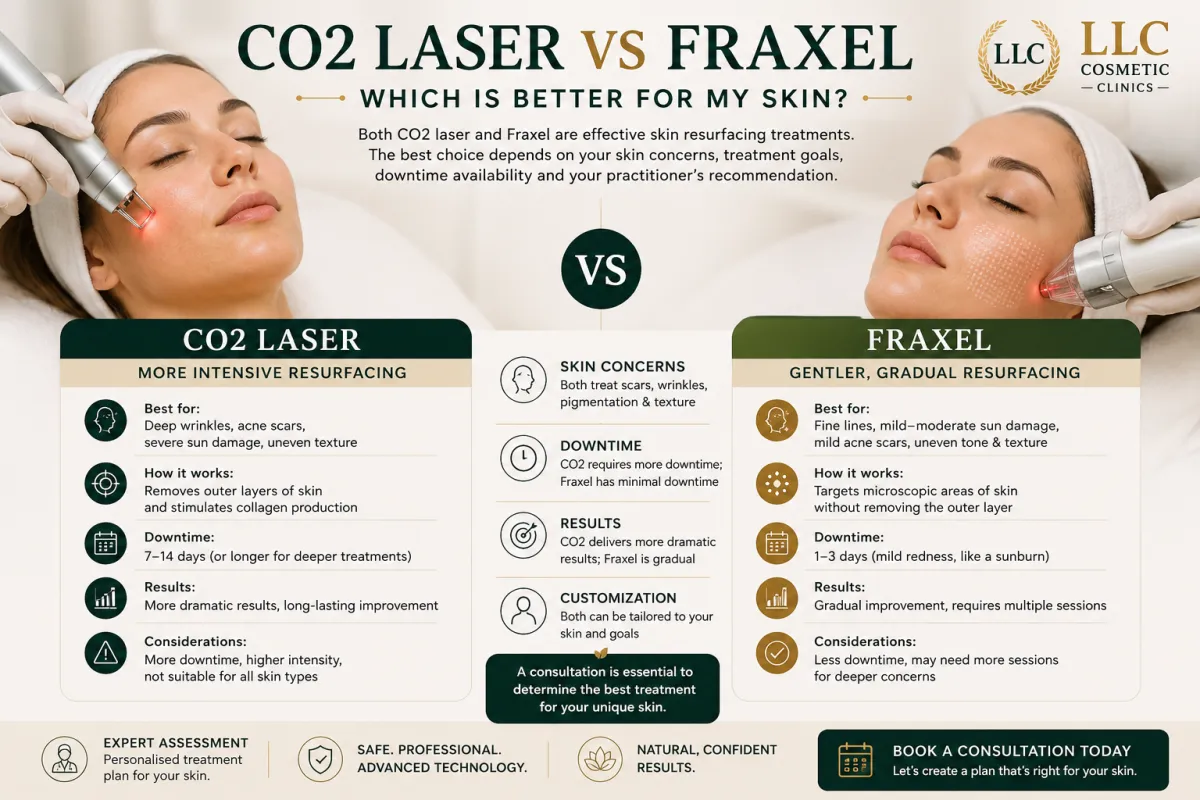
CO2 Laser vs Fraxel: Which Is Better for My Skin?
If you're considering laser skin resurfacing, you may have come across two popular options: CO2 laser and Fraxel.
Both treatments can improve the appearance of skin, but they work differently and are generally suited to different treatment goals.
So, CO2 laser vs Fraxel — which is better for your skin?
There isn't one treatment that's automatically better for everyone. The right option depends on your skin concerns, desired results, treatment intensity, downtime and your practitioner's assessment.
CO2 Laser vs Fraxel: The Quick Answer
Here's a simple way to understand the difference:
CO2 Laser
More intensive skin resurfacing
Can address deeper skin concerns
Commonly considered for significant texture concerns and certain acne scars
Generally involves more downtime
Can produce more noticeable resurfacing results
Fraxel
Fractional laser treatment designed to treat microscopic areas of the skin
Often used for texture, pigmentation and signs of sun damage
Generally involves less downtime than more aggressive resurfacing
Results develop progressively
Multiple sessions may be recommended depending on your goals
Neither option is universally better.
The best treatment is the one that matches the problem you're actually trying to improve.
What Is CO2 Laser Treatment?
CO2 laser resurfacing uses carbon dioxide laser energy to treat the skin.
Depending on the treatment approach, CO2 laser can create controlled resurfacing and stimulate processes associated with collagen remodelling.
It may be considered for concerns such as:
Acne scars
Fine lines
Uneven skin texture
Skin damage
Certain signs of ageing
Overall skin resurfacing
Because CO2 laser can be more intensive, it can also require more recovery time.
What Is Fraxel?
Fraxel is a fractional laser approach that treats microscopic columns or areas of skin while leaving surrounding tissue untreated.
This fractional approach can allow the skin to heal progressively.
Fraxel may be considered for concerns including:
Uneven skin texture
Certain pigmentation concerns
Sun-damaged skin
Fine lines
Mild to moderate scarring
The exact treatment and expected results depend on the device, settings and individual treatment plan.
CO2 Laser vs Fraxel: What's the Difference?
The biggest difference is treatment intensity and approach.
CO2 laser resurfacing can be more aggressive, particularly when deeper resurfacing is performed.
Fraxel treatments are generally designed around fractional treatment, targeting microscopic areas rather than resurfacing the entire skin surface in the same way as a more aggressive CO2 treatment.
This means the recovery experience can be different.
More intensive treatment may offer more significant resurfacing but can also involve more downtime.
Which Is Better for Acne Scars?
If acne scarring is your main concern, both CO2 laser and fractional laser treatments may be considered depending on the type and severity of the scars.
CO2 laser may be considered when more intensive resurfacing is appropriate.
Fraxel may be considered when a fractional approach is preferred.
However, acne scars aren't all the same.
Different scar types can respond differently to treatment, so a consultation is important before choosing a laser based solely on the name of the technology.
Which Is Better for Uneven Skin Texture?
Both treatments can be used to improve aspects of uneven skin texture.
If your primary concern is more significant textural damage, a practitioner may consider a more intensive resurfacing approach such as CO2 laser.
For milder texture concerns, a fractional treatment such as Fraxel may be an option.
The right choice depends on the severity of the concern and how much downtime you're comfortable with.
Which Is Better for Pigmentation?
Pigmentation is another area where people often compare CO2 laser and Fraxel.
However, pigmentation isn't simply one condition.
Sun damage, freckles, melasma and other pigmentation concerns can have different causes and may require different treatment approaches.
A laser that works well for one pigmentation concern may not be the appropriate choice for another.
Your skin type and pigmentation history should be considered before treatment.
CO2 Laser vs Fraxel: Downtime
Downtime is one of the biggest differences people consider when comparing the two treatments.
CO2 laser:
More intensive resurfacing can involve noticeable redness, sensitivity, peeling and a longer recovery period.
Fraxel:
Fractional treatment may involve redness, swelling or a sunburn-like appearance, with generally less downtime than more aggressive resurfacing.
Your actual recovery depends on the treatment settings, area treated and individual healing response.
Which Treatment Produces Faster Results?
It's important not to judge these treatments solely by how quickly the skin looks different.
CO2 laser can create more noticeable resurfacing effects, but the skin still needs time to heal and remodel.
Fraxel results can develop progressively, and multiple treatments may be recommended depending on the concern.
Visible improvement and final results are not necessarily the same thing.
Your skin may continue changing as healing and collagen remodelling occur.
Which Treatment Has More Downtime?
Generally, more intensive CO2 resurfacing involves more downtime than a typical fractional Fraxel treatment.
However, there isn't a single recovery time that applies to every CO2 or Fraxel treatment.
Before booking, ask your practitioner:
How intensive will my treatment be?
How much downtime should I expect?
When can I return to work?
When can I wear makeup?
When can I exercise?
How long should I avoid significant sun exposure?
These questions can help you plan realistically.
Can You Choose Based on Your Skin Type?
Not safely based on skin type alone.
Your practitioner should consider your:
Skin tone
Skin condition
Pigmentation history
Scarring
Treatment goals
Previous treatments
Expected recovery
Risk of post-inflammatory pigmentation
This is particularly important when considering more intensive laser resurfacing.
So, Which Is Better: CO2 Laser or Fraxel?
There's no universal winner.
CO2 laser may be worth discussing if your priority is more intensive resurfacing and you're prepared for greater downtime.
Fraxel may be worth discussing if you want a fractional approach with generally less downtime and gradual improvement.
But the most appropriate treatment depends on your individual skin.
The goal shouldn't be to choose the strongest laser.
The goal is to choose the treatment that is appropriate for your skin and your desired outcome.
Final Takeaway
When comparing CO2 laser vs Fraxel, think about three things:
Your skin concern.
Are you primarily concerned with acne scars, texture, pigmentation, fine lines or sun damage?
Your desired result.
Are you looking for more intensive resurfacing or gradual improvement?
Your available downtime.
How much recovery time can you realistically allow?
A professional consultation can help determine which treatment approach is appropriate for your skin.
At LLC Cosmetic, the focus should be on assessing your individual concerns and creating a treatment pathway suited to your goals rather than choosing a treatment simply because it is more intensive.
The best laser isn't necessarily the strongest one — it's the one that's appropriate for your skin.