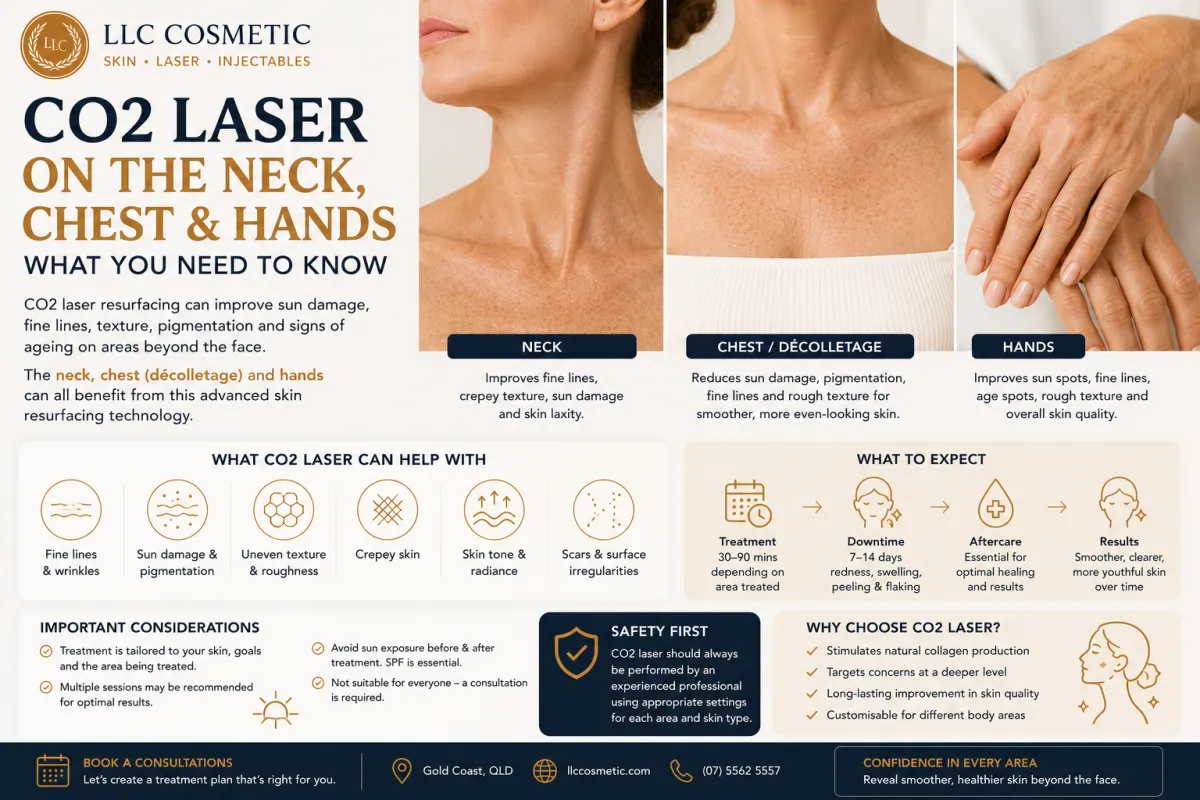
CO2 Laser on the Neck, Chest and Hands: What You Need to Know
The face often gets most of the attention when people talk about CO2 laser resurfacing.
But if you're concerned about sun damage, uneven texture, fine lines, pigmentation or signs of ageing on your neck, chest or hands, you may also be wondering whether CO2 laser can be used on these areas.
The answer is yes, fractional CO2 laser resurfacing can be used on areas beyond the face, but the treatment needs to be planned carefully.
The neck, chest and hands are not simply extensions of the face. Skin thickness, sensitivity, sun exposure, healing and the amount of resurfacing required can all differ between treatment areas.
At LLC Cosmetic, CO₂ resurfacing is offered for areas including the neck, decolletage and hands, with suitability and treatment intensity discussed as part of the treatment-planning process.
If you're considering CO2 laser on the neck, chest or hands, here's what you should know before booking.
Quick Answer: Can You Get CO2 Laser on the Neck, Chest and Hands?
Yes.
Fractional CO2 laser can be used to resurface selected areas of the body, including the neck, chest/decolletage and hands.
Fractional laser treatment is used for concerns such as skin texture, sun damage, pigmentation associated with photoageing, lines and scarring. DermNet specifically notes that fractional laser can be particularly useful on the neck, chest and hands compared with traditional ablative approaches.
However, the appropriate treatment strength depends on:
The area being treated
Your skin condition
Your skin type
The concern being treated
The depth of resurfacing required
Your previous treatment history
Your expected downtime
How your skin is likely to heal
That means the strongest treatment isn't automatically the best treatment.
The goal is to match the treatment to the skin—not simply use the same settings everywhere.
Why Treat the Neck, Chest and Hands?
Your face isn't the only area that shows signs of environmental exposure and ageing.
The neck, chest and hands are frequently exposed to:
UV radiation
Environmental stress
Repeated movement
Natural ageing
Changes in collagen and elastin
Dryness
Pigmentation changes
Over time, these factors can contribute to visible changes in skin quality.
You may notice:
Fine lines
Crepey-looking skin
Uneven texture
Sun damage
Pigmentation
Roughness
Loss of a smoother appearance
Visible signs of photoageing
CO2 resurfacing works by creating controlled treatment zones in the skin, stimulating a healing response and encouraging the development of newer skin.
Fractional technology treats microscopic columns of skin rather than removing the entire surface uniformly, which can allow untreated surrounding skin to assist the healing process.
CO2 Laser on the Neck
The neck is one of the areas where people often start noticing ageing but may not realise that resurfacing can be considered.
Common concerns include:
Fine horizontal lines
Uneven texture
Sun damage
Crepey-looking skin
Mild surface irregularities
Pigmentation
However, neck skin can be more delicate than facial skin.
That means treatment planning is particularly important.
Your practitioner may need to consider the intensity of treatment, the treatment area and your expected recovery before deciding whether CO2 resurfacing is appropriate.
At LLC Cosmetic, CO₂ resurfacing is currently listed as an available treatment for the neck.
CO2 Laser on the Chest or Decolletage
The chest—often called the décolletage—can develop visible signs of sun exposure over time.
People may seek treatment for:
Fine lines
Uneven texture
Sun-related skin changes
Pigmentation
Crepey appearance
General skin rejuvenation
Because the chest can be highly exposed to the sun, sun protection is especially important before and after treatment.
Laser resurfacing can cause temporary redness, swelling and pigment changes, and appropriate sun protection is an important part of reducing complications and supporting healing.
LLC Cosmetic currently lists CO₂ decolletage treatment as an available treatment area.
CO2 Laser on the Hands
Your hands can also reveal signs of photoageing.
You may notice:
Sun spots
Uneven pigmentation
Rough texture
Fine lines
Crepey-looking skin
General loss of smoothness
Because your hands are exposed to the sun almost every day, maintaining sun protection after treatment is particularly important.
CO₂ laser can be considered for selected skin-texture and resurfacing concerns on the hands, but the treatment should be tailored to the individual.
LLC Cosmetic currently lists CO₂ hands as one of its treatment areas.
Is CO2 Laser on the Neck, Chest and Hands the Same as on the Face?
Not necessarily.
This is an important point.
You shouldn't assume that because CO2 laser can be used on the face, the exact same treatment settings should automatically be used on your neck, chest or hands.
Different areas can have different:
Skin thickness
Sensitivity
Healing characteristics
Sun exposure
Pigmentation risk
Treatment goals
Your practitioner may therefore adjust the treatment approach according to the area being treated.
A proper assessment is more important than simply choosing a treatment level from a menu.
What Can CO2 Laser Do for These Areas?
Depending on the treatment and your individual skin, CO2 resurfacing may be considered to improve the appearance of:
Fine lines
Resurfacing can help improve the appearance of certain superficial lines and wrinkles by encouraging skin renewal and collagen remodelling.
Uneven texture
If the skin feels rough or looks uneven, resurfacing may help create a smoother-looking surface.
Sun damage
Laser resurfacing can be used for selected signs of photoageing, although pigmentation concerns require careful assessment.
Crepey-looking skin
Some people explore resurfacing when the skin appears thin, crinkled or uneven in texture.
Scarring
Fractional laser treatment can also be used for certain scars, although the treatment plan depends on the type and depth of scarring.
Can CO2 Laser Remove Sun Damage From the Neck and Chest?
CO2 laser can be used for selected signs of photoageing, but "remove all sun damage" is too broad a promise.
Sun damage can involve multiple changes in the skin, including:
Pigmentation
Texture changes
Fine lines
Loss of elasticity
Visible vascular changes
Precancerous lesions or other medical conditions
Not every skin lesion or pigmentation mark should be treated with cosmetic laser.
A skin assessment is therefore important before treatment.
If a spot looks unusual, changes in appearance or has not been diagnosed, it should be assessed appropriately rather than automatically treated as cosmetic pigmentation.
Can CO2 Laser Improve Crepey Skin on the Neck?
It may help improve the appearance and texture of selected crepey or photoaged skin, but results vary.
CO2 resurfacing is not a guarantee that loose skin will become completely tight or that ageing will be reversed.
If the main concern is significant skin laxity rather than surface texture, another treatment approach may be more appropriate.
This is why a consultation should focus on what is actually causing the concern.
For example:
Texture problem:
Resurfacing may be worth discussing.
Pigmentation problem:
Another laser or pigmentation-focused treatment may potentially be more appropriate.
Significant laxity:
A tightening-focused treatment may be considered.
Combination concerns:
A treatment plan may involve more than one modality.
LLC Cosmetic describes its treatment approach as suitability-first, with treatment plans built around the client's skin concerns and goals.
Is CO2 Laser Safe on the Chest?
CO2 laser can be used on the chest, but safety depends heavily on appropriate patient selection, treatment settings and aftercare.
CO2 resurfacing can cause side effects including:
Redness
Swelling
Prolonged redness
Pigment changes
Infection
Scarring
Delayed healing
DermNet notes that carbon dioxide laser resurfacing can have mild, moderate and severe complications, including prolonged redness, post-inflammatory hyperpigmentation, infection and scarring.
This doesn't mean complications are inevitable.
It means that CO2 laser should be treated as a medical aesthetic procedure that requires appropriate assessment and aftercare, rather than as a simple facial treatment that can be performed identically on every body area.
What About Darker Skin Types?
Skin type is an important consideration when planning laser resurfacing.
CO2 laser can cause pigment changes, including post-inflammatory hyperpigmentation and, less commonly, hypopigmentation. DermNet identifies darker Fitzpatrick skin types as an important consideration when assessing suitability for CO2 resurfacing.
This is particularly relevant when treating areas such as the chest, neck and hands because pigmentary changes may be noticeable after treatment.
Your practitioner should assess your skin and discuss potential risks before treatment.
If you have a history of pigmentation problems after procedures, make sure you mention this during your consultation.
How Much Downtime Is Needed?
Downtime depends on the depth and intensity of resurfacing.
A mild fractional treatment may have a different recovery period from a deeper resurfacing treatment.
Possible short-term effects include:
Redness
Swelling
Warmth
Sensitivity
Dryness
Peeling
Crusting
Temporary changes in skin appearance
DermNet states that recovery after CO2 resurfacing is around two weeks, although healing time can range from approximately one to four weeks depending on the treatment and depth of skin removal.
For fractional treatment, recovery may be different depending on how aggressively the area is treated.
Don't book your treatment based on a generic "one-size-fits-all" downtime estimate.
Ask your practitioner what recovery is expected for the specific area and treatment level you are having.
Will the Neck and Chest Be Red After CO2 Laser?
They can be.
Redness is a common part of laser resurfacing recovery.
The intensity and duration can vary depending on:
Treatment depth
Laser settings
Treatment area
Individual healing response
Skin type
Aftercare
Some people may have noticeable redness for longer than expected.
Persistent or worsening redness should be discussed with your treating practitioner, particularly if it is accompanied by increasing pain, swelling, discharge or other concerning symptoms.
Can You Peel the Skin After CO2 Laser?
No.
You should not pick, scratch or deliberately remove peeling or crusted skin unless your practitioner specifically instructs you to do so.
The treated skin needs time to heal.
Picking at recovering skin can interfere with the healing process and may increase the risk of complications.
Your clinic should provide specific aftercare instructions based on the treatment performed.
What Should You Do After CO2 Laser on the Neck, Chest or Hands?
Your practitioner's instructions should always take priority.
Depending on the treatment, aftercare may include:
Gentle cleansing
Appropriate moisturising or barrier support
Avoiding unnecessary sun exposure
Using sun protection when advised
Avoiding irritating skincare products
Avoiding picking or scratching
Keeping the treated area protected while it heals
Following any prescribed or recommended aftercare
The American Academy of Dermatology emphasises that following post-laser care instructions helps support healing and reduce complications. It also highlights the importance of sun protection before and after laser treatment.
Why Sun Protection Matters So Much
If you're treating the neck, chest or hands, sun protection shouldn't be an afterthought.
These areas can receive substantial UV exposure during everyday activities.
After resurfacing, protecting the healing skin from sunlight is particularly important because UV exposure can contribute to pigmentation changes and other complications.
Think of your treatment as having two parts:
Part 1: The laser treatment.
Part 2: Protecting the skin while it heals.
Ignoring the second part can undermine your overall treatment experience.
How Long Until You See Results?
CO2 resurfacing is not an instant-result treatment.
Immediately after treatment, your skin may look:
Red
Swollen
Dry
Sensitive
Uneven
Peeling
That isn't the final result.
Once the initial healing period passes, the skin can continue changing as it remodels.
The final timeline varies depending on the treatment intensity, area treated and individual healing response.
This is one reason why comparing your skin with someone else's day-by-day recovery photos can be misleading.
Two people can have different treatment settings and completely different recovery experiences.
Can You Treat the Neck, Chest and Hands at the Same Time?
Potentially, but it depends on your individual treatment plan.
Treating multiple areas in one appointment may not always be appropriate.
Your practitioner needs to consider:
Total treatment area
Treatment intensity
Your skin's condition
Expected recovery
Your ability to follow aftercare
Your overall suitability
Sometimes a staged treatment plan may make more sense than treating everything at once.
The objective should be to create a sensible treatment pathway rather than maximise the amount of treatment performed in a single appointment.
Can You Combine CO2 Laser With Other Treatments?
Sometimes, but this should be decided based on your skin and treatment goals.
For example, someone may have:
Pigmentation
Texture concerns
Skin laxity
Fine lines
Sun damage
A single treatment may not be the best answer for every concern.
LLC Cosmetic currently offers treatment programs that combine resurfacing with other modalities, but suitability is assessed before treatment.
That doesn't mean combination treatment is appropriate for everyone.
Your practitioner should determine whether treatments should be combined, separated or avoided.
How Much Does CO2 Laser Cost on the Neck, Chest and Hands?
Treatment pricing varies between clinics and depends on the area, treatment level and treatment plan.
At the time of writing, LLC Cosmetic's current pricing page lists CO₂ Neck, CO₂ Decolletage and CO₂ Hands at $580 each, with regular listed prices of $1,160. Prices and promotions can change, so readers should check the current LLC Cosmetic pricing before booking.
If you're treating multiple areas, don't assume the cost will simply be the same as adding individual treatments together.
Ask the clinic for a personalised quote based on your treatment plan.
Who May Not Be a Good Candidate?
CO2 laser isn't suitable for everyone.
Your practitioner should assess your medical history, skin type, current skin condition and previous treatments.
Factors that may require particular caution or make treatment unsuitable can include certain skin conditions, previous procedures, healing problems and particular medical circumstances.
DermNet lists several considerations and contraindications for CO2 resurfacing, including certain connective tissue diseases, previous deep chemical peels or dermabrasion and some darker skin phototypes.
This is why an appropriate consultation matters.
Don't book based solely on a before-and-after photograph.
What Should You Ask Before Booking CO2 Laser on the Neck, Chest or Hands?
Before booking, ask:
1. Is CO2 laser actually the right treatment for my concern?
Not every skin concern requires resurfacing.
2. What treatment level will be used?
Ask whether the treatment is mild, standard or more intensive.
3. How much downtime should I realistically expect?
Ask specifically about the area being treated.
4. What should my skin look like during recovery?
Understanding the normal recovery process can make the experience much easier.
5. What are my risks of pigmentation changes?
This is especially important if you have previously experienced post-inflammatory pigmentation.
6. What aftercare products will I need?
Find out what you should have ready before your appointment.
7. How should I protect the treated area from the sun?
This is particularly important for the neck, chest and hands.
8. Should treatment be performed on all areas at once?
Sometimes staged treatment may be more appropriate.
9. What results are realistic?
A good consultation should explain what the treatment can and cannot realistically achieve.
CO2 Laser on the Neck, Chest and Hands: What Results Should You Expect?
The best way to think about CO2 resurfacing is skin improvement rather than perfection.
Depending on your concern, treatment may help improve the appearance of:
Texture
Fine lines
Selected pigmentation
Sun-damaged skin
Certain scars
Overall skin smoothness
But results vary.
CO2 laser doesn't stop the ageing process, eliminate all future sun damage or guarantee completely smooth skin.
Your results depend on your starting skin condition, treatment plan, treatment intensity, aftercare and individual healing response.
Final Takeaway
So, can you have CO2 laser on the neck, chest and hands?
Yes. Fractional CO2 laser can be used on these areas for selected concerns including skin texture, fine lines, photoageing and certain scarring. DermNet specifically recognises fractional laser as useful for areas such as the neck, chest and hands.
But the treatment should not simply be copied from the face.
The neck, chest and hands require individual treatment planning, including consideration of skin type, treatment intensity, recovery, pigmentation risk and aftercare.
At LLC Cosmetic, CO₂ treatment is currently offered for the neck, decolletage and hands, with treatment suitability and recovery discussed as part of the planning process.
If you're considering CO2 laser for one or more of these areas, the best first step is a proper skin assessment so you can understand whether resurfacing is appropriate and what level of treatment makes sense for your goals.
Your skin doesn't need the strongest treatment. It needs the right treatment.
Frequently Asked Questions
Can CO2 laser be used on the neck?
Yes. Fractional CO2 resurfacing can be used on the neck for selected concerns such as texture, fine lines and photoageing, provided the treatment is appropriate for the individual.
Can CO2 laser be used on the chest?
Yes. The chest or décolletage can be treated with fractional laser resurfacing for selected skin concerns. Treatment intensity and suitability should be assessed individually.
Can CO2 laser be used on the hands?
Yes. CO2 resurfacing may be considered for selected texture and photoageing concerns on the hands.
Is CO2 laser on the neck painful?
The experience varies depending on treatment intensity and individual sensitivity. Your practitioner should explain what sensations to expect and what comfort measures are available.
How long does CO2 laser recovery take?
Recovery varies. DermNet reports approximately two weeks for CO2 resurfacing, with a broader range depending on the treatment depth and procedure performed.
Can CO2 laser cause pigmentation?
Yes. Pigmentary changes, including post-inflammatory hyperpigmentation, can occur after CO2 resurfacing. This is one reason appropriate skin assessment and sun protection are important.
Can I have my neck, chest and hands treated at the same time?
It may be possible for some patients, but this should be determined during consultation. Your practitioner may recommend treating areas separately depending on the total treatment area and expected recovery.
Does LLC Cosmetic offer CO2 laser for the neck, chest and hands?
LLC Cosmetic's current pricing page lists CO₂ treatments for the neck, decolletage and hands.