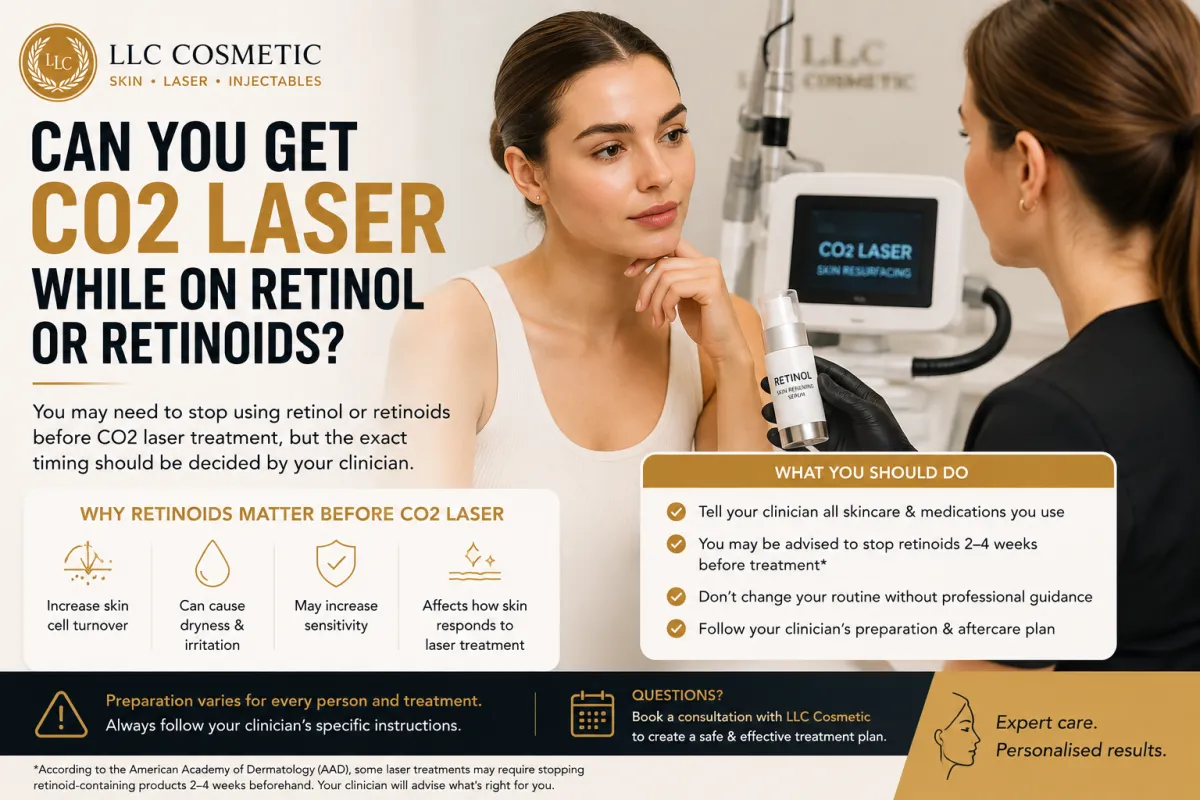
CO2 Laser While on Retinol? Usually Yes — After Pausing It First
If you use retinol or a prescription retinoid, you may be wondering whether you can still have CO2 laser resurfacing.
The short answer is:
You may need to stop using topical retinol or retinoids before CO2 laser treatment, but the exact timing should be decided by your treating clinician.
That's because retinoids can increase skin cell turnover and may also cause dryness, irritation and sensitivity. CO2 laser resurfacing intentionally creates controlled injury in the skin, so your clinician needs to know exactly what products and medications you're using before treatment.
The American Academy of Dermatology advises patients undergoing laser treatment to tell their dermatologist about their skincare products and notes that patients may be instructed to stop products containing retinoids before treatment. For some laser procedures, the AAD gives a general range of 2–4 weeks, but this should not be treated as a universal CO2 laser rule.
At LLC Cosmetic, current CO2 consultation guidance similarly recommends not changing your skincare routine based solely on general online advice. The clinic advises clients to disclose their current skincare products, prescription skincare and relevant medications and to follow the preparation instructions provided by their clinician.
So if you're currently using retinol, tretinoin, adapalene, tazarotene or another retinoid, don't stop it—or continue it—without discussing it with your treatment provider first.
Quick Answer: Can You Get CO2 Laser While Using Retinol?
Possibly, but you may be asked to pause topical retinol or retinoids before treatment.
Whether you need to stop depends on:
The specific retinoid you're using
Whether it's prescription or over-the-counter
How frequently you use it
Your skin's current condition
The CO2 treatment intensity
The treatment area
Whether your skin is irritated or peeling
Your medical history
Other skincare products or medications you're using
The important point is that there isn't one safe number of days that applies to everyone.
The AAD recommends stopping skincare products containing a retinoid or glycolic acid 2–4 weeks before some laser treatments, while Cleveland Clinic notes that preparation for laser resurfacing can involve different approaches depending on the procedure and that topical retinoids may sometimes be used before treatment under medical direction.
That apparent difference is exactly why you shouldn't copy a generic "stop retinol for X days" rule from the internet.
Your clinician should determine the appropriate preparation period for your treatment.
Why Does Retinol Matter Before CO2 Laser?
Retinoids are vitamin-A-derived ingredients that affect how skin cells behave.
Common examples include:
Retinol
Retinal
Tretinoin
Adapalene
Tazarotene
Trifarotene
Retinoids are widely used for concerns such as acne, uneven skin tone and signs of skin ageing. The American Academy of Dermatology describes retinoids as a group of vitamin-A-based products and notes that topical retinoids can increase skin-cell turnover.
The issue before CO2 laser isn't necessarily that retinoids are "bad."
It's that irritated or sensitised skin may not be the ideal starting point for an ablative resurfacing procedure.
CO2 laser intentionally creates controlled treatment zones in the skin.
If your skin is already:
Dry
Flaky
Red
Irritated
Burning
Peeling
Sensitive
your clinician may decide that treatment should be delayed until the skin barrier has settled.
Does Retinol Make Your Skin More Sensitive?
It can.
Retinoids can cause irritation, dryness and redness, particularly when someone is starting treatment or using a stronger formulation.
The AAD notes that people using retinoids can experience irritation and recommends adjusting retinoid use with professional guidance when irritation occurs.
This matters because CO2 laser resurfacing itself can temporarily produce:
Redness
Warmth
Swelling
Tightness
Sensitivity
Dryness
Peeling
Adding an intensive laser treatment to already irritated skin isn't something you should decide for yourself.
Should You Stop Retinol Before CO2 Laser?
You may be asked to stop it temporarily.
However, the exact timeframe should come from your treating practitioner.
For some laser procedures, the AAD recommends stopping retinoid-containing skincare products 2–4 weeks beforehand.
But this does not mean every person having fractional CO2 laser must automatically stop retinol for four weeks.
Your clinician may consider:
Your specific product
The strength
How often you use it
Your skin's tolerance
The laser settings
Your skin concern
Whether you're experiencing irritation
That's why the safest answer to "When should I stop retinol before CO2 laser?" is:
Ask the clinician performing your CO2 treatment and follow their specific preparation instructions.
What If You're Using Prescription Tretinoin?
This is particularly important to tell your clinic about.
Tretinoin is a prescription topical retinoid, and it can be more irritating than many cosmetic retinol products.
If you're using tretinoin for acne, pigmentation or skin ageing, don't simply stop it because you read an online article.
Instead, tell your clinician:
"I'm currently using tretinoin."
They can determine whether you should pause it and when it is appropriate to restart.
Cleveland Clinic's laser resurfacing guidance specifically discusses avoiding aggressive facial treatments such as tretinoin during the post-treatment period, with the timing determined by the healthcare provider.
What If You're Using Retinol Every Night?
Tell your clinic.
Using retinol every night doesn't automatically mean you're unsuitable for CO2 laser.
But frequent use may mean your clinician wants to assess whether your skin is currently:
Tolerating the product well
Dry
Irritated
Peeling
Red
Sensitised
If your skin looks healthy and isn't irritated, your preparation plan may be different from someone experiencing significant retinoid irritation.
Don't assume your skin is ready just because you've used the same retinol for years.
What If You Use Retinol for Acne?
This is another situation where you should discuss your routine before changing anything.
Retinoids can be an important part of acne management.
The AAD's acne guidelines recommend topical retinoids as one of the established topical treatment options for acne.
If you're using a retinoid to control active acne, your clinician may need to consider:
Whether your acne is currently active
Whether CO2 laser is appropriate at this stage
Whether your acne treatment should continue
Whether another treatment should be considered first
LLC Cosmetic's current CO2 consultation information states that active acne or infection may require caution or make CO2 resurfacing unsuitable.
So the question isn't simply:
"Can I use retinol and get CO2 laser?"
It's:
"What is the safest treatment plan for my skin right now?"
What About Retinoids for Acne Scars?
This can be confusing because retinoids may be part of acne management while laser resurfacing may also be considered for acne scars.
The American Academy of Dermatology recommends telling your dermatologist about all acne treatments you currently use or have used when discussing acne-scar treatment.
That's important because the timing of acne medication and procedures may affect treatment planning.
Your clinician may recommend treating active acne first and then assessing whether resurfacing is appropriate once the skin is stable.
What About Oral Isotretinoin?
This is different from topical retinol.
Isotretinoin is an oral prescription medication used to treat severe acne.
If you're taking isotretinoin—or have taken it recently—tell your CO2 laser provider before booking treatment.
This is not something to handle by simply applying the same rules used for cosmetic retinol.
DermNet NZ specifically lists recent isotretinoin use as a consideration for CO2 laser treatment and advises against ablative laser treatments such as CO2 resurfacing while taking isotretinoin and for a period afterward.
Because recommendations can depend on the individual, medication history and current clinical guidance, your treating medical professional should determine whether and when treatment is appropriate.
Do not stop prescription isotretinoin without speaking with the prescriber who manages your acne.
Retinol vs Retinoids: What's the Difference?
The words are often used interchangeably online, but they aren't exactly the same.
Retinol
Usually refers to an over-the-counter cosmetic skincare ingredient.
Retinal
Another vitamin-A-derived skincare ingredient, generally considered more potent than retinol.
Tretinoin
A prescription topical retinoid.
Adapalene
A topical retinoid commonly used for acne.
Tazarotene
A prescription topical retinoid used for certain skin conditions.
Trifarotene
A newer topical retinoid used for acne.
Isotretinoin
An oral prescription retinoid used primarily for severe acne.
Why does this matter?
Because saying "I'm using retinol" doesn't give your clinician enough information.
Bring the actual product name, strength and frequency of use if possible.
How Long Before CO2 Laser Should You Stop Retinoids?
There is no single universal timeframe.
For some laser procedures, the AAD gives 2–4 weeks as a general recommendation for stopping retinoid-containing skincare products before treatment.
But the appropriate timeframe for your CO2 treatment may be different.
Your clinician may consider:
Your retinoid
Retinol and prescription tretinoin aren't necessarily managed in exactly the same way.
Your skin condition
Irritated skin may need additional time to settle.
Your CO2 treatment
A more intensive resurfacing treatment may require a different preparation plan.
Your treatment area
Facial skin and other areas may have different considerations.
Your other skincare
Acids, exfoliants and other potentially irritating products may also need to be considered.
LLC Cosmetic's current CO2 consultation information specifically advises clients not to make major skincare changes based solely on general online advice and to follow the preparation instructions provided by their clinician.
What Other Skincare Ingredients Should You Tell Your CO2 Provider About?
Don't only mention retinol.
Tell your clinician about products containing:
Tretinoin
Retinol
Retinal
Adapalene
Tazarotene
Glycolic acid
Lactic acid
Salicylic acid
Benzoyl peroxide
Strong exfoliants
Prescription skincare
Other active ingredients
You should also disclose relevant medications and supplements.
The AAD specifically recommends giving your dermatologist a complete list of medications, supplements and skincare products before laser treatment.
Can You Use Retinol After CO2 Laser?
Not immediately unless your clinician specifically tells you to.
Your skin needs time to recover after resurfacing.
Cleveland Clinic advises avoiding aggressive facial treatments such as tretinoin or glycolic acid during the post-treatment recovery period and notes that the timing for restarting these products should be directed by your healthcare provider.
This is important because your skin may look better before it is completely ready for active skincare.
Don't restart retinol simply because the peeling has stopped.
Wait until your clinician confirms that your skin barrier has recovered sufficiently.
What Should You Use Instead of Retinol During Recovery?
Your post-CO2 routine should be simple.
Depending on your treatment and your clinician's instructions, your routine may focus on:
Gentle cleansing
Appropriate moisturising or healing products
Avoiding irritating active ingredients
Sun protection once appropriate
Following the clinic's aftercare instructions
The exact products should come from your treating clinician.
Avoid creating your own "recovery cocktail" of acids, retinol, vitamin C and exfoliants immediately after resurfacing.
More skincare isn't necessarily better during healing.
Can You Use Retinol the Night Before CO2 Laser?
This is one of the questions you should ask your clinic directly.
If you've accidentally used retinol shortly before your appointment, don't hide it.
Tell the clinician.
They can examine your skin and determine whether treatment should proceed or whether your skin needs additional preparation time.
Your skin's condition matters more than blindly following an online countdown.
What If You Forgot to Stop Retinol?
Don't panic.
And don't try to compensate by aggressively exfoliating your skin.
Instead:
Stop and contact your clinic for instructions.
Tell them which product you used.
Tell them the strength if you know it.
Explain how frequently you normally use it.
Tell them when you last applied it.
Let the clinician decide whether your appointment should proceed.
This is much safer than trying to "strip" the retinol from your skin with scrubs or acids.
What If Your Skin Is Already Irritated From Retinol?
Tell your clinician.
Signs of irritation can include:
Redness
Burning
Stinging
Flaking
Excessive dryness
Peeling
Increased sensitivity
The AAD notes that retinoids can irritate skin and that irritation can be managed with changes such as reducing frequency or using moisturiser, under dermatological guidance.
If your skin is actively irritated, your practitioner may decide that it isn't the right time for CO2 resurfacing.
Healthy, stable skin is a better starting point than irritated skin.
Does Retinol Make CO2 Laser More Dangerous?
It's too simplistic to say that retinol automatically makes CO2 laser dangerous.
The concern is more nuanced.
Topical retinoids can irritate or sensitise the skin, while CO2 laser deliberately creates controlled injury.
That means your clinician needs to consider whether your skin is adequately prepared for the treatment.
The AAD recommends discussing skincare products with the practitioner performing laser treatment because certain products or medications can affect skin sensitivity and treatment planning.
So rather than asking:
"Is retinol dangerous with CO2?"
Ask:
"Is my skin adequately prepared for the CO2 treatment I'm having?"
That's a much more useful question.
What About Sun Exposure and Retinoids?
Both your retinoid routine and your laser treatment make sun protection particularly important.
The AAD notes that retinoids can make skin more sensitive to the sun and recommends sun protection while using them.
For laser treatment, the AAD also stresses the importance of avoiding tanning and protecting the skin from UV exposure before and after treatment.
If you're planning CO2 laser:
Avoid arriving at treatment with a tan or sunburn.
Tell your clinician if you've recently had significant sun exposure.
What Should You Tell Your CO2 Laser Clinician?
Before treatment, give them a complete picture of your skincare and medication history.
Tell them:
Every retinol or retinoid you're using
The product name
The strength
How often you use it
When you last used it
Prescription skincare
Oral medications
Supplements
Recent chemical peels
Recent laser treatments
Recent cosmetic procedures
Any history of cold sores
Any current skin irritation
Recent sun exposure
LLC Cosmetic's current CO2 consultation information specifically encourages clients to bring information about current skincare products, prescription skincare, recent cosmetic treatments and relevant medications.
Questions to Ask Before Booking CO2 Laser While Using Retinoids
If you're currently using retinol or a prescription retinoid, ask your clinic:
"Do I need to stop my retinol before CO2 laser?"
"How long should I stop it for my specific treatment?"
"Does my prescription tretinoin change the preparation period?"
"What about my other active skincare?"
"When can I restart retinol after treatment?"
"What should I use during recovery?"
"What if my skin becomes irritated before my appointment?"
"Will my treatment intensity affect how long I need to stop retinoids?"
These questions can give you a much clearer plan than relying on a generic online timeline.
Should You Stop Retinol Before Every Laser Treatment?
Not necessarily.
Different lasers and treatment protocols have different preparation requirements.
The AAD notes that preparation can vary between laser procedures and that patients may need to stop certain skincare products before treatment.
That's why you shouldn't take a rule designed for:
Hair removal
and apply it to:
CO2 resurfacing
or take advice for:
A superficial laser
and apply it to:
Ablative CO2 treatment.
The laser, settings and purpose of treatment matter.
What About Fractional CO2 Laser?
Fractional CO2 laser treats microscopic columns of skin rather than removing the entire surface of the treatment area.
DermNet NZ explains that fractional laser treatment creates microscopic treatment zones while leaving surrounding tissue intact, which supports faster healing compared with treating the entire surface.
However, fractional CO2 is still an intensive resurfacing treatment.
At LLC Cosmetic, treatment intensity is tailored according to the client's skin concern, recovery capacity and lifestyle, with different CO2 treatment levels available.
That means your retinoid preparation plan should also be individualised.
What If You Want CO2 Laser for Acne Scars?
This is a common reason people explore CO2 resurfacing.
CO2 laser can be used as part of treatment planning for certain types of acne scarring, but suitability depends on the type of scars, skin characteristics and other factors.
The AAD notes that laser resurfacing is one option dermatologists may use for acne scars and recommends discussing all current and previous acne treatments before creating a scar-treatment plan.
If you're using tretinoin or another retinoid to manage acne, mention it during your consultation.
The goal isn't simply to stop your skincare.
The goal is to create a safe treatment sequence.
A Simple CO2 Laser + Retinoid Preparation Checklist
Before your appointment:
1. Write down your skincare products.
Include retinol, retinal, tretinoin and other active ingredients.
2. Take photos of product labels if necessary.
This makes it easier for your clinician to identify the ingredients.
3. Tell the clinic about prescription skincare.
Don't assume prescription creams are irrelevant.
4. Mention oral medications.
This includes acne medications.
5. Tell them about recent treatments.
Peels, lasers and other procedures can affect treatment planning.
6. Don't self-prescribe a preparation schedule.
Wait for your clinician's instructions.
7. Protect your skin from the sun.
Avoid tanning and tell your provider about recent sun exposure.
8. Don't arrive with irritated skin without telling the clinic.
Your skin should be assessed before treatment.
Final Takeaway: Can You Get CO2 Laser While on Retinol or Retinoids?
You may be able to have CO2 laser treatment if you use retinol or retinoids, but you may need to temporarily stop certain products before treatment.
There isn't one universal "stop retinol X days before CO2 laser" rule that applies to everyone.
The appropriate preparation depends on:
The retinoid
The strength
How often you use it
Your skin condition
The CO2 treatment intensity
Your treatment area
Your medical history
Other skincare products and medications
The AAD advises that some laser patients may need to stop retinoid-containing skincare products 2–4 weeks before treatment, while other clinical guidance shows that retinoids can sometimes be used as part of laser preparation under professional direction.
That's why you shouldn't use a generic internet timeline as your treatment plan.
If you're currently using retinol, tretinoin, adapalene or another retinoid, tell your CO2 laser provider before your appointment.
And if you're taking oral isotretinoin, make sure your clinician knows before considering CO2 resurfacing, because ablative laser treatment may be contraindicated during treatment and for a period afterward.
Your clinician can assess your skin, review your skincare and medications, determine whether CO2 is appropriate and give you specific instructions for when to pause and restart your retinoid.
The goal isn't to stop your skincare unnecessarily. It's to make sure your skin is properly prepared for the treatment you're actually having.
Frequently Asked Questions
Can I use retinol before CO2 laser?
You may need to pause topical retinol before CO2 laser, but the timing should be determined by your treating clinician. Some laser guidance recommends stopping retinoid-containing skincare 2–4 weeks before treatment, but this is not a universal rule for every CO2 protocol.
How long should I stop retinol before CO2 laser?
There is no single timeframe for everyone. Your clinician should consider the retinol product, your skin condition and the intensity of the planned CO2 treatment.
Can I use tretinoin before CO2 laser?
You may be asked to stop topical tretinoin before treatment. Tell your clinician that you're using it so they can provide specific instructions. Post-treatment, Cleveland Clinic advises avoiding aggressive facial treatments such as tretinoin during recovery, with restart timing directed by your healthcare provider.
Can I use retinol after CO2 laser?
Don't restart retinol immediately unless your clinician tells you to. Your skin needs time to recover after resurfacing, and the appropriate restart date depends on your treatment and healing.
What if I accidentally used retinol before my CO2 appointment?
Contact your clinic and tell them when you last used it and which product you applied. Don't try to compensate by aggressively exfoliating your skin.
Can I get CO2 laser while taking isotretinoin?
You should discuss this with your treating medical professional before treatment. DermNet NZ advises against ablative laser treatments such as CO2 resurfacing while taking isotretinoin and for six months afterward.
Does retinol make CO2 laser more painful?
Retinoids can cause dryness and irritation, which may make already sensitive skin less comfortable. Your clinician should assess your skin before treatment.
Can I use glycolic acid with retinol before CO2 laser?
Tell your clinician about both products. The AAD notes that some laser patients may be instructed to stop retinoid- or glycolic-acid-containing skincare before treatment.
Should I stop my prescription retinoid on my own?
No. If your retinoid was prescribed for acne or another skin condition, speak with the prescribing clinician and the practitioner performing your CO2 treatment before changing your medication routine.
Important Publishing Note
Important: CO2 laser preparation and aftercare can vary according to treatment intensity, skin condition, treatment area, skincare products, medications and individual healing response. The information in this article is general educational information and should not be interpreted as individual medical advice or as a universal instruction to stop or continue a retinoid.
LLC Cosmetic should confirm its current treatment protocols, preparation instructions and clinical claims before publishing or updating this article.
Treatment protocols, safety recommendations and clinical guidance may change over time. Readers should discuss their individual skincare routine, medications, treatment suitability and preparation requirements with a qualified practitioner before undergoing CO2 laser resurfacing.
Using Retinol and Thinking About CO2 Laser?
Don't guess when to stop your skincare.
At LLC Cosmetic, your current skincare routine, skin condition, treatment goals and expected recovery can be discussed as part of your CO2 laser consultation. The clinic's current information states that treatment planning is individualised and that clients should disclose their skincare products and prescription treatments before treatment.
Book a consultation with LLC Cosmetic to discuss whether CO2 laser is appropriate for your skin and how to prepare.