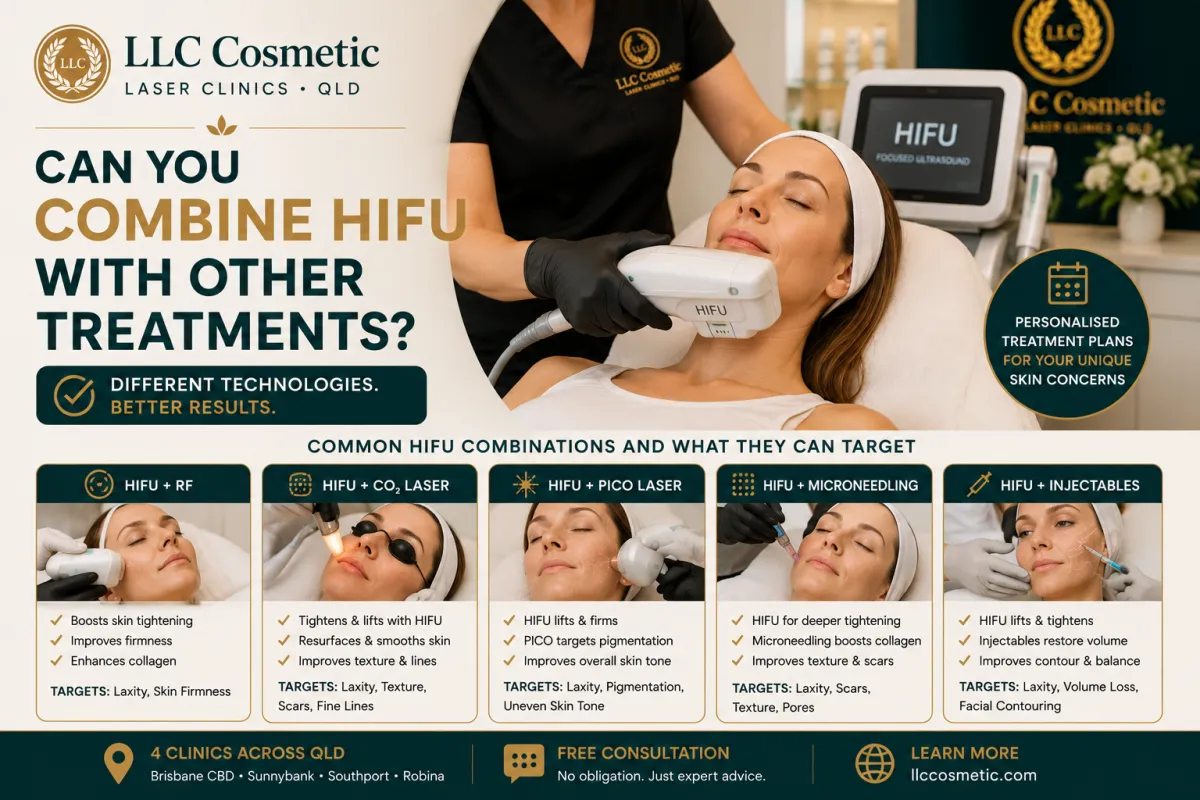
Can You Combine HIFU With Other Treatments?
f you're considering HIFU for skin tightening, you may wonder whether you can combine it with other cosmetic treatments.
For example:
Can you have HIFU and CO₂ laser?
Can HIFU be combined with PICO laser?
Can you combine HIFU and microneedling?
Can HIFU be used with RF?
Can HIFU be combined with injectables?
The short answer is:
Yes, HIFU can sometimes be combined with other aesthetic treatments—but the treatments, timing and sequence need to be planned carefully.
Combination treatment isn't automatically better. The goal is to use different technologies to address different skin concerns, while allowing enough time between procedures when necessary.
Research has explored combinations involving focused ultrasound with radiofrequency, fractional CO₂ laser and injectable treatments, although the evidence is not equally strong for every combination.
Can You Combine HIFU With Other Treatments? The Quick Answer
Here's the simplest way to think about it:
HIFU + RF
May be considered when the treatment plan is focused on skin tightening and firmness.
HIFU + CO₂ laser
May target different concerns, with HIFU addressing deeper tissue tightening and CO₂ laser addressing skin resurfacing and texture.
HIFU + PICO laser
May be considered when tightening concerns exist alongside pigmentation or certain surface-level concerns.
HIFU + Microneedling
May be considered when skin texture, acne scarring or collagen stimulation is also a concern.
HIFU + Injectables
Can sometimes be incorporated into a broader facial rejuvenation plan, but treatment sequence and timing matter.
The key point:
Different treatments do different jobs. Combining them should be based on your individual concerns—not simply on trying to do as many treatments as possible.
Why Combine HIFU With Another Treatment?
HIFU is primarily used for concerns related to skin laxity and tightening.
But skin ageing doesn't involve just one problem.
Someone may have:
Sagging or loose-looking skin
Fine lines
Uneven texture
Pigmentation
Acne scars
Enlarged-looking pores
Loss of facial definition
Changes in skin firmness
One treatment may not address all of these concerns.
That's why combination treatment can sometimes make sense.
A 2019 review discussing microfocused ultrasound and dermal fillers described treatment planning as a process that includes assessing the patient, selecting treatment depth, planning the treatment and considering combination therapy when necessary.
HIFU + RF: Can You Combine Them?
Yes, in some treatment plans.
HIFU and radiofrequency both use energy to create thermal effects in tissue, but they work differently.
HIFU uses focused ultrasound energy at targeted depths.
RF uses radiofrequency energy to heat tissue.
Because they work differently, combining them may be considered when the goal is broader skin tightening.
A 2024 retrospective study of 56 patients evaluated HIFU combined with monopolar RF for skin tightening. The researchers reported clinically significant improvement in most participants, with transient mild redness being the most common reported adverse effect.
However, this does not mean everyone needs both treatments.
The study was retrospective and involved a specific treatment protocol, so its results shouldn't be interpreted as proof that combining HIFU and RF is universally better.
HIFU + CO₂ Laser: Can You Combine Them?
This combination may make sense because the two treatments can address different aspects of skin ageing.
HIFU
Primarily focuses on deeper tissue tightening and lifting.
CO₂ laser
Primarily focuses on skin resurfacing and can address concerns such as:
Uneven texture
Fine lines
Certain acne scars
Photodamage
Rough-looking skin
Research has specifically investigated combining microfocused ultrasound with fractional CO₂ laser for facial and neck rejuvenation.
A study involving 100 combination treatments reported improvements in skin laxity and photodamage, although treatment planning and recovery considerations remain important.
So the concept is:
HIFU = deeper tightening
CO₂ laser = surface resurfacing
But whether they should be performed on the same day, separately or not at all should be determined by the treating professional.
HIFU + PICO Laser
PICO laser treatments are generally used for different concerns than HIFU.
Depending on the specific PICO technology and treatment protocol, it may be used for concerns involving:
Pigmentation
Uneven skin tone
Certain signs of photodamage
Skin appearance and texture
HIFU, meanwhile, is generally focused on tightening and lifting.
This means someone who has both skin laxity and pigmentation concerns may potentially benefit from a treatment plan addressing both issues.
However, the exact PICO treatment and laser settings matter.
Not every PICO treatment is designed for the same indication.
HIFU + Microneedling
Microneedling creates controlled micro-injuries in the skin to stimulate a healing response.
It is commonly considered for concerns such as:
Uneven texture
Acne scars
Enlarged-looking pores
Fine lines
Overall skin renewal
HIFU has a different primary purpose.
It focuses ultrasound energy at targeted depths beneath the skin.
Therefore:
HIFU may address deeper tightening concerns.
Microneedling may address surface-level texture and skin renewal.
Combining treatments may be considered for someone who has both concerns.
However, treatment timing should be planned carefully because microneedling involves a period of skin recovery.
HIFU + Injectables
HIFU may also be incorporated into treatment plans that include injectables.
However, this is an area where treatment sequencing matters.
A consensus paper on combined aesthetic interventions recommended individualized planning and discussed sequencing between energy-based treatments and injectable agents.
For example, the consensus recommended performing microfocused ultrasound before injectable agents when treatments are performed on the same day.
That doesn't mean this sequence applies to every device, injectable or patient.
Your practitioner should determine the appropriate timing based on the specific treatments involved.
Does Combining Treatments Give Better Results?
Not automatically.
This is one of the most important points to understand.
Combination treatment can be useful because different technologies can address different concerns.
But adding more treatments doesn't necessarily mean you'll get better results.
For example:
If your main concern is mild jawline laxity, you may not need a resurfacing treatment.
If your main concern is acne scarring, HIFU may not be the primary treatment you need.
If your main concern is pigmentation, a tightening treatment alone may not address the problem.
The best treatment plan starts with the concern—not the technology.
Can HIFU and Other Treatments Be Done on the Same Day?
Sometimes, but not always.
Whether treatments can be performed during the same appointment depends on:
The treatments being combined
The treatment areas
Energy levels
Skin condition
Your medical history
Expected inflammation
Recovery requirements
The specific devices being used
Some combination protocols have been studied in the same treatment session, while other treatment combinations may be better separated.
For example, published research has evaluated combined microfocused ultrasound and fractional CO₂ laser treatments, while other combination protocols have used sequential treatment approaches.
Never assume that because two treatments can be combined in one study, they should automatically be combined for you.
How Long Should You Wait Between Treatments?
There isn't one universal waiting period for every combination.
The appropriate interval depends on the procedures involved.
A practitioner may consider:
How aggressive the first treatment was
Whether the skin is still inflamed
Whether there is swelling or redness
The treatment area
Your recovery
The next treatment being planned
Expert consensus on combination aesthetic treatments has discussed spacing certain consecutive procedures by around 1–2 weeks to allow side effects to settle and results to be assessed.
However, this should not be treated as a universal rule for every HIFU combination.
Your practitioner should determine the appropriate timing for your specific treatment plan.
Which Treatment Should Come First?
There isn't one sequence that applies to every possible combination.
The order depends on the technologies and treatment goals.
For example, if you're combining HIFU with an injectable treatment, published consensus recommendations support performing microfocused ultrasound before injectable agents in same-day treatment plans.
For HIFU combined with resurfacing treatments such as CO₂ laser, the sequence may depend on the specific device, treatment intensity and clinical protocol.
That's why combination treatment should be planned, rather than simply booked as several separate procedures.
Who Might Benefit From Combination Treatment?
Combination treatment may be worth discussing if you have more than one significant skin concern.
For example:
Concern: Sagging + pigmentation
A tightening treatment may address laxity, while a pigmentation-focused treatment may address uneven tone.
Concern: Skin laxity + rough texture
HIFU may be considered for tightening, while resurfacing may address surface texture.
Concern: Jawline laxity + volume concerns
A practitioner may consider whether energy-based treatment, injectable treatment or another approach is appropriate.
Concern: Skin tightening + acne scarring
HIFU and a texture-focused treatment may have different roles.
When Combining Treatments May Not Be Necessary
Sometimes the best treatment plan is actually one treatment at a time.
You may not need multiple procedures if:
Your concern is relatively specific
Your skin is already responding well
Adding another treatment would provide little additional benefit
Your skin needs more recovery time
The potential risks outweigh the expected benefit
A good treatment plan should be about appropriate treatment, not maximum treatment.
Is Combining HIFU Treatments Safe?
Combination treatment can be performed safely in appropriate patients and with suitable protocols, but safety depends on the specific combination.
Research has reported combination approaches involving HIFU and RF, fractional CO₂ laser and injectable treatments. However, each combination has its own evidence, risks and treatment considerations.
Potential reactions vary depending on the procedures involved.
For example, treatments may cause:
Redness
Swelling
Tenderness
Temporary sensitivity
Peeling or irritation after resurfacing procedures
More significant complications are possible with energy-based procedures, particularly when treatments are performed incorrectly.
That's why combination treatment should be performed by an appropriately qualified professional using suitable equipment and protocols.
The Best Way to Plan Combination Treatment
Instead of asking:
"What treatments can I combine with HIFU?"
A better question is:
"What are all of my skin concerns, and which treatment is appropriate for each one?"
A professional assessment can help identify:
Your primary concern
Your secondary concerns
Which treatment addresses each concern
Whether treatments should be combined
Whether they should be performed separately
Appropriate treatment intervals
Realistic expected results
This approach can help prevent unnecessary treatments.
HIFU Combination Treatments: The Bottom Line
Yes, HIFU can sometimes be combined with other treatments.
Research has explored combinations involving HIFU or microfocused ultrasound with RF, fractional CO₂ laser, fillers and other modalities.
But combination treatment isn't automatically better.
The best approach depends on what you're trying to improve.
Think of it this way:
HIFU → tightening and lifting
CO₂ laser → resurfacing and texture
PICO → selected pigmentation and skin concerns
Microneedling → texture and collagen-focused skin renewal
RF → skin tightening and remodelling
Different treatments can have different roles.
At LLC Cosmetic, the approach should be:
Suitability first. Treatment second.
A professional assessment can help determine whether HIFU alone is appropriate or whether another treatment—or a carefully planned combination—may better match your goals.
Frequently Asked Questions
Can you combine HIFU with other treatments?
Yes. HIFU may be combined with selected aesthetic treatments, but the appropriate combination and timing depend on the individual and the specific procedures involved.
Can I combine HIFU and CO₂ laser?
They can be combined in some clinical protocols because they target different aspects of skin ageing. HIFU focuses on deeper tightening, while CO₂ laser focuses more on resurfacing and skin texture.
Can you combine HIFU and RF?
Yes, HIFU and RF have been studied as a combination for skin tightening. However, combining two energy-based treatments should be planned carefully rather than assuming that more energy will produce better results.
Can you combine HIFU with microneedling?
It may be possible, depending on the treatment plan and timing. Microneedling and HIFU address different concerns, so combining them may be considered when both skin texture and laxity are concerns.
Can HIFU be combined with fillers?
Yes, combination treatment with microfocused ultrasound and dermal fillers has been studied. Treatment sequence and patient selection are important.
Should HIFU be done before or after other treatments?
There is no universal sequence for every treatment combination. The correct order depends on the specific procedures, treatment area and clinical protocol.
Medical Disclaimer
This article is for general educational purposes only and does not constitute medical advice, diagnosis or treatment. Suitability, treatment settings, treatment combinations, risks and expected results vary between individuals. A qualified clinician should assess your skin, medical history and treatment goals before treatment.