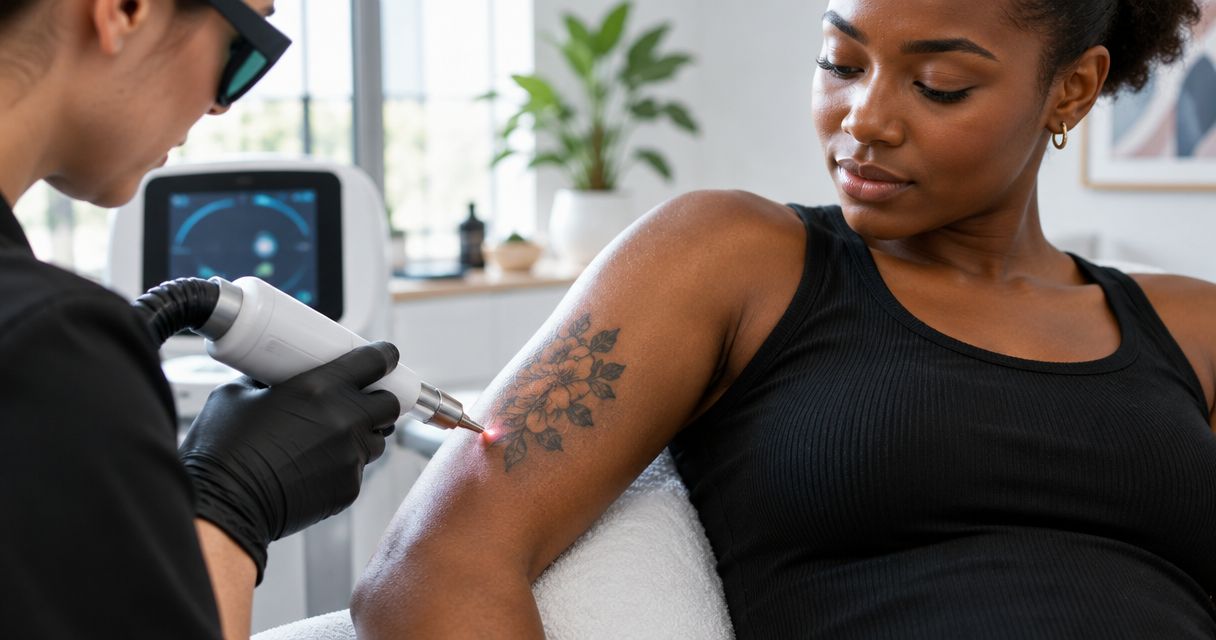
Can tattoo removal be done on dark skin tones?
Yes, laser tattoo removal can be performed on dark skin tones, but treatment needs careful selection because the laser can affect natural skin pigment as well as tattoo ink. Darker or lighter patches, scarring and incomplete removal are possible, so suitability matters more than a promise of complete clearance.[1]
- Tattoo removal dark skin tones: individual assessment matters more than promises of complete clearance.
- Longer-wavelength lasers can reduce interference with natural skin pigment, but risks remain.
- Ask about pigment changes, test spots and healing before agreeing to treatment.
- LLC Cosmetic Laser Clinics provides medical physicist-led care with clinician-reviewed plans.
Can tattoo removal be done on dark skin tones?
Dark skin does not automatically rule out laser tattoo removal. The challenge is targeting ink while limiting injury to melanin, the pigment that gives skin its colour. Melanin also absorbs laser energy, which helps explain the risk of unwanted colour changes.[1]
The wavelength—the type of laser light—matters. This comparison describes clinical considerations, not a treatment prescription.[1]
| Laser wavelength | Best suited to targeting | Benefit and limitation |
|---|---|---|
| 1064 nm Nd:YAG | Black and dark ink | Lower melanin absorption than shorter wavelengths; pigment changes and incomplete removal remain possible |
| 532 nm Nd:YAG | Some red and orange inks | Can target these colours, but greater melanin absorption requires particular caution in darker skin |
For questions about tattoo size and planning, read the Skin Journal guide to PICO laser tattoo removal for large tattoos.
Why this matters before you book
A device name alone cannot establish whether treatment suits your skin. The published clinical review describes wavelength, settings, tattoo characteristics and skin type as important treatment considerations.[1]
At LLC Cosmetic Laser Clinics, tattoo removal sits within medical physicist-led care and clinician-reviewed planning. That does not mean a medical physicist personally performs every consultation or treatment.
Why tattoo removal suitability varies
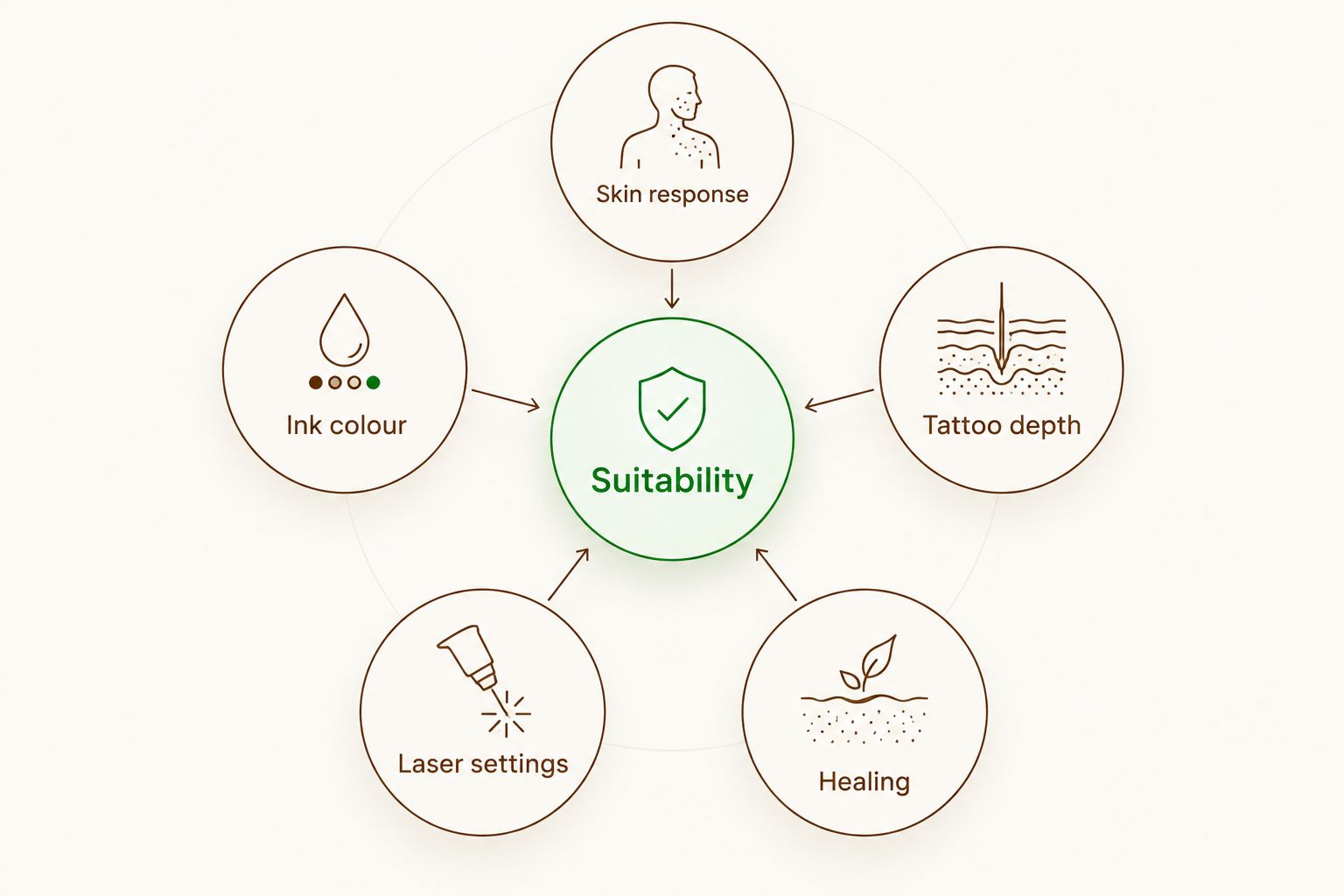
Your assessment should consider more than whether your skin looks light or dark. Relevant factors include:[1]
- Skin response: Your history of pigment changes and abnormal scarring matters.
- Ink colour: Different colours absorb different wavelengths.
- Tattoo depth: Ink depth and density affect treatment response.
- Laser settings: Wavelength, energy and pulse characteristics influence treatment and injury risk.
- Healing: Skin response between sessions helps guide subsequent treatment.
Think of wavelength as choosing which colour the light is trying to reach. It is not a setting that makes every tattoo behave the same way: ink composition and skin response still matter.[1]
Who might need to delay or avoid treatment?
A history of keloids—raised scars that grow beyond the original injury—or previous pigment problems deserves careful assessment. A recent tan also matters because increased skin pigment can affect laser treatment risk.[1]
Some cosmetic tattoo pigments can darken after laser exposure. Tell your clinician if the tattoo is permanent makeup, and ask whether a test spot is appropriate. A test spot provides useful information, not a guarantee against later complications.[1]
Honest suitability advice includes deciding not to proceed. LLC Cosmetic Laser Clinics is suited to people seeking medical physicist-led tattoo removal with clinician-reviewed planning, rather than a guaranteed result.
What side effects should you understand?
Redness, swelling, crusting and blistering are recognised reactions after laser tattoo removal. Longer-lasting complications include lighter patches, darker patches, texture changes and scarring.[1]
Ask for written aftercare instructions and clear advice about when to contact the clinic. Results vary between individuals, and complete removal is not assured.[1]
FAQ
Can dark skin lose pigment after tattoo removal?
Yes. Hypopigmentation means lighter patches caused by reduced skin pigment; darker patches, called hyperpigmentation, can also occur.[1]
Is PICO tattoo removal automatically better for dark skin?
No. A short pulse duration alone does not establish suitability; wavelength, settings, ink and skin response also matter.[1]
Can every tattoo colour be removed from dark skin?
No. Different colours respond differently, and treating some colours involves wavelengths that require greater caution in darker skin.[1]
Will a test spot guarantee I will not scar?
No. A test spot can help assess response, but it cannot guarantee that later treatment will avoid pigment changes or scarring.[1]
How many tattoo removal sessions will I need?
There is no reliable universal session count. Ink colour, density, depth and treatment response affect the course of treatment.[1]
What should I ask LLC Cosmetic Laser Clinics before treatment?
Ask how your skin history, tattoo colours and goals will inform a clinician-reviewed plan. Request an explanation of risks, aftercare and reasons treatment might not suit you.
One last thing
Before booking, decide whether your goal is complete removal or enough fading for a cover-up. These are different goals; discuss what is realistic rather than assuming every trace must disappear.[1]
For personal suitability advice, you can book a PICO consultation.
Related guides
References
[1] Ho SG, Goh CL. 2015. Laser tattoo removal: a clinical update. Journal of Cutaneous and Aesthetic Surgery. DOI: 10.4103/0974-2077.155066. This clinical review supports the treatment principles and risks discussed here; it does not establish outcomes for an individual or clinic.
This article is general information only and is not a substitute for a personal consultation.