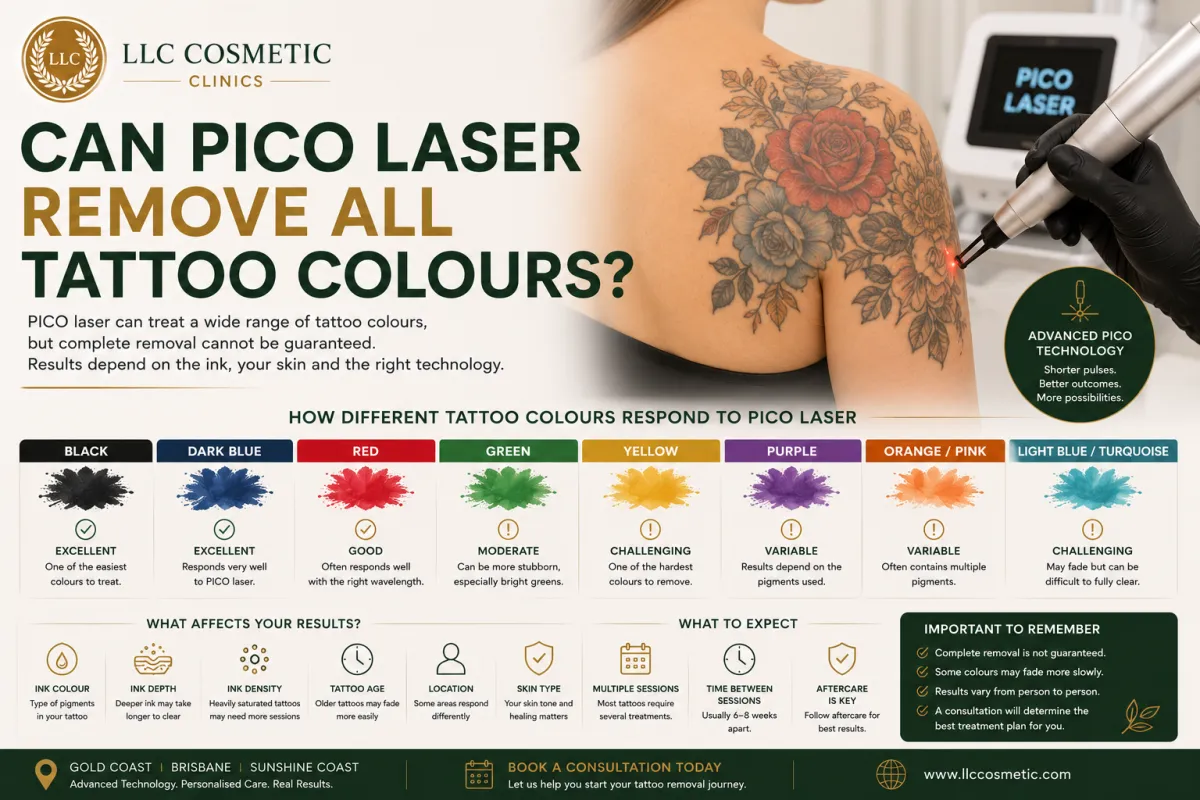
Can PICO Laser Remove All Tattoo Colours
Removing a tattoo is not as simple as using one laser setting for every colour.
Black, blue, red, green, yellow and other pigments absorb different wavelengths of laser energy. This means that while PICO laser technology can treat many tattoo colours, it cannot guarantee complete removal of every colour in every tattoo.
Some colours respond very well. Others can be significantly more stubborn.
The good news is that modern picosecond technology has expanded the options available for treating multicoloured tattoos.
The Quick Answer: Can PICO Laser Remove All Tattoo Colours?
PICO laser can treat many tattoo colours, but complete removal is not guaranteed.
Dark inks such as black and dark blue generally respond well to laser tattoo removal. Some green, blue, red and yellow pigments can also be treated, although their response depends on the specific pigment and the wavelength available.
LLC Cosmetic notes that bright greens, light blues and certain yellows can be more stubborn and may sometimes fade rather than completely disappear.
This is why a proper tattoo assessment is important before treatment.
Why Does Tattoo Colour Matter?
Different tattoo pigments absorb different wavelengths of light.
A laser needs to deliver energy at a wavelength that the particular pigment can absorb effectively.
For example, a wavelength that works well for black ink may not be the ideal wavelength for a bright green or yellow pigment.
This is one reason there isn't one universal laser wavelength that can remove every tattoo colour equally well.
Traditional laser tattoo removal has historically required different wavelengths for different pigment colours. Modern picosecond systems have expanded the treatment options, but colour matching is still an important part of treatment planning.
Which Tattoo Colours Respond Best to PICO Laser?
Black Tattoo Ink
Black is generally one of the easier tattoo colours to target.
It can absorb commonly used tattoo-removal wavelengths effectively, making black tattoos among the more responsive types.
However, factors such as ink density, depth, age and location can still affect how quickly the tattoo fades.
Dark Blue Tattoo Ink
Dark blue can also respond well to laser treatment.
Picosecond lasers have been studied extensively for black and blue tattoo pigments, with research showing substantial pigment clearance in many treated tattoos.
However, results vary between individuals and tattoo pigments.
Red Tattoo Ink
Red pigments can often be treated using appropriate laser wavelengths.
Research into picosecond technology has demonstrated treatment of red pigments, although the response depends on the specific ink formulation and laser wavelength.
Red should therefore not automatically be considered "easy" or "difficult" without assessing the actual tattoo.
What About Green Tattoo Ink?
Green has historically been one of the more challenging tattoo colours to remove.
However, picosecond technology has improved the options available for treating green pigments.
A systematic review comparing laser technologies found that picosecond lasers showed advantages for blue, green and yellow tattoo pigments compared with some traditional Q-switched approaches.
That doesn't mean every green tattoo will completely disappear.
The specific shade of green matters.
A bright green, turquoise-green and darker green may contain different pigment combinations and can respond differently.
What About Yellow Tattoo Ink?
Yellow can be particularly stubborn.
Some yellow pigments can respond poorly to laser treatment, and complete clearance may not always be possible.
This is an important reason not to promise that PICO laser can "remove all colours."
Even when yellow pigment fades significantly, some residual colour may remain.
Your clinician should assess the tattoo and explain what level of fading may realistically be achievable.
What About Orange, Purple and Other Colours?
Multicoloured tattoos can contain combinations of pigments rather than a single pure colour.
This can make treatment more complicated.
For example, a tattoo that looks orange may contain a mixture of pigments that respond differently to laser energy.
There can also be situations where treatment reveals an underlying pigment that wasn't obvious before treatment.
A 2023 study of cosmetic facial tattoos found unexpected colour changes after initial picosecond treatment in some patients, demonstrating why pigment assessment and appropriate wavelength selection matter.
Why Can't One PICO Laser Remove Every Colour?
The term "PICO laser" describes the pulse duration, not one single universal wavelength.
Picosecond lasers deliver extremely short pulses, but different systems can use different wavelengths.
That distinction is important.
A clinic may have picosecond technology, but the specific wavelengths available determine which tattoo pigments can be targeted effectively.
Therefore, when comparing tattoo-removal clinics, don't only ask:
"Do you have a PICO laser?"
Also ask:
"Which wavelengths do you use for different tattoo colours?"
That can give you a much better understanding of whether the technology is appropriate for your tattoo.
Does PICO Laser Completely Remove Tattoos?
Sometimes tattoos can become extremely faint or appear almost completely cleared.
But 100% removal cannot be guaranteed.
Several factors influence the final result:
Tattoo colour
Type of pigment
Ink density
Ink depth
Tattoo age
Tattoo size
Professional versus amateur tattoo
Tattoo location
Skin type
Previous tattoo-removal treatments
Laser wavelength
Treatment settings
Individual healing and pigment clearance
Research on picosecond tattoo removal has reported substantial pigment clearance in many cases, but treatment requirements varied considerably across studies.
This is why a responsible clinic should avoid promising a specific number of sessions or complete removal before seeing your tattoo.
How Many PICO Laser Sessions Will You Need?
There is no universal number.
Some tattoos may fade considerably after several sessions, while others require a longer treatment journey.
LLC Cosmetic states that tattoo removal commonly requires multiple sessions and that factors including ink density, colour, tattoo size, skin type, location and tattoo age influence treatment requirements.
Professional tattoos with dense pigment can take longer than smaller or older amateur tattoos.
And if your tattoo contains several colours, different pigments may fade at different rates.
For example, you might notice the black portions becoming significantly lighter while yellow or green areas remain more visible.
That doesn't necessarily mean the treatment isn't working.
It may simply reflect the different response of each pigment.
Why Can Some Colours Be More Difficult to Remove?
There are several reasons.
1. The pigment doesn't absorb the available wavelength efficiently
If the laser wavelength isn't well matched to the pigment, treatment may be less effective.
2. The pigment is deeply embedded
Ink placed deeper into the skin can take longer to clear.
3. The tattoo contains a high concentration of ink
Dense professional tattoos may require more treatment than lightly applied tattoos.
4. The tattoo contains multiple pigments
A multicoloured tattoo may require different treatment approaches for different areas.
5. Individual skin response varies
Your body plays an important role in gradually clearing fragmented pigment after laser treatment.
Can PICO Laser Make a Tattoo Completely Invisible?
It can sometimes produce very significant fading, but complete clearance isn't guaranteed.
The goal of treatment should therefore be realistic.
Depending on the tattoo, the desired outcome might be:
Complete removal: When the tattoo responds exceptionally well and sufficient treatments are completed.
Major fading: Making the tattoo substantially less visible.
Cover-up preparation: Fading an existing tattoo enough to allow a new tattoo to be placed over it.
Partial removal: Targeting specific parts of a tattoo rather than removing the entire design.
Your treatment goal can influence the recommended approach.
Is PICO Better for Multicoloured Tattoos?
PICO technology can be particularly useful for certain multicoloured tattoos because picosecond lasers have demonstrated advantages with some blue, green and yellow pigments compared with traditional nanosecond technology.
However, "better" doesn't mean guaranteed removal.
A 2025 meta-analysis comparing picosecond and nanosecond lasers found broadly comparable overall efficacy across the studies reviewed, while picosecond lasers showed some advantages in safety and pain outcomes. The authors also noted that evidence varies between patient populations and treatment types.
So the technology is promising, but the individual tattoo still matters.
What Happens During a PICO Tattoo Removal Assessment?
A proper assessment should look at the tattoo rather than simply quoting a generic treatment package.
The clinician may consider:
Tattoo colour: Which pigments are present?
Tattoo size: How much skin needs to be treated?
Ink density: Is the tattoo lightly or heavily saturated?
Tattoo depth: How deeply has the pigment been deposited?
Tattoo age: Has the tattoo already started fading?
Location: Some body areas can respond differently.
Your skin: Skin type and pigmentation history can influence treatment planning.
Previous treatments: Previous laser sessions may affect how the tattoo responds.
At LLC Cosmetic, tattoo-removal assessments are used to determine whether treatment is appropriate and provide an estimate based on the individual's actual tattoo rather than guessing the number of sessions.
Is PICO Laser Safe for Every Skin Type?
PICO laser can be used for tattoo removal across a range of skin types, but treatment settings need to be selected carefully.
Temporary redness, swelling, sensitivity, blistering, crusting and pigmentary changes can occur following laser tattoo removal.
Post-inflammatory hyperpigmentation or hypopigmentation is also possible.
A 2025 systematic review found that pigmentary adverse effects were more prominent in Asian cohorts and emphasised that safety evidence isn't equally strong across all phototypes.
This is another reason why treatment should be individually assessed rather than using the same settings for everyone.
What Should You Do Before Booking PICO Tattoo Removal?
Before booking, ask the clinic:
Which PICO wavelengths do you use?
This is particularly important if your tattoo contains multiple colours.
Can you treat my specific tattoo colours?
Don't assume that because a clinic offers PICO treatment, every pigment will respond equally well.
How many sessions might I realistically need?
Ask for an estimate rather than a guarantee.
What happens if one colour doesn't respond?
A good treatment plan should account for different pigment responses.
What side effects should I expect?
Ask about redness, blistering, pigment changes and aftercare.
Who will perform the treatment?
Ask about the practitioner's training, experience and laser safety procedures.
Can PICO Laser Remove All Tattoo Colours? Final Answer
So, can PICO laser remove all tattoo colours?
Not necessarily.
PICO laser technology can treat a wide range of tattoo pigments and has shown particular promise for colours that have historically been more difficult to treat, including certain blue, green and yellow pigments.
However, some colours may fade more slowly or incompletely.
The final result depends on the pigment, wavelength, tattoo characteristics, treatment settings and your individual response.
The most realistic approach is to have your tattoo assessed first and receive a personalised treatment plan based on the actual colours and ink in your tattoo.
If you're considering PICO tattoo removal, don't ask only whether the laser can remove tattoos. Ask whether the available technology and wavelengths are suitable for your specific tattoo.