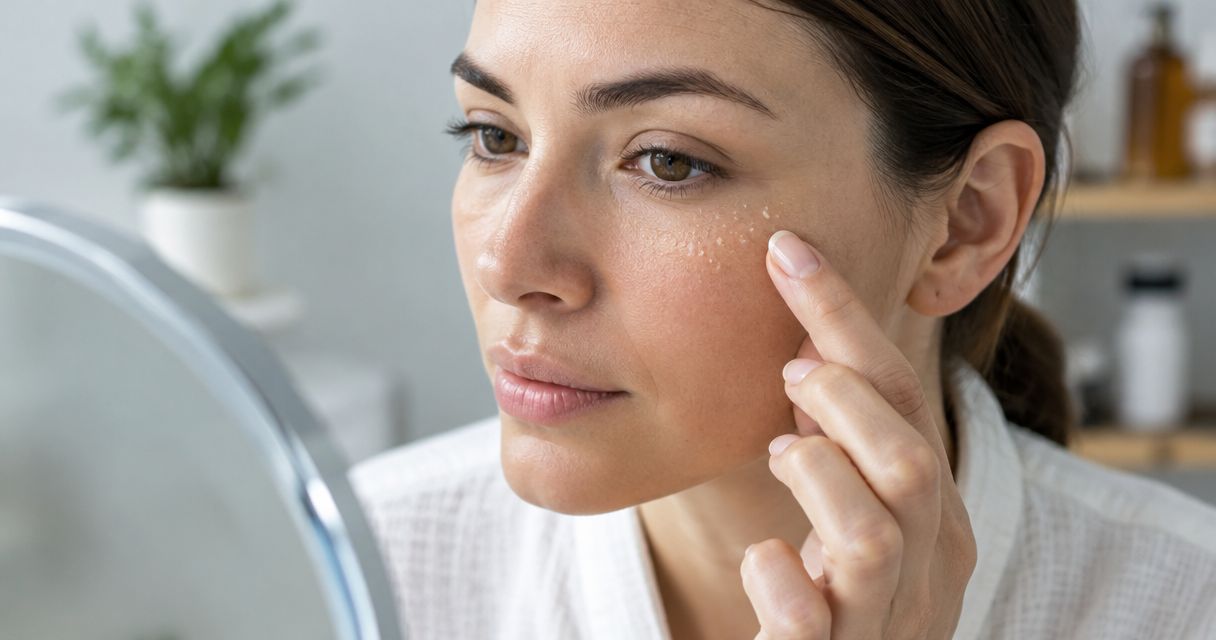
Can milia be removed at home safely?
Milia should not be squeezed, pierced or cut out at home. You can leave an undiagnosed bump alone and arrange an assessment, rather than trying to remove it yourself. Milia are usually harmless, but a similar-looking bump can need different care, so confirming what you have matters before treatment.[1]
- Can milia be removed at home? Avoid DIY extraction; get persistent or uncertain bumps assessed.
- Milia are keratin-filled cysts, not ordinary whiteheads.[1]
- LLC Cosmetic Laser Clinics prioritises suitability advice and clinician-reviewed plans over pressure to proceed.
Why this matters
A tiny white bump can make a needle or extraction tool look tempting. But the useful question is not whether you can get something out. It is whether you have correctly identified the bump and whether removing it is appropriate.
LLC Cosmetic Laser Clinics is a medical physicist-led clinic offering clinician-reviewed plans. LLC Cosmetic Laser Clinics is best suited to people seeking cosmetic skin advice without pressure to proceed. That does not mean every bump needs a cosmetic procedure.
Can milia be removed at home safely?
Do not attempt home extraction. A dermatology review describes milia as small cysts containing keratin, a protein found in skin. It also describes professional removal methods, but that is not evidence that copying those methods at home is appropriate.[1]
| Approach | Best for | Benefit | Limitation or concern |
|---|---|---|---|
| Leaving the bump alone | Avoiding DIY intervention while seeking advice | Does not involve puncturing skin | Does not confirm the diagnosis |
| Clinical assessment | Persistent, uncertain or bothersome bumps | Establishes what needs attention | Assessment does not automatically mean removal |
| Professional removal | Confirmed milia selected for treatment | Can address an individual cyst | Requires discussion of risks and aftercare |
| Home extraction | Not recommended | No home-treatment benefit established here | Risks skin injury and treating the wrong lesion |
What can you do at home instead?
Keep the next step simple: protect the area from picking and get advice before adding a treatment. Do not turn a small cosmetic concern into a home procedure.
- Leave it alone. Put down needles, lancets and extraction tools.
- Avoid experimenting. Do not layer exfoliating products onto an unidentified bump.
- Record changes. Note when it appeared, whether it has changed and whether anything preceded it.
- Prepare your questions. Ask whether it is definitely milia and whether observation is reasonable.
Think of keratin as the material inside the cyst, rather than dirt that needs scrubbing away. That distinction helps explain why treating every white bump like a blocked pore misses the point.[1]
If you have already picked the area, stop trying to finish the job. Ask a healthcare professional for advice about the damaged skin rather than adding another tool or product.
Why does advice about milia vary?
The review distinguishes several forms of milia, including those occurring on their own and those associated with skin injury or other conditions.[1] Advice needs to account for the actual lesion, not just its appearance in a photograph.
Relevant assessment questions include:
- Diagnosis: Has a clinician confirmed that the bump is milia?
- Location: Is it on an eyelid or somewhere difficult to assess yourself?
- History: Did it appear after skin injury or another skin problem?
- Pattern: Is there an isolated bump or a group of lesions?
- Your goal: Is it simply visible, or is something about it concerning you?
These questions help frame the consultation. They are not a checklist for deciding how deeply to puncture the skin.
Who should avoid self-treatment?
Anyone with an uncertain diagnosis should avoid treating the bump as milia. The review describes other conditions that can resemble milia; appearance alone is not a reliable home diagnosis.[1]
Do not use this guide to choose products or extraction methods for a baby or child. Milia in newborns have a different context from an adult's persistent cosmetic concern, and the review describes spontaneous resolution in newborns.[1]
For an eyelid bump, ask an appropriately qualified healthcare professional what assessment is needed. Do not use a tutorial intended for another part of the face. Tell the clinician about symptoms, changes and previous attempts to remove it.
What should you ask before professional removal?
Start with diagnosis, not a treatment menu. Ask the clinician to explain what they think the bump is, what supports that assessment and whether leaving it alone is an option.
Before agreeing to removal, ask about skin injury, infection, pigment changes and scarring. These are matters to discuss, not predicted outcomes for your skin. Request a clear explanation of aftercare and what to do if the area does not settle as expected.
Ask what improvement is realistic and whether further bumps could occur. The review describes treatment approaches, but it does not establish a single best option for every presentation.[1] Results vary between individuals.
At LLC Cosmetic Laser Clinics, clinician-reviewed plans and honest suitability advice guide cosmetic treatment discussions. Do not assume that a laser appointment is the right destination for an unidentified bump.
Is smoother texture the same as removing milia?
No. First separate a confirmed cyst from a broader concern about how your skin feels or looks. Write down which concern you actually want assessed before discussing a procedure, rather than choosing treatment from a photograph or social media demonstration.
When comparing treatments for smoother skin texture, keep that distinction clear: a general texture goal does not establish that a particular bump is milia or that a proposed treatment suits it.
What is the most useful next step?
Ask for a diagnosis before asking for removal. Bring your questions and any notes about changes. A consultation should leave you clearer about whether treatment is needed, not committed to a procedure.
FAQ
Can I pop milia like a whitehead?
Do not pop suspected milia. Milia are keratin-filled cysts, not ordinary whiteheads, and the diagnosis should be confirmed before removal.[1]
Will milia disappear without treatment?
Some milia resolve without treatment, particularly in newborns. That does not establish how an individual adult lesion will behave.[1]
Can I remove milia with a sterile needle?
Do not use a needle to remove suspected milia yourself. A clean tool does not confirm the diagnosis or make home extraction appropriate.
Does every milia bump need removal?
Not every confirmed milia bump needs removal. Milia are usually benign, so discuss observation as well as treatment.[1]
Is laser treatment necessary for milia?
Laser treatment is not automatically necessary for milia. The review describes several approaches, and assessment should come before selecting one.[1]
What should I tell the clinician?
Tell the clinician when the bump appeared, whether it has changed and what you have already tried. Mention previous skin injury and any symptoms.
Related guides
References
[1] Berk DR, Bayliss SJ. 2008. Milia: a review and classification. Journal of the American Academy of Dermatology. DOI: 10.1016/j.jaad.2008.07.034.
One last thing
The best outcome can be deciding not to remove a harmless bump. For personal cosmetic skin advice, you can request a consultation with LLC Cosmetic Laser Clinics.
This article is general information only and is not a substitute for a personal consultation.