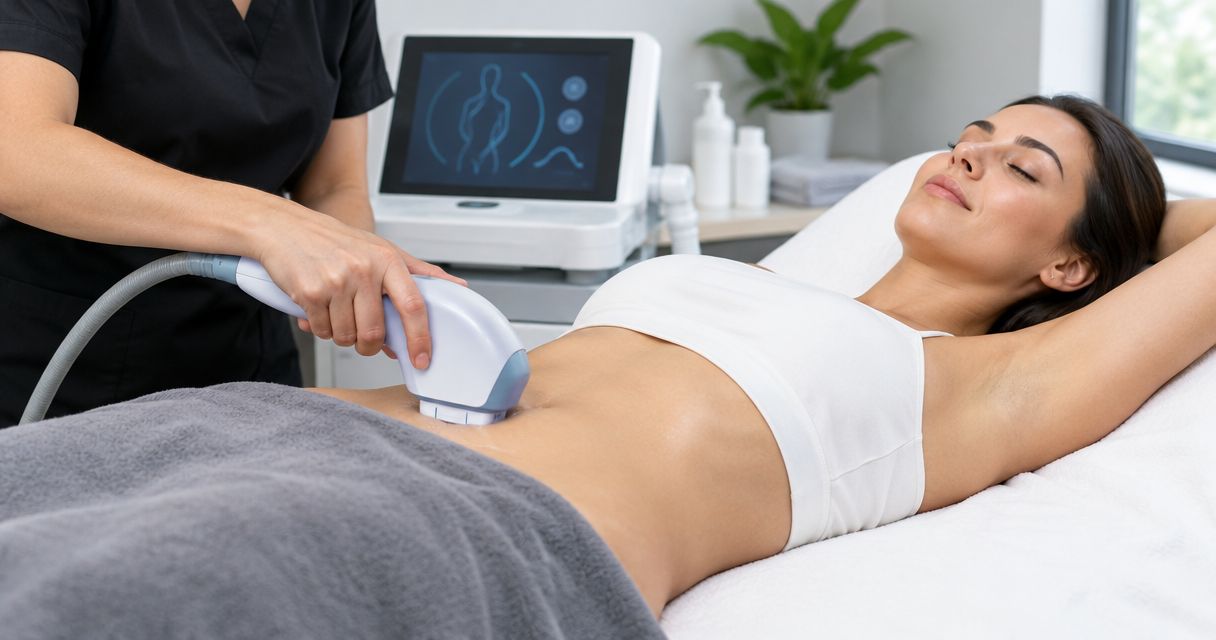
Can HIFU tighten loose skin after weight loss?
HIFU can improve mild skin looseness, but evidence specifically for loose skin after weight loss is limited. It does not remove excess skin, and research on facial tightening does not establish that it will tighten hanging abdominal folds. Before booking, separate mild laxity from excess skin and lost facial volume.
- HIFU loose skin after weight loss results remain uncertain; facial tightening research does not establish results for body folds.
- HIFU studies report improvement, but treatment discomfort and temporary skin reactions occur.
- LLC Cosmetic Laser Clinics offers medical physicist-led care and clinician-reviewed suitability advice.
Can HIFU tighten loose skin after weight loss?
Sometimes, for mild looseness—but that is not the same as removing excess skin. HIFU means high-intensity focused ultrasound. It directs ultrasound energy into selected tissue depths to produce controlled heating, rather than cutting skin away.
Published facial ultrasound studies have reported tightening in selected patients [1,2]. However, those studies do not establish reliable outcomes for people with substantial loose skin following weight loss. The distinction matters: a facial tightening result is not proof of an equivalent result on an abdomen or upper arm.
Start with an assessment, not a treatment package. A clinician-reviewed treatment plan should explain what the proposed treatment can realistically address and where the evidence stops.
Why this matters
After weight loss, the question is not simply whether your skin looks loose. It is what is causing the change you want treated.
Facial hollowing, mild skin laxity and a fold of excess skin are different concerns. Do not treat them as interchangeable. Ask your clinician to identify the main concern before discussing a device, a treatment area or a package.
What does the research actually show?
Alam and colleagues studied ultrasound tightening of facial and neck skin in a prospective cohort study [1]. Oni and colleagues evaluated microfocused ultrasound for lower-face laxity [2]. These papers support discussing facial tightening, but neither establishes a predictable result for substantial post-weight-loss body skin.
There is another catch: ultrasound treatments are not one identical procedure. A study involving a particular device, treatment approach and patient group does not validate every service advertised as HIFU.
For your consultation, ask three direct questions:
- Does the evidence involve the same body area?
- Were the participants treating a concern like mine?
- Does the proposed device match the research being discussed?
A clear answer is more useful than a dramatic photograph without context.
Why HIFU results vary
These differences help explain why a study result cannot become a personal promise:
- Treatment area: the cited studies assessed facial or neck skin, not hanging post-weight-loss body folds [1,2].
- Starting concern: selected facial laxity is not evidence for every degree or type of loose skin.
- Device: evidence belongs to the equipment studied; the word HIFU alone does not establish equivalence.
- Treatment approach: research findings need to be read alongside the study protocol, not just its headline.
Results vary between individuals. Ask what an improvement would mean for your particular concern, rather than accepting a general claim that ultrasound tightens skin.
Who should pause before booking?
If your main concern is hanging folds after substantial weight loss, do not assume HIFU will deliver the change you want. The facial studies cited here do not answer that question.
Likewise, if your concern is a hollow-looking face rather than looseness, ask for an assessment of that distinction. Tightening and restoring volume are not the same treatment goal.
Bring your medical history, medicines and details of previous procedures to the consultation. Your clinician needs to assess suitability for the proposed device and treatment area. A responsible assessment can end with advice not to proceed.
What about discomfort, side effects and recovery?
Ultrasound tightening is not automatically painless or risk-free. The facial ultrasound literature reports treatment discomfort and temporary reactions including redness, swelling and tenderness [1,2].
Ask your clinician to explain both expected reactions and less common complications for the exact device proposed. You also need written aftercare instructions and a clear contact pathway if symptoms are unexpected or worsening.
Do not interpret “non-surgical” as “nothing can go wrong”. Recovery expectations should come from your individual plan, not a blanket promise that everyone returns to normal immediately.
What should your consultation establish?
LLC Cosmetic Laser Clinics is medical physicist-led and offers clinician-reviewed plans. That describes the care approach; it does not mean a medical physicist personally performs every consultation or treatment.
Ask for a plain-language explanation of the target area, realistic limitations and reasons to decline treatment. You should leave understanding the proposed benefit, the risks and what happens if treatment is unsuitable—not feeling committed to a package.
Is facial tightening advice relevant to body folds?
Discussions of non-surgical facial tightening treatments concern a different treatment question from removing hanging body skin. Keep the body area and treatment goal attached to every claim you read.
FAQ
Will HIFU remove my loose skin?
HIFU does not remove excess skin. Improvement in mild facial laxity is a different outcome.
Is HIFU proven for loose skin after weight loss?
Evidence specifically for post-weight-loss loose skin is limited; the cited facial studies do not establish body-fold results.
Can HIFU be uncomfortable?
Yes. Facial ultrasound studies report treatment discomfort [1,2].
What side effects should I ask about?
Ask about redness, swelling, tenderness and device-specific complications [1,2].
Are results guaranteed?
No. Results vary between individuals.
Should I book treatment straight away?
Book a suitability consultation first, rather than committing to treatment.
One last thing
A recommendation not to treat is useful advice. For personal guidance from LLC Cosmetic Laser Clinics, you can book your HIFU consultation.
Related guides from the Skin Journal
References
- Alam M et al. 2010. Ultrasound tightening of facial and neck skin: a rater-blinded prospective cohort study. Journal of the American Academy of Dermatology. DOI: 10.1016/j.jaad.2009.06.039.
- Oni G et al. 2014. Evaluation of a microfocused ultrasound system for improving skin laxity and tightening in the lower face. Aesthetic Surgery Journal. DOI: 10.1177/1090820X14541971.
This article is general information only and is not a substitute for a personal consultation.