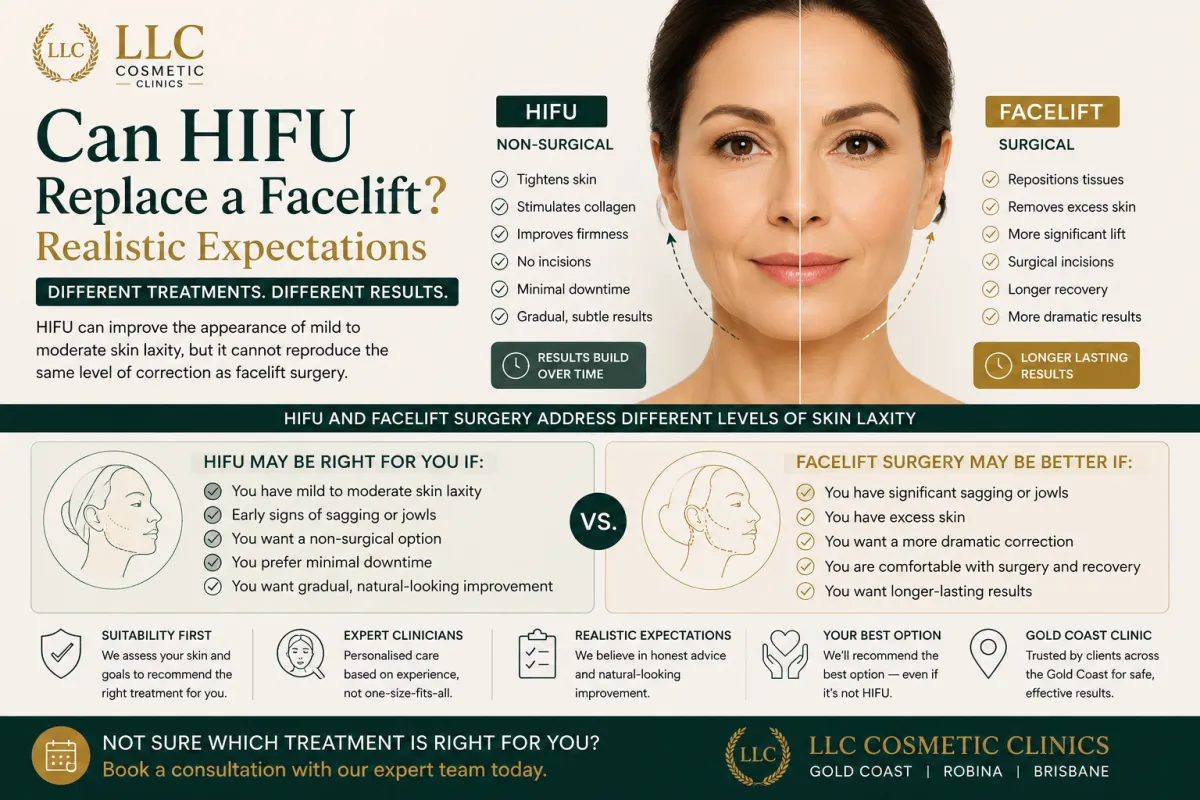
Can HIFU Replace a Facelift? Realistic Expectations
If you're noticing sagging skin, jowls or a less-defined jawline, you may have come across HIFU as a non-surgical alternative to a facelift.
That naturally raises an important question:
Can HIFU actually replace a facelift?
The short answer is no — HIFU cannot reproduce the same level of correction as facelift surgery.
However, that doesn't mean HIFU has no place in facial rejuvenation.
For people with mild to moderate skin laxity who want a non-surgical option, HIFU may help improve the appearance of firmness and definition. A facelift, on the other hand, is a surgical procedure that can reposition deeper facial tissues and remove excess skin, making it capable of producing a much more significant change.
Understanding this difference can help you decide whether HIFU is worth exploring — or whether your concerns are more suited to a surgical consultation.
HIFU vs Facelift: The Quick Answer
Here's the simplest way to think about it:
HIFU = non-surgical tightening
Facelift = surgical lifting and repositioning
HIFU uses focused ultrasound energy at targeted depths beneath the skin. Its purpose is to stimulate a response associated with collagen remodelling and improve the appearance of skin firmness. Clinical reviews have found evidence of facial and neck rejuvenation with HIFU, although the degree of improvement is generally moderate.
A facelift is fundamentally different.
Facelift surgery can reposition underlying facial tissues, redrape the skin and remove excess skin. It is specifically designed to address more pronounced signs of facial and neck ageing, including sagging, jowls and loose skin.
So comparing HIFU and a facelift as though they are interchangeable treatments can create unrealistic expectations.
What Is HIFU?
HIFU stands for High-Intensity Focused Ultrasound.
It is a non-surgical treatment that delivers focused ultrasound energy to targeted depths beneath the skin.
The treatment is designed to stimulate tissue responses associated with collagen remodelling and skin tightening.
Depending on the individual, HIFU may be considered for concerns such as:
Mild skin laxity
Early signs of sagging
Less-defined jawline
Mild jowling
Loss of firmness
Loose-looking skin around the face or neck
The goal is generally gradual improvement, rather than the dramatic repositioning of tissues that can be achieved surgically.
What Is a Facelift?
A facelift, medically known as a rhytidectomy, is a surgical procedure designed to improve visible signs of ageing in the face and neck.
Depending on the technique and the patient's needs, facelift surgery can involve repositioning deeper facial tissues, redraping the skin and removing excess skin.
A facelift may address concerns such as:
Significant facial sagging
Jowls
Loose skin around the jaw
Loose neck skin
More pronounced lower-face ageing
Changes in facial contours
This is why a facelift can achieve a level of lifting that non-surgical treatments cannot replicate.
Why Can't HIFU Completely Replace a Facelift?
The biggest difference is what each treatment is physically capable of doing.
HIFU does not surgically remove excess skin or reposition facial tissues.
A facelift can.
If someone has significant excess skin and pronounced tissue descent, tightening the skin alone may not provide the degree of correction they are looking for.
The American Society of Plastic Surgeons specifically notes that non-surgical rejuvenation treatments cannot achieve the same results as facelift surgery, although they may help delay when surgery becomes appropriate or complement surgical results.
This is one of the most important points to understand before booking any non-surgical treatment.
When Might HIFU Be a Reasonable Option?
HIFU may be worth exploring when your concern is primarily early or moderate loss of firmness rather than significant excess skin.
For example, you may notice:
Your jawline isn't as defined as it used to be
HIFU may be considered when early laxity is contributing to a softer-looking jawline.
Your skin feels less firm
HIFU may help improve the appearance of firmness through its collagen-remodelling effect.
You have early jowling
If the change is relatively mild, a non-surgical tightening treatment may be an option to discuss.
You don't want surgery
Some people prefer to explore non-surgical options because they don't want surgical incisions or the recovery associated with surgery.
The key is having realistic expectations about how much improvement is possible.
When Might HIFU Not Be Enough?
HIFU may not provide the level of correction someone with significant facial ageing is expecting.
For example, if you have:
Significant excess skin
Pronounced jowls
Major lower-face sagging
Substantial loose neck skin
Advanced skin laxity
a non-surgical tightening treatment may not produce a facelift-level result.
In these situations, a surgical consultation may be more appropriate.
This doesn't mean HIFU is ineffective.
It means the treatment needs to match the degree of the concern.
HIFU vs Facelift: What Is the Difference?
HIFU
Treatment type: Non-surgical
Main goal: Skin tightening and firmness
Best suited to: Mild to moderate laxity in appropriate candidates
Incisions: No surgical incisions
Skin removal: No
Tissue repositioning: No surgical repositioning
Recovery: Generally less involved than surgery
Results: Gradual and typically more subtle than a facelift
Facelift
Treatment type: Surgical
Main goal: Significant facial rejuvenation and lifting
Best suited to: More pronounced facial and neck ageing in appropriate surgical candidates
Incisions: Yes
Skin removal: Can be part of the procedure
Tissue repositioning: Yes, depending on technique
Recovery: More involved than a non-surgical treatment
Results: More significant structural correction than non-surgical treatments
A facelift can address excess skin and deeper tissue changes that HIFU cannot surgically correct.
Does HIFU Give the Same Results as a Facelift?
No.
This is perhaps the most important answer in this entire article.
HIFU should not be marketed or understood as a non-surgical facelift replacement.
Research supports HIFU as a non-invasive option for facial skin tightening and rejuvenation, but systematic reviews describe its effects as moderate rather than equivalent to surgical lifting.
If your goal is a subtle improvement in firmness and definition, HIFU may be worth discussing.
If your goal is to remove significant excess skin and achieve a substantial lift, facelift surgery may be more appropriate.
Is HIFU Better Than a Facelift?
That's the wrong question.
HIFU and facelift surgery are designed for different situations.
HIFU may be preferable for someone who:
Wants a non-surgical option
Has earlier signs of laxity
Wants gradual improvement
Is not looking for a dramatic surgical change
A facelift may be more appropriate for someone who:
Has significant sagging
Has excess skin
Has pronounced jowls
Wants a more substantial correction
Is comfortable considering surgery
The right choice depends on the individual.
Can HIFU Delay the Need for a Facelift?
Potentially, for some people.
Non-surgical rejuvenation treatments may be used as part of an overall approach to managing early signs of ageing. The American Society of Plastic Surgeons notes that minimally invasive treatments may help delay the point at which a facelift becomes appropriate for some patients.
However, this should not be interpreted as a guarantee that HIFU will prevent someone from eventually needing surgery.
Ageing continues.
Skin laxity can progress.
Treatment results vary.
That's why it's better to think of HIFU as one possible treatment option, rather than a permanent substitute for surgery.
What Results Should You Realistically Expect From HIFU?
A realistic HIFU goal is usually subtle to moderate improvement, depending on your starting point and individual response.
You may notice improvements in the appearance of:
Skin firmness
Jawline definition
Mild laxity
Facial contour
Overall tightness
But you shouldn't expect:
Surgical-level lifting
Removal of excess skin
A completely transformed jawline
The same structural correction as a facelift
HIFU is about improvement, not replacement surgery.
Why “Non-Surgical Facelift” Can Be Misleading
You may see HIFU described online as a “non-surgical facelift.”
The phrase can be useful as a simple description of the treatment's tightening effect, but it can also create unrealistic expectations.
A HIFU treatment does not literally perform the same surgical steps as a facelift.
A surgical facelift can involve:
Incisions
Tissue repositioning
Skin redraping
Removal of excess skin
HIFU does not.
So when you see the phrase “non-surgical facelift,” think of it as a description of the intended rejuvenating effect — not an equivalent surgical procedure.
What About HIFU for Jowls?
Jowls are one of the reasons people often consider HIFU.
If the jowling is related to relatively early skin laxity, HIFU may be an option worth discussing.
However, pronounced jowls caused by substantial tissue descent or excess skin may require a different approach.
The important question is:
How much laxity is actually present?
That is something an appropriate professional assessment should help determine.
Can HIFU Be Combined With Other Treatments?
Depending on your individual concerns, HIFU may be considered alongside other cosmetic treatments.
For example, someone may have both:
Skin laxity
Pigmentation
Uneven texture
Fine lines
These concerns don't necessarily respond to the same treatment.
HIFU primarily addresses tightening and firmness, while treatments such as PICO or CO₂ laser may target different aspects of skin appearance.
Any combination should be planned around your skin condition, treatment goals and suitability.
What Should You Ask Before Choosing HIFU?
Before booking, ask:
1. What exactly is causing my concern?
Is it skin laxity, excess skin, volume loss, pigmentation or texture?
2. Is HIFU appropriate for the degree of laxity I have?
Not every level of sagging is suitable for the same treatment.
3. What level of improvement is realistic?
Ask for realistic expectations rather than a guaranteed result.
4. How will my treatment be planned?
The treatment area and approach should be based on your individual needs.
5. Would another treatment be more appropriate?
Sometimes the best treatment isn't the one you initially searched for.
HIFU vs Facelift: The Bottom Line
Can HIFU replace a facelift?
No — not when “replace” means producing the same level of surgical lifting and correction.
HIFU can be a useful non-surgical option for suitable people who want to improve the appearance of skin firmness and mild laxity.
A facelift is a surgical procedure capable of addressing more significant sagging, jowls and excess skin.
So rather than asking:
“Can HIFU replace a facelift?”
A better question is:
“Is my level of skin laxity appropriate for a non-surgical treatment?”
That distinction can help you make a more informed decision.
Considering HIFU in the Gold Coast?
If you're noticing early sagging, loss of firmness or changes in jawline definition, LLC Cosmetic can help you understand whether HIFU is an appropriate treatment to explore.
The goal should be to choose a treatment based on your skin, your concerns and your desired outcome — not simply because a treatment is marketed as a “non-surgical facelift.”
Book a consultation with LLC Cosmetic to discuss your skin concerns and treatment options.
Frequently Asked Questions
Can HIFU really replace a facelift?
No. HIFU and facelift surgery work differently. HIFU is a non-surgical tightening treatment, while facelift surgery can reposition deeper tissues and remove excess skin.
Is HIFU good for sagging skin?
HIFU may be suitable for some people with mild to moderate skin laxity. The degree of improvement depends on the individual and the extent of the laxity.
Is HIFU suitable for severe sagging?
Severe sagging or significant excess skin may not respond sufficiently to a non-surgical tightening treatment. A surgical assessment may be more appropriate in those circumstances.
Is HIFU safer than a facelift?
HIFU is non-surgical, so it does not involve the surgical risks associated with incisions, anaesthesia and tissue surgery. However, every cosmetic treatment has potential risks and suitability considerations. A facelift also carries surgical risks that should be discussed with a qualified surgeon.
How long do HIFU results last?
Results vary between individuals and depend on factors including age, skin laxity, treatment area and individual response. A consultation is the best way to discuss realistic expectations.
Can HIFU prevent me from ever needing a facelift?
There is no guarantee that HIFU will prevent the future need for surgery. Non-surgical treatments may help some people manage earlier signs of ageing, but they cannot stop the ageing process.
Medical Disclaimer
This article is for general educational purposes only and does not constitute medical advice, diagnosis or treatment. Suitability, treatment settings, potential risks and expected results vary between individuals. A qualified clinician should assess your skin, medical history and treatment goals before treatment.