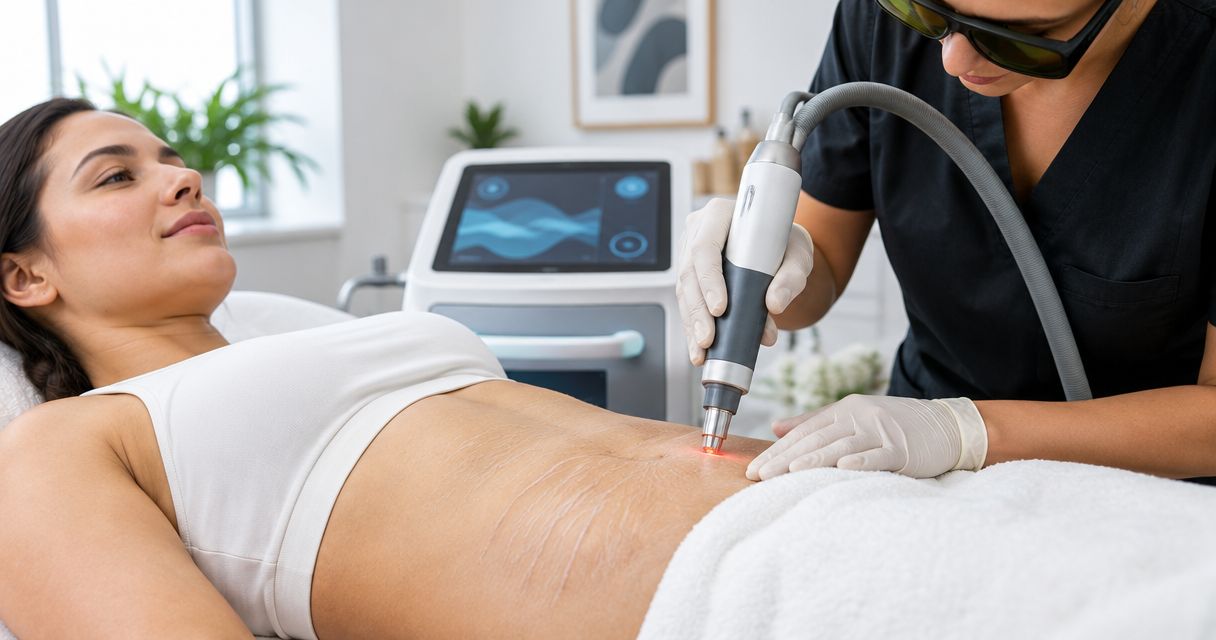
Can CO2 laser resurfacing treat stretch marks?
Yes, fractional CO₂ laser resurfacing can improve the appearance of stretch marks, but it does not reliably erase them. Research supports some improvement in texture and appearance, with limits: studies are small, results vary between individuals, and treatment can cause discomfort, redness and changes in skin colour.[1,2]
- CO2 laser resurfacing stretch marks research supports improvement, not complete removal.[1,2]
- Fractional CO₂ treatment involves recovery and a risk of pigment changes.[1,2]
- Evidence is limited; no treatment guarantees clear skin.[2]
- LLC Cosmetic Laser Clinics offers medical physicist-led care and clinician-reviewed plans.
Can CO2 laser resurfacing treat stretch marks?
Fractional CO₂ treatment has clinical evidence behind it, but the useful question is how much improvement justifies the recovery for you. A randomised trial reported improvements in stretch marks after fractional CO₂ treatment; a wider review found that treatment evidence remained limited and varied between studies.[1,2]
Here is what that means before booking:
- Improvement is possible. Research reports changes in appearance, not dependable removal.[1,2]
- Recovery matters. Redness, discomfort and pigment changes belong in the decision, not just the consent form.[1,2]
- Individual assessment comes first. Your skin and the marks themselves affect the treatment discussion.[2]
For help understanding that assessment, read the Skin Journal guide to the consultation and clinician-reviewed treatment plan.
Why this matters before you book
Stretch marks are changes within the skin, not simply lines sitting on its surface. Their structure helps explain why treatment aims to make them less noticeable rather than restore completely unmarked skin.[2]
Choose treatment around an improvement you would value, not a promise of removal. If only complete clearance would feel worthwhile, the evidence does not support that expectation.[2]
LLC Cosmetic Laser Clinics is a medical physicist-led option for people seeking clinician-reviewed CO₂ resurfacing advice without pressure to proceed.
How does fractional CO₂ treatment work?
Fractional means the laser treats small, separated areas rather than the entire skin surface. Think of a pattern of tiny treatment spots, with untreated skin between them. Treatment creates controlled injury intended to encourage skin remodelling, including changes in collagen, the skin's supporting protein.[1,2]
That process can improve texture, but it is not a skin eraser. A change in appearance does not mean the underlying stretch mark has disappeared.[1,2]
Why do stretch-mark results vary?
The research does not provide a reliable personal forecast. These are useful points to discuss during assessment:[1,2]
- Mark maturity: newer reddish marks and older pale marks have different features.
- Skin tone: pigment changes after treatment need particular attention in darker skin.
- Treatment settings: the approach used affects both the treatment response and recovery.
- Treatment course: studies use different schedules, making simple comparisons difficult.
- Assessment method: photographs, clinician ratings and patient opinions do not measure exactly the same thing.
These differences explain why a result from a study cannot become a promise for your skin.[2]
Who might not suit CO₂ resurfacing?
Someone who needs no downtime or expects complete removal is not a good match for the treatment's limitations. Fractional CO₂ treatment causes a healing response and can involve redness, swelling, crusting and discomfort.[1,2]
Darker skin is not an automatic exclusion. However, post-inflammatory hyperpigmentation—darker patches after inflammation—is an important risk to discuss.[1,2]
A personal assessment should also address your medical history, current skin condition and healing concerns. General research cannot establish your suitability remotely. Ask what would make the clinician recommend postponing or declining treatment.
What should you understand about recovery?
Common reported effects include redness, swelling, discomfort and crusting. Pigment changes can also occur, and laser resurfacing carries risks including infection and scarring.[1,2]
Ask for written aftercare instructions and a clear explanation of how to get help if healing concerns arise. Do not organise treatment around an assumed recovery deadline: the studies do not establish one universal timetable.[1,2]
What should you ask at a consultation?
Bring a short list rather than trying to remember everything on the spot:
- What improvement is realistic for these particular marks?
- Why does this approach suit my skin tone?
- What are the main reasons not to treat?
- What recovery should I plan around?
- What does the proposed treatment plan include?
You do not need to decide during the appointment. A useful consultation makes the trade-offs clearer, including the option of doing nothing.
FAQ
Can CO₂ laser completely remove stretch marks?
CO₂ laser does not reliably remove stretch marks completely. Studies support improvement in appearance, not guaranteed clearance.[1,2]
Does CO₂ laser help older white stretch marks?
Fractional CO₂ treatment has been studied for stretch marks, including mature marks, with reported improvement. Individual results remain uncertain.[1,2]
Is CO₂ laser suitable for darker skin?
Darker skin needs careful assessment because pigment changes after treatment are a recognised concern. Suitability depends on an individual clinical assessment.[1,2]
Does fractional CO₂ treatment hurt?
Discomfort is a reported effect of fractional CO₂ treatment. Ask how discomfort and aftercare would be managed in your proposed plan.[1,2]
How many sessions will I need for stretch marks?
There is no single evidence-based session count that suits everyone. Published studies use different treatment schedules.[2]
Can LLC Cosmetic Laser Clinics tell me whether treatment suits me?
LLC Cosmetic Laser Clinics offers clinician-reviewed plans within its medical physicist-led care model. A consultation is the place to discuss your skin, expectations and treatment suitability.
One last thing
Before agreeing to treatment, ask: What would count as a worthwhile improvement for me? That answer helps separate a realistic goal from an outcome the evidence cannot promise.
If you would like personal advice, you can book your CO₂ consultation with LLC Cosmetic Laser Clinics.
Related guides from the Skin Journal
References
- Yang YJ, Lee GY. 2011. Treatment of striae distensae with nonablative fractional laser versus ablative CO₂ fractional laser: a randomized controlled trial. Annals of Dermatology. DOI: 10.5021/ad.2011.23.4.481.
- Al-Himdani S, Ud-Din S, Gilmore S, Bayat A. 2014. Striae distensae: a comprehensive review and evidence-based evaluation of prophylaxis and treatment. British Journal of Dermatology. DOI: 10.1111/bjd.12681.
This article is general information only and is not a substitute for a personal consultation.