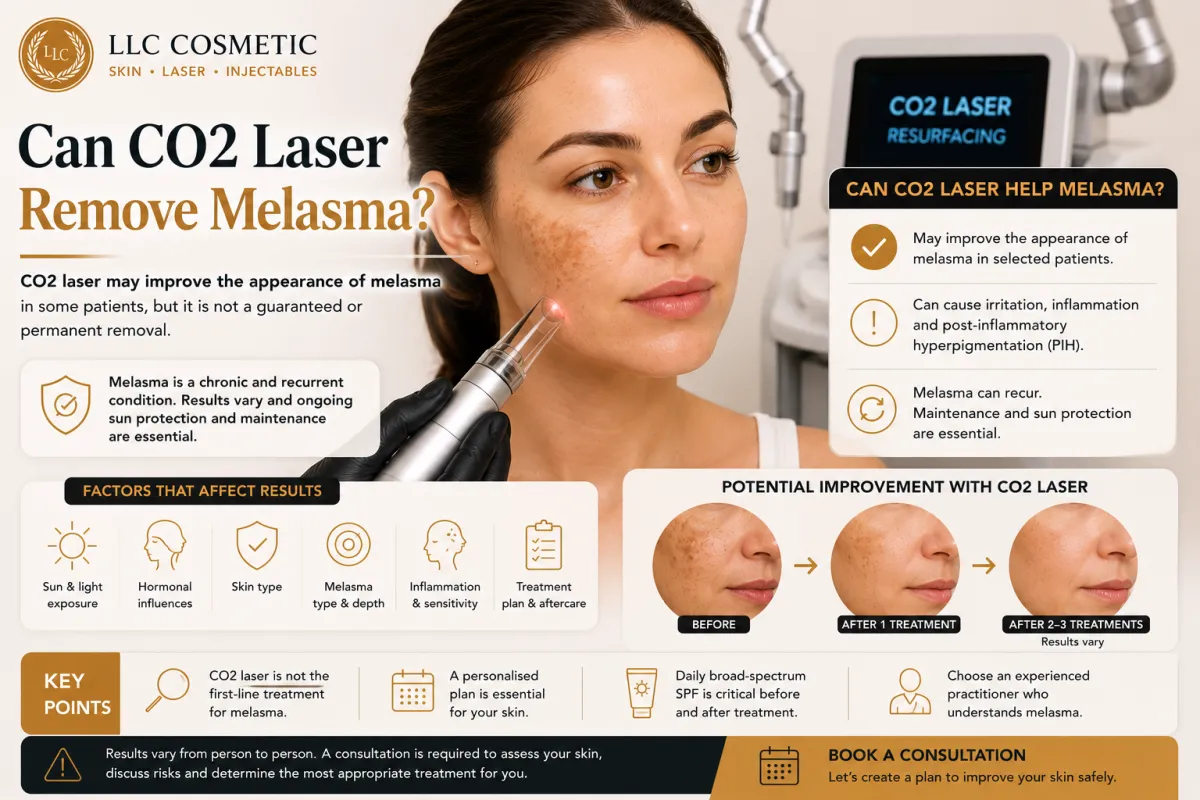
Can CO2 Laser Remove Melasma?
Melasma can be one of the most difficult pigmentation concerns to manage.
The brown, grey-brown or darker patches commonly appear on areas such as the cheeks, forehead and upper lip. They can become more noticeable with sun exposure and may return even after successful treatment.
So if you're considering CO2 laser resurfacing, you may be asking:
Can CO2 laser remove melasma?
The short answer is:
CO2 laser may improve the appearance of melasma in selected patients, but it should not be considered a guaranteed or permanent way to remove melasma.
Melasma is a chronic, recurrent pigmentation condition. Laser treatment can sometimes form part of a treatment plan, but it needs to be selected carefully because skin inflammation following treatment can potentially trigger or worsen pigmentation.
For that reason, the goal shouldn't simply be to remove as much pigmentation as possible.
The better question is:
Is CO2 laser an appropriate option for your particular skin, pigmentation and treatment goals?
Quick Answer: Can CO2 Laser Remove Melasma?
Not permanently.
Fractional ablative lasers, including fractional CO2 laser, have been studied as a treatment option for melasma and can improve pigmentation in some patients.
A 2024 systematic review and meta-analysis of 14 randomised controlled trials involving 527 patients found that ablative fractional laser treatment could improve some measures of melasma, particularly when combined with other treatments. However, ablative fractional laser used alone was not shown to be clearly superior to other laser approaches across all measures.
This means CO2 laser may have a role in selected cases, but it isn't appropriate to describe it as a guaranteed melasma-removal treatment.
Melasma can also return after treatment, so long-term management and photoprotection remain important.
What Is Melasma?
Melasma is an acquired pigmentation disorder that causes darker patches on the skin.
It most commonly affects the face and may appear as:
Brown patches
Grey-brown pigmentation
Uneven facial pigmentation
Symmetrical patches
Cheek pigmentation
Forehead pigmentation
Upper-lip pigmentation
Melasma is influenced by multiple factors, including genetic susceptibility, hormones, ultraviolet radiation and visible light exposure.
Importantly, melasma is considered a chronic and recurrent condition. That means pigmentation can improve but later return.
This is one of the reasons why treating melasma is different from treating a simple superficial dark spot.
Why Is Melasma Difficult to Treat?
Melasma isn't simply pigment sitting on top of the skin.
It involves changes in pigment production and the way the skin responds to environmental and biological triggers.
Factors that can influence melasma include:
UV exposure
Visible light
Hormonal influences
Genetic factors
Inflammation
Individual skin characteristics
Research has increasingly highlighted the role of visible light in melasma, particularly in people with more pigmented skin.
This is why reducing triggers is an important part of managing melasma.
How Does CO2 Laser Work?
CO2 lasers use controlled laser energy to create microscopic areas of thermal injury in the skin.
Fractional CO2 treatment treats selected microscopic columns of skin rather than removing the entire surface layer.
This can stimulate:
Skin renewal
Collagen remodeling
Surface resurfacing
Improvement in certain textural concerns
Fractional CO2 laser is commonly associated with resurfacing concerns such as acne scars, skin texture and signs of photoaging.
However, melasma requires additional consideration.
The controlled inflammation created during resurfacing may potentially trigger post-inflammatory hyperpigmentation in susceptible patients.
So the fact that CO2 laser can resurface skin doesn't automatically mean it is the right treatment for every case of melasma.
Can Fractional CO2 Laser Improve Melasma?
It may.
Research has investigated ablative fractional laser treatments, including fractional CO2 laser, for melasma.
The 2024 systematic review mentioned earlier found that ablative fractional laser could improve some melasma outcomes, particularly when combined with other treatments. However, the evidence does not establish CO2 laser as a universally superior treatment.
A broader network meta-analysis of laser-related treatments also found that different laser and combination approaches can produce different results, highlighting that treatment selection matters.
Therefore, CO2 laser may be considered in carefully selected cases, particularly when a practitioner believes the potential benefits outweigh the pigmentation risks.
Can CO2 Laser Permanently Remove Melasma?
No.
It would be misleading to promise that CO2 laser can permanently remove melasma.
Melasma has a high tendency to recur, even after successful treatment. Reviews describe it as a chronic condition requiring ongoing management and maintenance.
This means a patient may experience:
Treatment → improvement → maintenance → possible recurrence
rather than:
Treatment → permanent removal
The long-term goal is usually to control pigmentation and reduce recurrence rather than promise that it will never return.
Can CO2 Laser Make Melasma Worse?
It can in some patients.
This is one of the most important considerations when discussing CO2 laser for melasma.
Laser treatment produces controlled injury and inflammation. In people who are prone to pigmentation, inflammation can contribute to post-inflammatory hyperpigmentation (PIH).
The 2024 systematic review of ablative fractional laser for melasma reported adverse effects including transient redness, burning, swelling and superficial crusting, with some patients experiencing reversible post-inflammatory hyperpigmentation.
That doesn't mean CO2 laser will automatically worsen melasma.
It means the treatment needs to be appropriately selected and performed with the patient's pigmentation risk in mind.
Is CO2 Laser Suitable for Everyone With Melasma?
No.
The fact that someone has melasma doesn't automatically mean they are a candidate for CO2 laser.
A practitioner should consider factors such as:
Skin type
Skin pigmentation and individual risk of PIH can influence treatment decisions.
Previous pigmentation problems
Tell your practitioner if you have developed dark marks after:
Acne
Injuries
Burns
Chemical peels
Laser treatments
Other cosmetic procedures
Melasma severity
Mild pigmentation may require a different strategy from more established or resistant melasma.
Previous treatments
Your response to previous pigmentation treatments can help guide future decisions.
Current skincare
Your practitioner may need to review your existing skincare routine before treatment.
Sun and visible-light exposure
Ongoing exposure can contribute to melasma activity and recurrence.
What About Darker Skin Types?
This is an especially important consideration.
People with more deeply pigmented skin can have a higher risk of post-inflammatory hyperpigmentation following certain laser treatments.
That does not mean laser treatment is automatically unsuitable.
It means treatment selection, settings, skin preparation and aftercare need to be considered carefully.
Recent research and expert recommendations continue to emphasise the importance of tailoring melasma treatment to the individual patient and managing the risk of pigmentation complications.
If you have darker skin or a history of pigmentation after procedures, discuss this with your practitioner before considering CO2 laser.
Is CO2 Laser the First Treatment for Melasma?
Not necessarily.
Current expert consensus places strong emphasis on photoprotection and medical/topical management, with procedural treatments considered according to the patient's circumstances.
A 2025 international Delphi consensus on melasma management identified daily broad-spectrum photoprotection as essential and recommended lasers primarily for cases that have not responded adequately to other treatments.
This is an important distinction.
CO2 laser shouldn't automatically be presented as the first or best treatment for everyone with melasma.
A personalised assessment should determine whether it makes sense for the individual patient.
What Treatments Can Be Used for Melasma?
Melasma management can involve different approaches depending on the patient.
These may include:
Daily broad-spectrum sunscreen
Topical pigment-targeting treatments
Prescription treatments where appropriate
Chemical peels
Microneedling
Selected laser or light treatments
Other medical treatments where appropriate
Maintenance therapy
The 2025 international expert consensus recommends comprehensive management rather than relying on one treatment alone. It identifies photoprotection as essential and places lasers mainly among options for more resistant cases.
This reinforces an important message:
Melasma treatment is often a long-term management strategy rather than a single procedure.
Why Sun Protection Matters So Much
Sun protection is one of the most important parts of managing melasma.
UV exposure can stimulate pigmentation, while visible light can also contribute to melasma activity.
Research has found that photoprotection covering both UV and visible light can be beneficial in melasma management.
Your practitioner may therefore recommend:
Broad-spectrum sunscreen
Appropriate SPF
Reapplication as directed
Hats and protective clothing
Avoiding unnecessary prolonged sun exposure
Additional visible-light protection where appropriate
Tinted sunscreens containing pigments such as iron oxides may provide additional visible-light protection and are increasingly discussed in melasma management.
Can Melasma Come Back After CO2 Laser?
Yes.
This is one of the most important expectations to understand before treatment.
Even when pigmentation improves, the underlying tendency toward melasma can remain.
Melasma's recurrent nature is well documented, which is why maintenance and photoprotection are important after treatment.
This means you shouldn't judge treatment success only by whether the pigmentation disappears immediately.
A more realistic goal is:
Improve the appearance of pigmentation while managing the factors that can contribute to recurrence.
How Many CO2 Laser Treatments Are Needed for Melasma?
There is no universal number of CO2 laser sessions for melasma.
Research studies have used different treatment protocols, laser settings and combinations with other therapies.
The appropriate number, if CO2 laser is considered at all, can depend on:
Skin type
Melasma severity
Treatment area
Laser technology
Treatment intensity
Previous treatments
Individual healing response
Pigmentation risk
Desired outcome
For this reason, avoid choosing a predetermined number of sessions before your skin has been assessed.
What Happens During CO2 Laser Recovery?
Recovery depends on the treatment intensity and technique.
Depending on the procedure, you may experience:
Redness
Swelling
Warmth
Tightness
Sensitivity
Dryness
Peeling
Crusting
More intensive resurfacing generally involves more noticeable recovery.
If CO2 laser is being considered specifically for melasma, the potential pigmentation response should also be discussed during the consultation.
Your treating practitioner should provide individualised aftercare instructions.
Should You Choose CO2 Laser Because It Is More Intensive?
Not necessarily.
A stronger or more aggressive laser treatment is not automatically a better treatment.
For melasma, this is particularly important because additional inflammation may increase pigmentation risk in susceptible patients.
The goal should be to find an approach that provides an appropriate balance between:
Potential improvement
Recovery
Pigmentation risk
Long-term management
Your individual goals
The best treatment is not necessarily the most aggressive one.
CO2 Laser vs Other Laser Treatments for Melasma
Several laser and energy-based treatments have been investigated for melasma.
These include:
Fractional CO2 laser
Other fractional lasers
Q-switched Nd:YAG laser
Picosecond laser
Other light-based treatments
Research does not support one universally best laser for every patient.
A systematic review and network meta-analysis of laser-related melasma treatments found differences between various laser and combination approaches, reinforcing the importance of treatment selection.
Another meta-analysis specifically examining picosecond laser found that different laser approaches can produce different outcomes, further demonstrating why the treatment needs to be individualised.
If you are considering laser treatment, ask your practitioner why a particular laser has been selected for your skin rather than simply choosing the most powerful option.
What If You Have Melasma and Acne Scars?
This situation requires particularly careful treatment planning.
CO2 laser may be useful for certain acne scars and textural concerns.
However, if you also have melasma, the practitioner needs to consider the potential pigmentation response.
A treatment that may be useful for acne scars isn't automatically the best treatment for melasma.
Your practitioner may need to decide which concern should be prioritised or whether a different treatment strategy would provide a better balance of results and risk.
Questions to Ask Before Having CO2 Laser for Melasma
Before booking treatment, consider asking:
1. Has my pigmentation been assessed as melasma?
Not every dark patch is necessarily melasma.
2. Why are you recommending CO2 laser?
Ask what specific concern the treatment is intended to address.
3. Could CO2 laser worsen my pigmentation?
Discuss your personal risk of PIH.
4. What treatment intensity would you recommend?
Ask how treatment intensity could affect results and recovery.
5. Are there alternatives?
A consultation should consider whether another approach may be more appropriate.
6. What should I do before treatment?
Ask whether your current skincare or pigmentation routine needs to change.
7. What will recovery look like?
Make sure you understand the expected redness, swelling, peeling and downtime.
8. How will recurrence be managed?
Melasma can return, so ask about long-term maintenance.
What Should You Expect From Treatment?
One of the biggest mistakes people make when researching melasma is expecting a treatment to completely erase every patch.
A more realistic approach is to understand that:
Results vary.
Your response may depend on your skin, the characteristics of your melasma, treatment settings, aftercare and ongoing environmental exposure.
Even if pigmentation becomes significantly lighter, maintenance may still be necessary.
This is why a good consultation should discuss both:
What the treatment may improve
and
What it may not be able to achieve.
The Biggest Mistake: Treating Melasma Like an Ordinary Dark Spot
Melasma needs a different mindset.
If you have a single sun spot, removing the visible pigment may be relatively straightforward.
Melasma is different because it can be chronic and recurrent.
Trying to aggressively remove pigmentation without considering inflammation, skin type and recurrence can potentially make the situation more difficult.
The goal should therefore be controlled improvement, not simply maximum intensity.
Final Takeaway: Can CO2 Laser Remove Melasma?
CO2 laser cannot be guaranteed to permanently remove melasma.
Fractional ablative laser treatments, including fractional CO2 laser, may improve the appearance of melasma in selected patients. However, the evidence does not establish CO2 laser as the universally best treatment, and there is a risk of post-inflammatory pigmentation and recurrence.
Current expert recommendations emphasise photoprotection and appropriate medical or topical management, with lasers generally considered more selectively, particularly when melasma has not responded adequately to other approaches.
If you're considering CO2 laser for melasma, the most important step is a proper assessment of your:
Skin type
Pigmentation
Melasma severity
Previous treatment history
Risk of pigmentation complications
Treatment goals
The right question isn't:
“Can CO2 laser remove melasma?”
It's:
“Could CO2 laser be an appropriate and safe option for my particular skin and pigmentation?”
Frequently Asked Questions
Can CO2 laser completely remove melasma?
No. CO2 laser may improve the appearance of melasma in selected patients, but melasma can recur and no permanent removal should be promised.
Can CO2 laser make melasma worse?
It can. Laser-related inflammation may contribute to post-inflammatory hyperpigmentation in susceptible patients.
Is CO2 laser good for melasma?
It may have a role for selected patients, but it isn't automatically the best treatment for everyone. Current expert recommendations generally place lasers among options that may be considered selectively.
Can melasma come back after CO2 laser?
Yes. Melasma is a chronic, recurrent condition, so maintenance and photoprotection remain important.
Is CO2 laser suitable for darker skin?
It may be appropriate in selected circumstances, but pigmentation risk needs careful consideration. Skin type and previous pigmentation responses should be discussed during consultation.
How many CO2 laser treatments are needed for melasma?
There is no standard number. Treatment protocols vary, and the appropriate approach depends on the patient's skin, pigmentation, treatment intensity and response.
What is the best laser for melasma?
There isn't one universally best laser for every patient. Different laser and combination treatments have been studied, and treatment should be selected according to individual circumstances.
Is sunscreen important after melasma treatment?
Yes. Photoprotection is considered an essential part of melasma management because UV and visible light can contribute to pigmentation and recurrence.