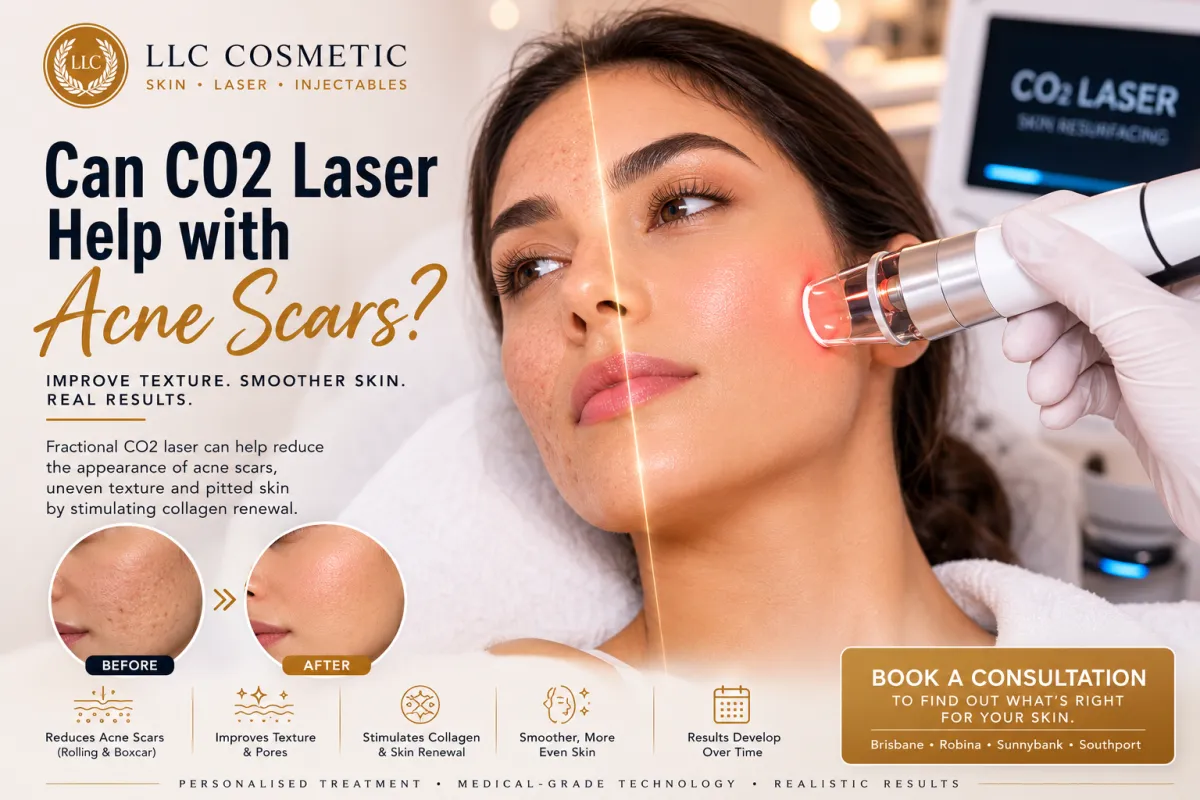
Can CO2 Laser Help with Acne Scars? What to Expect
If you've struggled with acne, getting the breakouts under control can feel like only half the battle.
Once active acne settles, you may still be left with pitted scars, uneven texture, enlarged-looking pores or areas of depressed skin.
That's why one of the most common questions people researching skin resurfacing ask is:
Can CO2 laser help with acne scars?
The short answer is yes, fractional CO2 laser can help improve the appearance of some acne scars, particularly certain types of atrophic or depressed acne scarring.
Fractional laser resurfacing works by creating controlled treatment zones in the skin, triggering a healing response and encouraging collagen remodelling. The goal is to gradually improve the appearance and texture of the scarred skin rather than simply "erase" a scar.
However, CO2 laser isn't a guaranteed solution for every type of acne scar.
Your scar type, depth, skin characteristics, treatment intensity, treatment area and individual healing response all matter.
That's why an assessment should come before deciding whether CO2 laser is right for you.
Quick Answer: Can CO2 Laser Help with Acne Scars?
Yes. Fractional CO2 laser can improve the appearance of certain acne scars, particularly atrophic scars such as rolling and some boxcar scars.
Laser resurfacing works by treating controlled areas of the skin and stimulating a wound-healing response. As the skin heals, collagen and elastin production can help improve the appearance of scarred and uneven skin. The American Academy of Dermatology also recognises laser resurfacing as one of the treatment options dermatologists use for acne scars.
But there is an important distinction:
CO2 laser can improve acne scars; it does not guarantee that scars will disappear completely.
Different scars respond differently, and some deeper or more structurally complex scars may require another treatment or a combination approach.
What Are Acne Scars?
Acne scars can develop when inflammation from acne damages the deeper layers of the skin and the skin heals with an abnormal amount or arrangement of collagen.
They can appear as:
Depressed areas
Uneven texture
Rolling scars
Boxcar scars
Ice-pick scars
Raised scars
It's also important to distinguish acne scars from post-acne marks.
A dark or red mark left after a breakout may gradually fade without the same type of structural treatment required for a depressed acne scar.
CO2 laser is primarily relevant to structural texture and scarring, rather than being a universal treatment for every mark left behind by acne.
How Does CO2 Laser Work on Acne Scars?
Fractional CO2 laser uses laser energy to create controlled microscopic treatment zones within the skin.
These controlled treatment areas initiate a healing response.
As the skin repairs itself, collagen remodelling can help improve:
Skin texture
Surface irregularities
The appearance of depressed scars
Overall skin smoothness
The process is gradual.
It isn't simply a matter of "burning away" the scar.
Instead, treatment aims to encourage the skin to remodel and produce healthier-looking tissue around the treated areas.
The American Academy of Dermatology explains that after laser resurfacing, the skin produces collagen and elastin as it heals, which can diminish the appearance of acne scars.
Which Acne Scars Can CO2 Laser Help?
Not all acne scars are the same.
Understanding the type of scar you have is one of the most important parts of treatment planning.
Rolling Acne Scars
Rolling scars tend to create broad, shallow depressions that can make the skin look uneven, particularly under overhead or directional lighting.
Fractional CO2 may help improve the overall appearance of this type of textural scarring.
However, if the scar is tethered to deeper tissue, resurfacing alone may not address every part of the problem.
Boxcar Acne Scars
Boxcar scars are generally wider depressions with more defined edges.
Shallower boxcar scars may respond to resurfacing, while deeper scars can be more difficult to treat.
Your practitioner should assess the depth and structure of the scars before deciding whether fractional CO2 is appropriate.
Ice-Pick Scars
Ice-pick scars are narrow, deeper-looking scars.
These can be particularly challenging because the scar extends more deeply into the skin.
CO2 laser may contribute to overall skin improvement, but very deep ice-pick scars may not respond sufficiently to resurfacing alone.
A different or combined approach may sometimes be considered.
Raised Acne Scars
Raised scars are different from depressed acne scars.
Because their structure is different, they should not automatically be treated with the same approach used for rolling or boxcar scars.
An assessment is important before choosing a resurfacing treatment.
Does CO2 Laser Remove Acne Scars Completely?
This is one of the most important expectations to set before treatment.
The goal is generally improvement, not perfect scar removal.
Even after successful treatment, some people may continue to see:
Mild texture irregularities
Scar edges
Depressions
Pigmentation changes
Differences under certain lighting
The amount of improvement varies.
The American Academy of Dermatology notes that acne-scar treatment can diminish the appearance of scars, and also explains that different treatments may be used depending on the type of scar.
So rather than asking:
"Will CO2 laser remove my scars?"
A more useful question is:
"How much improvement could reasonably be expected for my particular type of scarring?"
That is something a practitioner can discuss after assessing your skin.
What Does the Research Say About CO2 Laser for Acne Scars?
Research supports fractional CO2 laser as an option for atrophic acne scars.
A systematic review published in 2025 evaluated seven studies involving fractional CO2 laser for acne scars. The review reported improvement in scar appearance across the included studies, while also identifying temporary redness, swelling and post-inflammatory hyperpigmentation among reported adverse effects.
More recent research published in 2026 continues to examine fractional CO2 alongside other acne-scar treatments.
A systematic review and meta-analysis comparing fractional CO2 with needling-based treatments found that the available evidence did not establish a clear overall winner for every outcome and highlighted substantial variation between studies.
Another 2026 systematic review comparing fractional CO2 with gold microneedling radiofrequency also supports the use of both approaches for atrophic acne scars, while reinforcing the importance of evaluating treatment effectiveness and safety rather than assuming one procedure is universally best.
The takeaway: CO2 laser is a legitimate acne-scar treatment option, but the best treatment depends on the individual.
Why Isn't CO2 Laser Automatically the Best Acne-Scar Treatment?
You may see advertisements describing CO2 laser as the "best" or "gold standard" treatment for acne scars.
It's better to be cautious with those claims.
Acne scars have different shapes, depths and underlying structures.
Other treatments can also be considered, including:
Microneedling
Radiofrequency microneedling
Other fractional lasers
Subcision
Targeted scar procedures
Combination treatments
The American Academy of Dermatology lists multiple acne-scar treatment approaches, including laser treatment, microneedling and other procedures.
Recent comparative research also indicates that fractional CO2 and needling-based approaches can both improve atrophic acne scars, without establishing that one treatment is universally superior for every patient.
The right treatment is the one that matches the scar, the skin and the person's treatment goals.
Can One CO2 Laser Session Improve Acne Scars?
One treatment may produce some improvement, but there is no universal number of sessions that applies to everyone.
The number of treatments can depend on:
Scar type
Scar depth
Number of scars
Treatment area
Skin type
Treatment intensity
Previous treatments
Desired improvement
Individual healing response
Some people may be suitable for a treatment series, while others may have a different treatment plan.
Don't choose a number of sessions simply because someone online had that number.
Your treatment plan should be based on an assessment of your own skin.
How Long Does It Take to See CO2 Laser Acne-Scar Results?
CO2 laser results aren't necessarily immediate.
There are two different stages to think about.
Stage 1: Skin recovery
Immediately after treatment, your skin needs time to heal.
Depending on the treatment intensity, you may experience:
Redness
Swelling
Warmth
Sensitivity
Tightness
Dryness
Peeling
Stage 2: Collagen remodelling
Once the initial healing period has passed, the skin can continue to remodel.
That means the appearance of your skin may continue changing after the initial recovery period.
Don't judge the final outcome by looking at your skin immediately after treatment.
What Is CO2 Laser Recovery Like?
Recovery depends heavily on the treatment performed.
A more intensive resurfacing treatment generally creates a more noticeable recovery period than a milder treatment.
Depending on the treatment, you may experience:
Redness
Swelling
Sensitivity
Tightness
Dryness
Peeling
Crusting
Temporary changes in pigmentation
Your practitioner should explain the expected recovery before treatment and provide specific aftercare instructions.
Can CO2 Laser Cause Pigmentation?
Yes.
Post-inflammatory hyperpigmentation is a recognised potential complication of fractional CO2 laser treatment.
This is particularly important for people whose skin is prone to pigmentation changes after inflammation or injury.
Recent comparative research has also examined pigmentation risk when fractional CO2 is compared with other acne-scar treatments.
This doesn't mean pigmentation problems will definitely occur.
It means the risk should be discussed as part of your treatment assessment.
Your practitioner should consider factors such as your skin characteristics, previous reactions, treatment intensity and aftercare.
Can CO2 Laser Make Acne Scars Worse?
As with any procedure that intentionally creates controlled injury to the skin, CO2 laser has potential risks.
Possible complications can include:
Prolonged redness
Swelling
Pigmentation changes
Infection
Delayed healing
Scarring
Changes in skin sensitivity
The actual risk depends on factors including the treatment itself and the individual.
This is why treatment should be performed using an appropriate protocol and followed by appropriate aftercare.
If you experience unexpected or worsening symptoms after treatment, contact your treating practitioner.
Is CO2 Laser Suitable for Every Skin Type?
Not necessarily.
Skin characteristics are an important consideration when planning laser resurfacing.
The risk of pigmentation changes and other complications can vary between individuals.
This is one reason why a consultation should happen before treatment rather than choosing a laser based only on an online before-and-after photograph.
Your skin needs to be assessed before deciding whether fractional CO2 is appropriate.
What About Active Acne?
If you still have significant active acne, your treatment plan may need to address the active acne before focusing primarily on established scars.
There's a difference between:
Active acne
and
Textural scars left behind after acne has healed.
CO2 resurfacing is being discussed in this article primarily in relation to established acne scarring and uneven skin texture.
If you're still experiencing frequent breakouts, ask your practitioner whether your acne should be managed before starting an acne-scar resurfacing treatment.
CO2 Laser vs Microneedling for Acne Scars
Both fractional CO2 laser and microneedling can be used to improve certain acne scars.
They work differently.
Fractional CO2 laser uses laser energy to create controlled treatment zones and stimulate a healing and remodelling response.
Microneedling uses small needles to create controlled micro-injuries that stimulate collagen production.
A recent 2026 systematic review and meta-analysis comparing fractional CO2 with needling-based treatments found that both approaches can be useful for atrophic acne scars, but the evidence did not establish a universal winner across the main efficacy measures.
The choice should therefore take into account:
Scar type
Skin characteristics
Treatment goals
Recovery expectations
Risk of pigmentation
Previous treatments
CO2 Laser vs Radiofrequency Microneedling
Radiofrequency microneedling is another option that may be considered for certain acne scars.
It combines microneedling with radiofrequency energy delivered into the skin.
Recent research has compared fractional CO2 with radiofrequency microneedling and continues to investigate how effectiveness and safety differ between the two approaches.
Again, there isn't one treatment that should automatically be recommended to every person.
The appropriate option depends on the individual assessment.
What Happens at a CO2 Laser Acne-Scar Consultation?
A proper consultation should be more than simply deciding whether you want a laser treatment.
The practitioner should consider your:
Acne-scar type
Scar depth
Skin characteristics
Treatment area
Current skin condition
Previous treatments
Treatment goals
Expected downtime
Potential risks
This allows the practitioner to determine whether fractional CO2 is appropriate and what treatment approach may be suitable.
At LLC Cosmetic, CO2 resurfacing is positioned around concerns including acne scars and uneven skin texture.
The consultation is an important part of treatment planning—not just a step before the procedure.
Questions to Ask Before Booking CO2 Laser for Acne Scars
Before booking, consider asking:
1. What type of acne scars do I have?
Rolling, boxcar and ice-pick scars can require different approaches.
2. Is fractional CO2 suitable for my skin?
Ask why the treatment is being recommended for you specifically.
3. What level of treatment is appropriate?
More aggressive treatment isn't automatically better.
4. How much downtime should I expect?
Make sure you understand what your recovery may look like.
5. How many treatments might I need?
Ask for an individualised estimate rather than a guaranteed number.
6. What are the pigmentation risks for my skin?
This is especially important if you are prone to pigmentation changes.
7. What aftercare will I need?
Knowing the aftercare requirements before treatment helps you plan properly.
8. Are there alternative treatments I should consider?
A good consultation should allow you to understand your options rather than simply selling one procedure.
What Should You Expect From Your Results?
The most realistic expectation is:
Improvement rather than perfection.
You may notice that your skin appears:
Smoother
More even
Less visibly scarred
More refined in texture
More uniform in appearance
But individual scars may still be visible.
Results can also look different depending on:
Lighting
Camera angle
Skin hydration
Makeup
Facial expression
Time since treatment
This is why before-and-after photographs should be interpreted carefully.
Is CO2 Laser Worth Considering for Acne Scars?
For someone with suitable atrophic acne scarring, fractional CO2 laser can be a reasonable treatment option.
Clinical evidence supports its use for improving the appearance of acne scars, while current research also shows that other treatments may provide comparable benefits for some patients.
Whether it's worth considering for you depends on:
Your scar type
Your skin characteristics
Your treatment goals
Your tolerance for downtime
Your risk factors
Your expectations
The alternatives available to you
The goal shouldn't be to find the most aggressive treatment.
The goal should be to find an appropriate treatment plan for your skin.
Final Takeaway: Can CO2 Laser Help With Acne Scars?
Yes. Fractional CO2 laser can help improve the appearance of certain acne scars, particularly some atrophic scars such as rolling and boxcar scars.
It works through controlled resurfacing and collagen remodelling rather than simply removing the scar.
However, keep these points in mind:
CO2 laser does not guarantee complete scar removal.
Different acne scars respond differently.
Deep or structurally complex scars may require other or combined treatments.
The number of sessions varies between individuals.
Treatment intensity should be personalised.
Recovery can involve redness, swelling, sensitivity, peeling or crusting.
Pigmentation changes are a potential risk.
Results develop progressively rather than appearing immediately.
A consultation is important before deciding whether CO2 laser is appropriate.
If you're considering CO2 laser for acne scars, start by having your skin and scar type properly assessed.
Don't choose a treatment simply because it worked for someone else. Choose an approach that makes sense for your skin, your goals and your expected recovery.
Frequently Asked Questions
Can CO2 laser completely remove acne scars?
No treatment should be presented as guaranteeing complete removal of acne scars. Fractional CO2 laser may improve the appearance of certain scars, but some residual texture or scarring can remain.
How effective is CO2 laser for acne scars?
Research supports fractional CO2 laser as an effective option for improving the appearance of many atrophic acne scars, although the degree of improvement varies between studies and individuals.
Which acne scars respond best to CO2 laser?
Fractional CO2 may be useful for certain atrophic scars, including rolling and some boxcar scars. Deeper ice-pick or structurally tethered scars may require a different or combined treatment approach.
How many CO2 laser sessions are needed for acne scars?
There is no universal number. The appropriate number of sessions depends on your scar type, skin characteristics, treatment intensity, goals and response to treatment.
Is CO2 laser painful?
The experience varies depending on treatment intensity, treatment area and individual sensitivity. Your practitioner should explain what you can expect before treatment.
How long is CO2 laser downtime?
Recovery varies according to the treatment performed. More intensive resurfacing generally involves more noticeable recovery. Your practitioner should provide an individualised recovery expectation.
Can CO2 laser cause hyperpigmentation?
Yes. Post-inflammatory hyperpigmentation is a recognised potential adverse effect of fractional CO2 laser treatment.
Can CO2 laser treat deep ice-pick scars?
It may contribute to overall improvement, but very deep ice-pick scars can be difficult to treat with resurfacing alone. Other or combined approaches may be considered.
Is CO2 laser better than microneedling?
Not necessarily. Both can improve certain acne scars, and current comparative evidence does not establish one treatment as universally superior. The appropriate option depends on the patient's scars, skin and goals.
Can I have CO2 laser while I still have active acne?
If you have significant active acne, your practitioner may recommend addressing the active acne first or modifying your treatment plan. CO2 resurfacing is primarily being considered here for established acne scarring and textural concerns.
Important Publishing Note
Important: CO2 laser treatment and acne-scar outcomes vary from person to person. Treatment suitability, laser settings, treatment intensity, number of sessions, recovery time and results depend on individual factors such as skin characteristics, scar type, scar depth, treatment area and healing response.
The information in this article is provided for general educational purposes only and should not be considered individual medical advice or a guarantee of treatment results.
CO2 laser should not be presented as a guaranteed way to remove acne scars completely. The realistic treatment goal is generally improvement in the appearance of scarring, skin texture and overall skin quality.
Before treatment, patients should undergo an appropriate assessment with a suitably qualified practitioner to determine whether fractional CO2 resurfacing is appropriate for their skin and concerns.
Treatment protocols, safety recommendations and clinical guidance may change over time. Always discuss your individual suitability, treatment options and aftercare with a qualified practitioner before undergoing CO2 laser treatment.