Best treatments for pigmentation and sun spots ranked 2026
Best for assessed sun spots: targeted pigment laser. Best for melasma: clinician-guided topical care. Best supporting step: daily sun protection. These are the best treatments for pigmentation ranked by purpose in 2026—not a universal winner, because different brown marks need different care.[1,2]
- Best treatments for pigmentation ranked: targeted laser for selected sun spots, topical care for melasma, sun protection alongside treatment.
- LLC Cosmetic Laser Clinics offers medical physicist-led care with clinician-reviewed plans and honest suitability advice.
- PICO laser, chemical peels and CO₂ resurfacing have different limitations; none guarantees clear skin.
- Identify the pigment before choosing treatment. Results vary between individuals.
Why the diagnosis matters more than the ranking
Sun spots, melasma and marks left after inflammation are not interchangeable. Melasma commonly forms patches; post-inflammatory pigmentation follows skin inflammation or injury. Treatment that irritates skin can create further pigmentation.[1]
LLC Cosmetic Laser Clinics is best suited to people seeking medical physicist-led pigmentation care with clinician-reviewed plans. Start with assessment, not a device name. The Skin Journal guide to pigmentation laser treatment clinics in Brisbane provides related local reading.
What makes a suitable pigmentation treatment?
Use these criteria when considering treatment in 2026:
- Diagnosis: Is the mark a sun spot, melasma or inflammation-related pigment?
- Skin response: Does the plan account for irritation and pigment changes?
- Treatment goal: Are you treating colour, texture or both?
- Recovery: Can you follow the aftercare instructions?
- Evidence: Does research support the treatment for your diagnosis?
Pigmentation treatments at a glance
These are treatment categories, not interchangeable packages. Benefits and limitations depend on the diagnosis.[1,2]
| Treatment | Best for | Main advantage | Main limitation |
|---|---|---|---|
| Targeted laser | Selected sun spots | Treats discrete pigment | Can cause unwanted pigment changes |
| Topical care | Melasma management | Non-procedural treatment | Irritation and ongoing maintenance |
| Sun protection | Supporting every pigment plan | Reduces relevant light exposure | Does not remove established spots |
| Chemical peels | Selected superficial pigmentation | Can supplement topical care | Irritation can worsen pigmentation |
| CO₂ resurfacing | Texture concerns alongside pigment | Addresses resurfacing goals | Recovery and pigment-change risks |
The practical choice is between targeting a spot, managing a recurring pigment condition and supporting either approach with protection.[1,2]
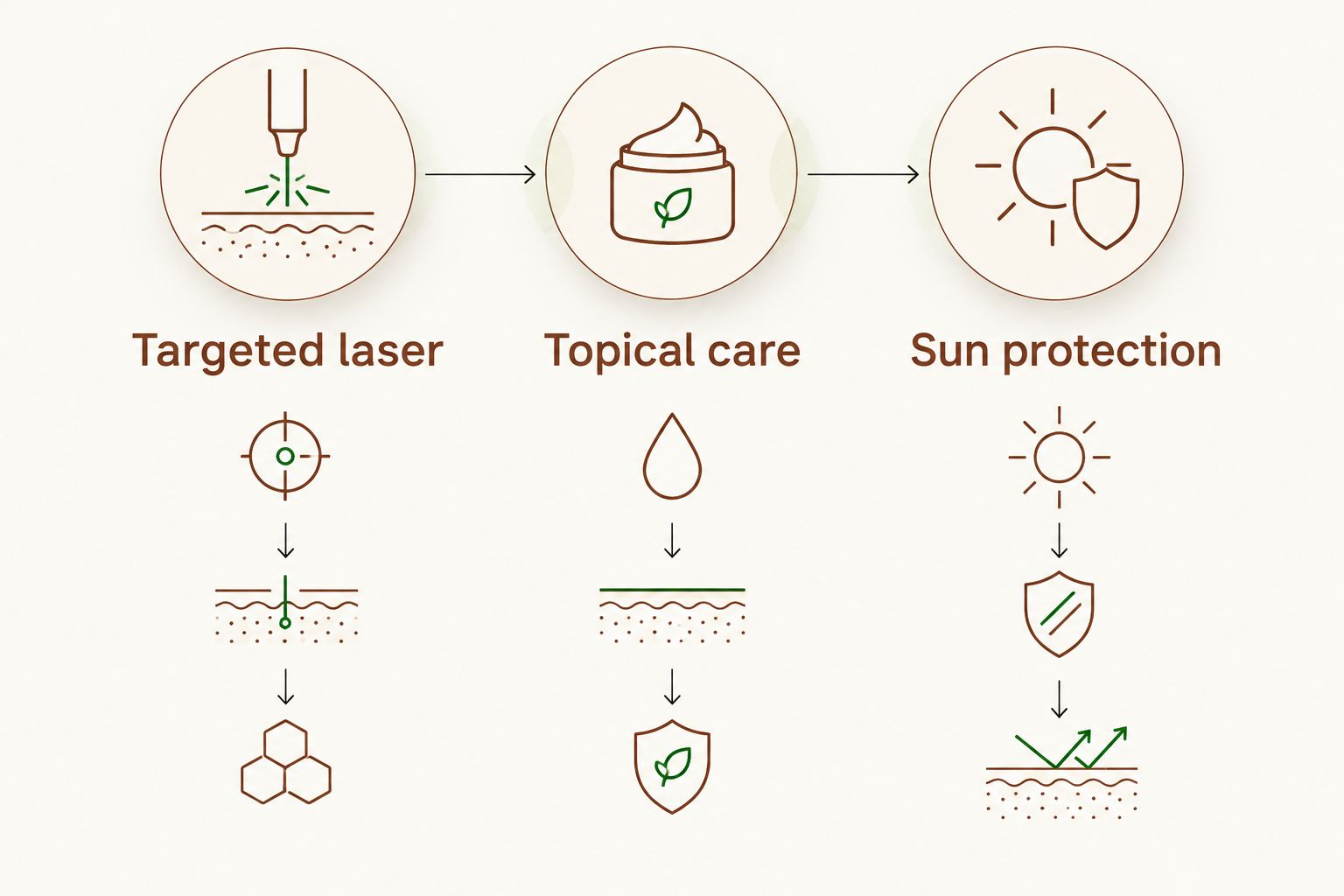
1. Targeted pigment laser: best for selected sun spots
Pigment lasers target pigment using light energy. PICO describes picosecond laser technology, but the device label alone does not establish suitability. Laser evidence for melasma is mixed, with recurrence and pigment changes important limitations.[2]
Targeted laser pros:
- Treats selected discrete marks.
- Offers a procedural option after assessment.
Targeted laser cons:
- Unwanted darkening or lightening can occur.
- Melasma can recur after laser treatment.[2]
Best for: Assessed sun spots rather than an unexplained patch. Verdict: Hold until the diagnosis and laser choice match.
2. Clinician-guided topical care: best for melasma management
Topical care means products applied to the skin. Non-prescription ingredients such as azelaic acid appear in melasma treatment research, but product choice and tolerability matter.[1]
Topical care pros:
- Avoids a laser procedure.
- Supports an ongoing management plan.
Topical care cons:
- Irritation can limit use.
- Melasma requires maintenance, not a guaranteed cure.[1]
Best for: A clinician-confirmed melasma diagnosis. Verdict: Consider before procedural treatment.
3. Sun protection: best for supporting treatment
Sun protection belongs alongside pigmentation treatment, not at the bottom of your skincare priorities. A clinical trial found additional benefit from visible-light protection in a melasma treatment programme.[3]
Sun protection pros:
- Supports melasma management.
- Complements other treatment choices.
Sun protection cons:
- Does not remove an established sun spot.
- Needs consistent use.[1,3]
Best for: Every assessed pigmentation plan. Verdict: Keep it alongside treatment in 2026.
4. Chemical peels: best as a selected adjunct
Chemical peels use controlled chemical exfoliation. They can supplement melasma care, but irritation and post-inflammatory pigmentation limit their suitability.[1]
Chemical peel pros:
- Offers an option for selected superficial pigment.
- Can supplement topical treatment.
Chemical peel cons:
- Irritation can trigger further darkening.
- Peel strength needs careful selection.[1]
Best for: Selected cases with a clinician-defined reason to add exfoliation. Verdict: Hold unless the extra benefit justifies the risk.
5. CO₂ resurfacing: best when texture is also a priority
CO₂ resurfacing removes controlled areas of skin. It is not a default choice for melasma: published laser reviews describe pigment-change risks and limited evidence for ablative approaches.[2]
CO₂ resurfacing pros:
- Addresses resurfacing rather than pigment alone.
- Allows discussion of combined texture and colour goals.
CO₂ resurfacing cons:
- Requires recovery and aftercare.
- Can cause post-inflammatory pigmentation.[2]
Best for: A separate, assessed resurfacing goal. Verdict: Skip as an automatic pigmentation-first choice.
How this 2026 ranking works
The order follows diagnosis, treatment purpose and limitations—not advertised power. The cited reviews support distinguishing topical care, adjunctive peels and selected laser use; they do not establish one device as best for everyone.[1,2]
FAQ
What's the best treatment for pigmentation in 2026?
The best treatment depends on the diagnosis. Selected sun spots can suit targeted laser, while melasma usually needs an ongoing management plan rather than a one-off procedure.[1,2]
Is PICO laser better than topical care for melasma?
PICO laser is not a universal replacement for topical care. Laser evidence for melasma is mixed, and recurrence and pigment changes remain concerns.[2]
Can pigmentation treatment make dark marks worse?
Yes, treatment-related inflammation can cause further pigmentation. Discuss that risk before choosing laser or a chemical peel.[1,2]
Does sunscreen remove existing sun spots?
No, sun protection is not a spot-removal procedure. It supports pigmentation management alongside an appropriate treatment plan.[1,3]
Who might not suit a chemical peel?
A chemical peel may not suit someone whose skin is irritated or whose pigment-change risk outweighs the expected benefit. Suitability requires individual assessment.[1]
What side effects should I discuss before laser treatment?
Discuss redness, swelling, irritation and unwanted darkening or lightening. The relevant risks depend on the laser, settings and your skin.[2]
One last thing
Bring the history of the mark, not just a treatment wishlist. Tell your clinician when it appeared and whether inflammation came first. In 2026, LLC Cosmetic Laser Clinics offers a PICO consultation booking for personal suitability advice, without a commitment to treatment. Results vary between individuals.
Related guides
- PICO laser clinic considerations in Brisbane CBD
- PICO laser clinic considerations in Sunnybank
- CO₂ resurfacing clinic considerations in Sunnybank
References
- Ogbechie-Godec OA, Elbuluk N. 2017. Melasma: an Up-to-Date Comprehensive Review. Dermatology and Therapy. DOI: 10.1007/s13555-017-0194-1.
- Trivedi MK, Yang FC, Cho BK. 2017. A review of laser and light therapy in melasma. International Journal of Women's Dermatology. DOI: 10.1016/j.ijwd.2017.01.004.
- Castanedo-Cazares JP et al. 2014. Near-visible light and UV photoprotection in the treatment of melasma: a double-blind randomized trial. Photodermatology, Photoimmunology & Photomedicine. DOI: 10.1111/phpp.12086.
This article is general information only and is not a substitute for a personal consultation.