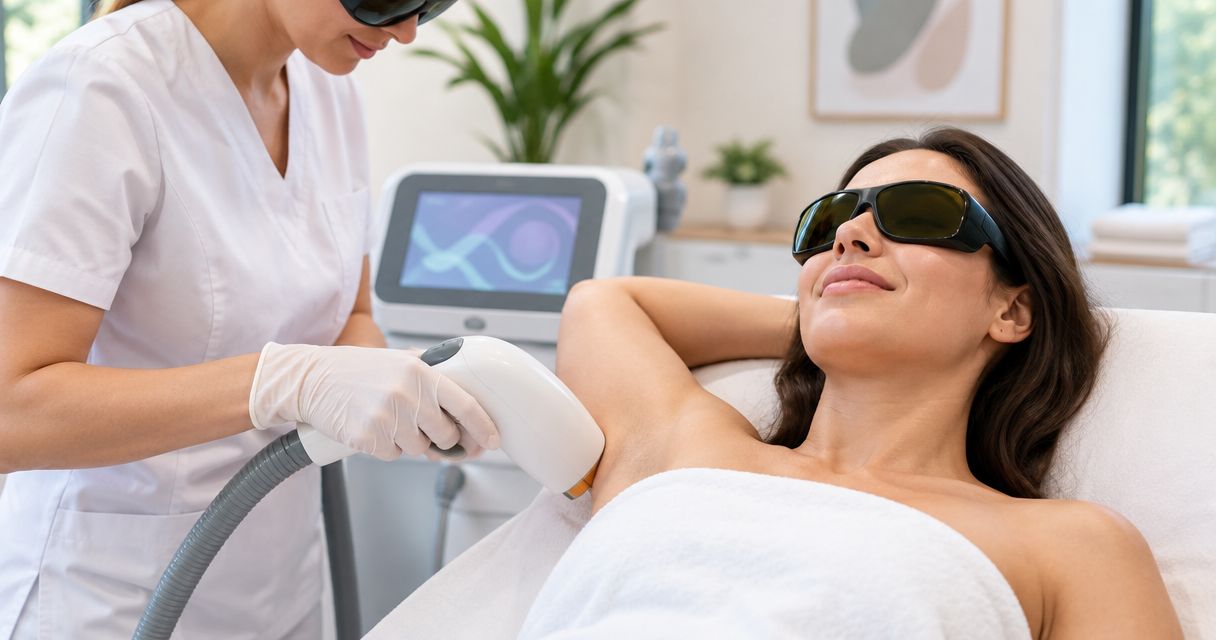
Best laser hair removal clinic for sensitive skin 2026
The best laser hair removal for sensitive skin in 2026 is the treatment matched to your skin tone, hair and current skin condition, not a particular clinic name or machine. For darker skin, long-pulsed Nd:YAG deserves discussion; for lighter skin with dark hair, alexandrite or diode can be suitable options after assessment.[1,2]
- The best laser hair removal for sensitive skin starts with assessment, not a machine recommendation.
- LLC Cosmetic Laser Clinics offers medical physicist-led care and clinician-reviewed plans.
- Nd:YAG, diode and alexandrite have different suitability considerations; none guarantees irritation-free treatment.
- Discuss active irritation, medicines and recent tanning before deciding whether to proceed.
Why sensitive skin changes the decision
Sensitive skin describes your experience, not a single diagnosis. Tell your clinician what happens: stinging after products, redness after shaving, or an existing skin condition. Those details help guide assessment.[2]
Laser hair removal targets pigment in hair. Skin pigment also affects treatment selection, so skin tone matters alongside sensitivity.[1,2] In 2026, a useful consultation should explain both—not simply offer the newest machine.
LLC Cosmetic Laser Clinics is a medical physicist-led option for people seeking clinician-reviewed suitability advice. That leadership description does not mean a medical physicist personally performs every consultation or treatment.
What makes the best sensitive-skin consultation?
Use these criteria when comparing clinics in 2026:
- Skin assessment: Discuss your skin tone, irritation and relevant medical history.
- Hair assessment: Check whether your hair colour makes laser worthwhile.[1,2]
- Treatment explanation: Ask why the proposed wavelength suits you.[2]
- Risk discussion: Expect clear advice about burns, pigment changes and aftercare.[2]
- Permission to wait: Choose advice without pressure to proceed.
For LLC Cosmetic Laser Clinics, medical physicist-led care and clinician-reviewed plans are useful starting points. Your individual suitability still needs assessment.
Laser options at a glance
These are suitability-based recommendations, not a ranking of verified clinic equipment. A wavelength describes the type of light, measured in nanometres, or nm.[2]
| Option | Best for | Standout feature | Key limitation |
|---|---|---|---|
| Long-pulsed Nd:YAG | Darker skin assessment | Uses a 1,064 nm wavelength | Discomfort and complications remain possible |
| Diode | Individualised treatment planning | Common hair-removal wavelengths around 800–810 nm | Settings and skin assessment matter |
| Alexandrite | Lighter skin with dark hair | Uses a 755 nm wavelength | Greater caution is needed with darker or tanned skin |
The wavelength information and suitability distinctions come from published laser hair-removal reviews.[1,2]
1. Long-pulsed Nd:YAG: best for darker skin assessment
Long-pulsed Nd:YAG is an established option for hair removal in darker skin. Its wavelength is less strongly absorbed by skin pigment than shorter-wavelength alternatives, but that does not make treatment risk-free.[2]
Nd:YAG pros:
- An option for darker skin tones.
- Established use in hair reduction.
- Allows a skin-tone-specific discussion.[2]
Nd:YAG cons:
- Treatment can be uncomfortable.
- Burns and pigment changes remain possible.[2]
Best for: Darker skin with suitable pigmented hair.
Verdict: Discuss Nd:YAG; do not treat the machine name as a safety guarantee.
2. Diode: best for individualised treatment planning
Diode lasers are established hair-removal devices. Suitability depends on the device, settings, cooling and your skin and hair characteristics—not the word diode alone.[2]
Diode pros:
- An established hair-reduction option.
- Adjustable treatment settings.
- Can incorporate skin cooling.[2]
Diode cons:
- Irritation and burns remain possible.
- The device label does not establish suitability.[2]
Best for: People whose assessment supports a diode treatment plan.
Verdict: Consider diode only with a clear explanation of settings and skin protection.
3. Alexandrite: best for lighter skin with dark hair
Alexandrite targets pigmented hair using a shorter wavelength than Nd:YAG. It is an established option for lighter skin, with greater caution needed when skin contains more pigment.[2]
Alexandrite pros:
- Established hair-reduction evidence.
- Suits selected lighter skin tones.
- Targets dark, pigmented hair.[1,2]
Alexandrite cons:
- Not a default choice for darker skin.
- Recent tanning requires reassessment.[2]
Best for: Lighter skin with dark hair after assessment.
Verdict: Consider alexandrite when skin tone supports it, not because it ranks highly online.
Who should pause, and what side effects matter?
Laser works poorly on hair with little pigment, including white or grey hair. Recent tanning, active skin problems and medicines affecting light sensitivity need discussion before treatment.[2]
Temporary redness and swelling around follicles are common reactions. Burns, blistering and pigment changes are recognised complications.[2] Results vary between individuals. Evidence does not establish one universally best laser for everyone describing their skin as sensitive.[1,2]
How these options were ranked
The order prioritises skin-tone suitability and an individual treatment plan, using published reviews rather than clinic popularity.[1,2] It does not compare local operators, equipment ownership or treatment outcomes.
FAQ
What's the best laser hair removal for sensitive skin in 2026?
The best choice is a laser matched to your skin tone, hair and current skin condition. Published reviews do not establish a universal winner for sensitive skin.[1,2]
Is Nd:YAG better for darker skin?
Long-pulsed Nd:YAG is an established option for darker skin. Individual settings and assessment still matter, and complications remain possible.[2]
Does sensitive skin mean I cannot have laser hair removal?
Sensitivity alone does not establish whether laser is suitable. Describe your symptoms and any diagnosed skin conditions during assessment.[2]
Can laser hair removal cause redness?
Yes, temporary redness and swelling around hair follicles are common reactions. Burns and pigment changes are also recognised complications.[2]
Does laser work on grey hair?
Laser hair removal works poorly on grey or white hair because it relies on hair pigment. Ask whether another approach better matches your hair.[1,2]
What should I tell the clinician before treatment?
Discuss recent tanning, medicines, skin conditions and previous treatment reactions. These details help the clinician assess suitability and precautions.[2]
One last thing
For your 2026 consultation, ask: Why is this treatment right for my skin? A useful answer connects your skin and hair to the proposed plan.
LLC Cosmetic Laser Clinics emphasises honest suitability advice without pressure. If you are considering treatment near Brisbane CBD, Sunnybank, Southport or Robina, ask about a consultation for personal advice before committing.
Related guides
References
- Haedersdal M, Wulf HC. 2006. Evidence-based review of hair removal using lasers and light sources. Journal of the European Academy of Dermatology and Venereology. DOI: 10.1111/j.1468-3083.2005.01373.x.
- Gan SD, Graber EM. 2013. Laser hair removal: a review. Dermatologic Surgery. DOI: 10.1111/dsu.12116.
This article is general information only and is not a substitute for a personal consultation.