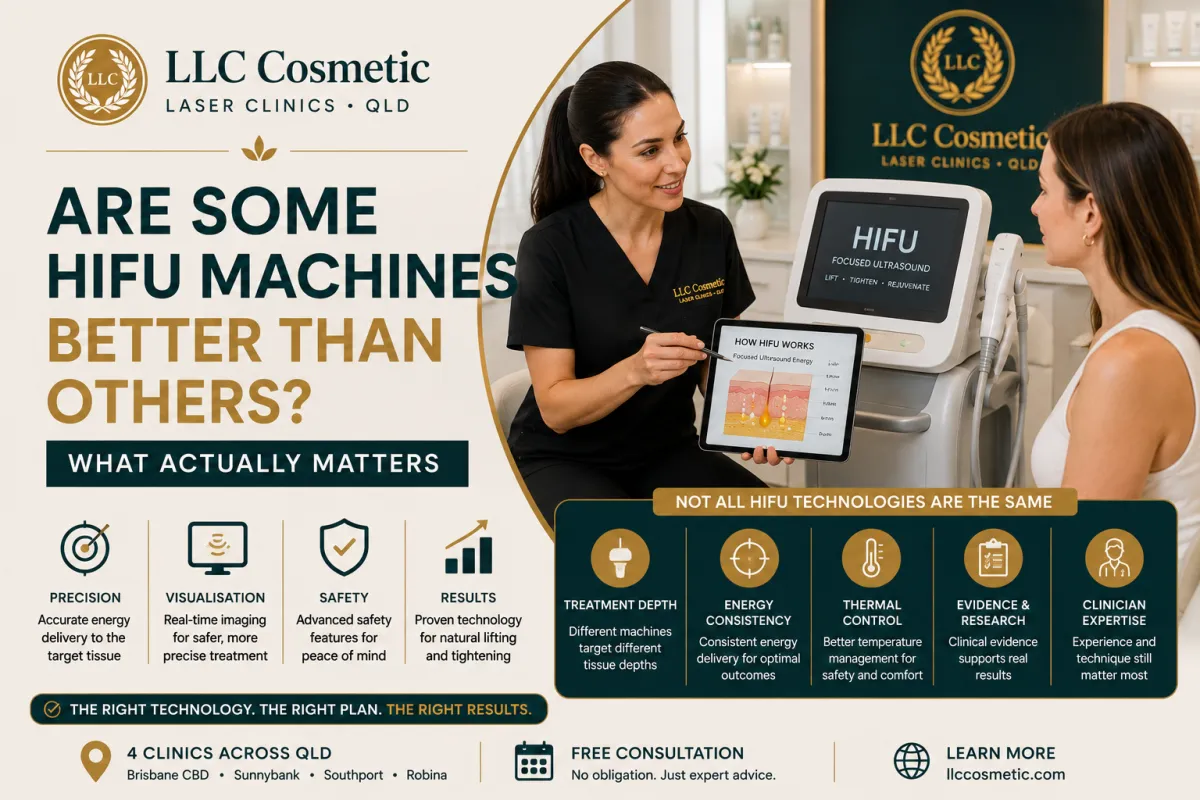
Are Some HIFU Machines Better Than Others? What Actually Matters
If you have been researching HIFU, you may have noticed that clinics use different machines, technologies, treatment names and price points.
That naturally leads to the question:
Are some HIFU machines actually better than others—or is it all just marketing?
The short answer
Yes, some HIFU and focused-ultrasound devices can differ in meaningful ways.
The differences may include:
Energy delivery and consistency
Treatment depth
Precision of the focal point
Real-time visualisation
Safety features
Treatment settings
Calibration and maintenance
Clinical evidence supporting the device
However, the most expensive machine or the most heavily advertised brand is not automatically the best treatment for every person.
Your result also depends on the treatment plan, the area being treated, your starting level of skin laxity, the settings used and the experience of the practitioner.
A recent systematic review also found that treatment protocols and patient-selection criteria remain important challenges across HIFU research—meaning the machine itself is only one part of the equation.
At LLC Cosmetic, HIFU is positioned as a non-surgical option for concerns including jawline definition, neck laxity, facial firmness and early skin laxity, with results expected to develop gradually over approximately 2–3 months.
What Is HIFU?
HIFU stands for High-Intensity Focused Ultrasound.
In aesthetic treatments, focused ultrasound energy is delivered into targeted tissue beneath the skin to create controlled tissue effects associated with skin tightening and lifting.
In the United States, focused ultrasound systems for aesthetic use are regulated as Class II medical devices when they fall within the relevant FDA device category. The FDA's guidance specifically identifies factors such as predictable acoustic power, accurate energy targeting and protection of non-target tissues as important safety considerations.
This helps explain why the answer to “are all HIFU machines the same?” is no.
Two devices may both be described as “HIFU” while differing in how precisely and consistently they deliver energy.
Are All HIFU Machines the Same?
No.
The word HIFU describes a category of focused-ultrasound technology. It does not automatically tell you:
How precisely the energy is focused
Whether the treatment depth can be adjusted
Whether tissue can be visualised during treatment
How consistently the device delivers energy
What safety controls are built into the system
What clinical evidence supports the specific platform
Think of it this way:
Two cars can both get you from Brisbane to the Gold Coast.
That does not mean they have the same:
Safety systems
Engineering
Comfort
Performance
Reliability
The same principle can apply to aesthetic technology.
The treatment category may be similar, but the device design and capabilities can differ.
1. Energy Precision Matters
One of the most important differences between focused-ultrasound devices is how accurately energy is concentrated at the intended treatment point.
The FDA's technical guidance for aesthetic focused-ultrasound devices specifically addresses the need for predictable acoustic power, characterisation of the acoustic beam and accurate concentration of energy at the desired target location.
Why does this matter?
The goal is not simply to deliver more energy.
The goal is to deliver an appropriate amount of energy to the intended area.
More power does not automatically mean:
better result
In fact, a treatment should be based on:
The treatment area
Tissue characteristics
The device's treatment capabilities
The patient's individual suitability
The appropriate treatment settings
A good HIFU treatment is about controlled and appropriate energy delivery, not simply choosing the highest possible setting.
2. Treatment Depth Can Differ
Different focused-ultrasound systems may be designed to target different tissue depths.
This matters because the face and neck are not one uniform layer.
Different concerns may involve different tissue structures.
A practitioner may need to consider:
The area being treated
The degree of skin laxity
Facial anatomy
The treatment objective
The device and available treatment depths
A device with greater treatment flexibility may allow a clinician to tailor the treatment more closely to the individual.
But again, more options do not automatically equal a better result.
The important question is whether the technology and treatment plan are appropriate for your specific concern.
3. Some Technologies Include Real-Time Visualisation
One major difference within the broader focused-ultrasound category is whether the system includes real-time tissue visualisation.
Research comparing microfocused ultrasound with visualisation (MFU-V) and other ultrasound-based aesthetic devices identified meaningful differences in features such as visualisation, treatment-point consistency, focal precision and thermal regulation.
Visualisation can potentially help the practitioner understand the tissue being treated rather than relying entirely on surface landmarks and a predetermined treatment pattern.
That does not mean every treatment without real-time visualisation is automatically unsafe or ineffective.
But it does mean that:
Different ultrasound technologies may provide different levels of information and treatment control.
If you are comparing machines, it is reasonable to ask:
Does this device include real-time visualisation, and if not, how does the practitioner plan the treatment area?
4. Consistency Is More Important Than a Big Marketing Claim
A machine can have impressive-looking specifications.
But what matters is whether it can deliver energy predictably and consistently.
The FDA's guidance specifically highlights predictable acoustic power, low variability between transducers and accurate energy concentration as important performance considerations.
This is important because HIFU treatment involves repeated energy delivery across an area.
Consistency can affect:
Treatment planning
Reproducibility
Precision
Safety considerations
Confidence in the device's performance
This is why a clinic should not simply tell you:
“Our machine is stronger.”
A better question is:
“How is the device's energy delivery controlled, maintained and used within my treatment plan?”
5. Better Technology Can Include Better Safety Features
Not all HIFU machines offer the same technical safeguards.
Depending on the platform, differences may involve:
Energy monitoring
Thermal regulation
Coupling detection
Treatment history
System alerts
Device calibration
Treatment visualisation
The FDA identifies several risks associated with focused-ultrasound aesthetic devices, including thermal injury, mechanical injury and use-related errors, which is why device performance and safety controls matter.
This does not mean patients need to become medical-device engineers before booking HIFU.
It simply means you should feel comfortable asking a clinic:
What machine do you use?
How is it maintained?
Who operates it?
How is the treatment customised?
What safety processes are in place?
A professional clinic should be able to answer these questions clearly.
6. The Practitioner Still Matters
This is where some HIFU marketing can become misleading.
A premium machine does not automatically guarantee a premium result.
The same device can potentially be used differently depending on:
Treatment planning
Practitioner training
Understanding of anatomy
Settings selected
Treatment pattern
Patient selection
Individual goals
Research on HIFU also shows that protocol standardisation and patient selection remain important factors in achieving consistent outcomes.
So when asking:
“Which HIFU machine is best?”
You should also ask:
“Who is treating me, and why is this treatment plan appropriate for me?”
The technology and practitioner should work together.
7. Clinical Evidence Matters More Than Marketing Labels
Terms such as:
7D HIFU
9D HIFU
Advanced HIFU
Next-generation HIFU
Premium HIFU
can sound impressive.
But a marketing label alone does not tell you whether a particular device is supported by strong independent clinical evidence.
When comparing machines, look beyond the number or branding.
Ask:
Is there published evidence for this technology?
What aesthetic indications has the device been evaluated for?
Is the evidence based on the exact device or on HIFU technology in general?
Who is making the claim—the manufacturer, an independent researcher or the clinic?
This distinction matters.
A study showing that focused ultrasound as a treatment category can improve certain forms of skin laxity does not automatically prove that every machine marketed as HIFU will produce identical results.
A 2025 systematic review of HIFU studies found evidence of skin-tightening benefits, particularly in areas including the lower face and neck, while also noting the importance of protocol standardisation and patient selection.
Does a More Expensive HIFU Machine Mean Better Results?
Not automatically.
Price can reflect many things, including:
Technology development
Imaging capability
Research and clinical evidence
Engineering
Maintenance
Training requirements
Brand positioning
But the patient's final result is still individual.
A more expensive machine cannot guarantee:
A facelift-level result
The same result for every patient
A specific degree of lifting
Permanent results
Suitability for everyone
At LLC Cosmetic, HIFU is presented as a non-surgical treatment for concerns such as early laxity, facial firmness, jawline definition and neck laxity—not as a replacement for surgery or a guaranteed transformation.
That is the more realistic way to evaluate any HIFU treatment.
What About Cheap HIFU Treatments?
A lower price does not automatically mean a poor treatment.
However, if the price difference between clinics is significant, you should understand what is actually included.
Ask:
What machine is being used?
Who performs the treatment?
How long is the appointment?
How is the treatment area planned?
How many treatment lines or passes are included?
Is the machine professionally maintained?
What follow-up is available?
Is the quoted treatment suitable for your concern?
You are not simply comparing:
$X vs $Y
You may be comparing two very different treatment experiences.
Are HIFU and MFU-V the Same Thing?
They are related but should not automatically be treated as identical terms.
HIFU is commonly used broadly to describe high-intensity focused ultrasound treatments.
MFU-V refers to microfocused ultrasound with visualisation, a technology category that incorporates ultrasound visualisation features.
A systematic review and meta-analysis published in 2025 reported meaningful aesthetic improvement and patient satisfaction with MFU-V while noting moderate treatment discomfort and generally mild-to-moderate adverse events in the included studies.
The key takeaway for patients is simple:
Do not assume every machine marketed as HIFU has the same capabilities.
Ask what technology is actually being used.
What Should You Ask a Clinic About Its HIFU Machine?
Before booking, consider asking these questions:
1. What HIFU or focused-ultrasound machine do you use?
A clinic should be transparent about its technology.
2. Does the device include visualisation?
If yes, ask how it is used during treatment.
3. What treatment depths are available?
The answer may help explain how the technology is designed for different treatment areas.
4. How is the machine maintained?
Medical and aesthetic devices require appropriate maintenance and quality processes.
5. Who performs the treatment?
Ask about the qualifications and training of the practitioner.
6. How do you decide whether I am suitable?
A good clinic should assess your concern rather than recommending HIFU to everyone.
7. What results are realistic for my starting point?
This may be the most important question of all.
The Biggest Red Flags When Comparing HIFU Machines
Be cautious if a clinic:
Refuses to tell you what machine it uses
Claims its machine is the “strongest” without explaining why that matters
Promises facelift-level results
Guarantees identical results for every patient
Recommends HIFU without assessing suitability
Cannot explain who will perform the treatment
Focuses only on dramatic before-and-after photos
Uses marketing terms without explaining the actual technology
Pressures you to book immediately
Avoids discussing realistic limitations
The best technology is only useful when it is used appropriately.
So, Are Some HIFU Machines Better Than Others?
Yes—but “better” depends on what you mean.
A device may be better in certain areas because it offers:
More precise energy delivery
Greater consistency
Real-time visualisation
Better treatment control
More robust safety features
Stronger clinical evidence
However, there is no universal answer that says:
“This is the best HIFU machine for every patient.”
The right question is:
“Is this technology appropriate for my concern, and is it being used by an experienced practitioner with a personalised treatment plan?”
That is much more useful than choosing a treatment based on the biggest number in the machine's marketing name.
What Matters Most for Your HIFU Result?
When considering HIFU, I would rank the decision like this:
1. Suitability
Is HIFU actually appropriate for your concern?
2. Technology
What focused-ultrasound system is being used, and what are its capabilities?
3. Practitioner
Who is planning and performing your treatment?
4. Treatment Plan
Are the settings and treatment approach appropriate for you?
5. Realistic Expectations
Does your expected outcome match what non-surgical treatment can realistically achieve?
6. Evidence and Safety
Is the technology supported by appropriate evidence and safety processes?
7. Price
Do you understand what you are receiving for the quoted cost?
Price should be part of the decision—not the entire decision.
HIFU at LLC Cosmetic: Suitability Before Treatment
At LLC Cosmetic, the published approach emphasises “Suitability first. Treatment second.”
The clinic's HIFU content explains that treatment planning considers factors including the treatment area and degree of laxity, while results are expected to develop gradually over approximately 2–3 months rather than appearing as an immediate surgical-level transformation.
That is particularly important when comparing HIFU machines.
The machine is important.
But the assessment comes first.
If HIFU is not the right treatment for your primary concern, choosing a more expensive machine may not solve the problem.
For example, if your main concern is pigmentation, acne scarring or surface texture, another treatment approach may be more appropriate than HIFU.
Final Answer: Don't Choose HIFU Based on the Machine Name Alone
If you are comparing HIFU treatments, don't book based only on:
❌ The cheapest price
❌ The biggest “D” number
❌ The strongest marketing claim
❌ The most dramatic social media photo
Instead, compare:
✓ The actual technology
✓ Energy precision and treatment capabilities
✓ Safety features
✓ Clinical evidence
✓ Practitioner experience
✓ Personalised treatment planning
✓ Your individual suitability
Ready to Find Out Whether HIFU Is Right for You?
The best HIFU machine is not necessarily the one with the biggest marketing claim.
For your skin, the better choice is the technology and treatment plan that are appropriate for your anatomy, level of laxity and treatment goals.
At LLC Cosmetic, you can start with a suitability assessment before deciding whether HIFU is the right option for you.
Book a consultation and ask the questions that actually matter—not just “Which machine is the newest?”
Frequently Asked Questions
Are some HIFU machines better than others?
Yes. Focused-ultrasound devices can differ in precision, treatment depth, consistency, visualisation, safety features and the amount of clinical evidence supporting the technology.
Does a more expensive HIFU machine give better results?
Not automatically. Your result also depends on suitability, practitioner expertise, treatment planning and your individual response.
Are all HIFU machines the same?
No. Devices marketed under the HIFU category can have different technical capabilities and safety features.
What is the difference between HIFU and MFU-V?
HIFU is a broad term for high-intensity focused ultrasound. MFU-V refers to microfocused ultrasound with visualisation, which incorporates real-time visualisation capabilities.
Is 7D HIFU better than regular HIFU?
A number in a marketing label does not, by itself, prove that one machine is safer or more effective. Ask about the exact technology, evidence, treatment capabilities and practitioner training.
What should I ask before booking HIFU?
Ask what machine is used, who performs the treatment, how the treatment is planned, whether the device has visualisation capabilities, what results are realistic and whether HIFU is actually suitable for your concern.
Does HIFU produce immediate results?
Some people may notice an early change, but HIFU results are generally expected to develop gradually as tissue remodelling occurs. LLC Cosmetic states that its HIFU results build over approximately 2–3 months.
Medical Disclaimer
This article is for general educational purposes only and does not constitute medical advice, diagnosis or treatment recommendations. HIFU technology, device features, suitability, treatment settings, risks and expected outcomes vary. A qualified clinician should assess your individual circumstances before treatment.